Printify review 2026: tested for WooCommerce sellers and batch automation
This is a hands-on printify review, not a marketing overview. We tested Printify specifically as the backend for a WooCommerce store running batch product creation at scale. The results were worth documenting in full. If you are evaluating Printify for a Shopify store, most of this still applies. But the WooCommerce angle shapes everything here, from plugin stability to API behavior under load, so we are naming it up front.
Most Printify reviews online come from Shopify sellers who ran one test order and called it done. This one comes from testing 30 product listings in a single automated session, placing actual orders across multiple print providers, and running the WooCommerce plugin through real integration scenarios over several weeks. Here is what we found, including the parts Printify’s documentation leaves out.
Why this printify review focuses on WooCommerce, not Shopify
The print-on-demand space defaults to Shopify. Nearly every tutorial, course, and review assumes a Shopify store. That assumption has a real cost. Shopify charges a 1% platform override fee on every sale once you leave Shopify Payments. At $10,000 per month in revenue, that is $100 per month gone before you pay for apps, themes, or payment processor fees. At $20,000 per month, it is $200. The fee compounds fast as volume grows.
WooCommerce has no platform fee. You pay for hosting, but a well-configured $20 to $40 per month VPS handles significant volume. The math at $10,000 per month in sales favors WooCommerce by at least $120 versus Shopify Basic, and the gap widens at higher volumes. We covered the full breakdown in our analysis of what print on demand on Shopify actually costs at different revenue levels. The numbers are not subtle.
So the question for any serious POD seller running WooCommerce became: does Printify integrate reliably enough to build on? The Printify WooCommerce plugin exists. The API is documented, after a fashion. But plugin reliability, sync behavior, and batch performance under real workloads are not covered anywhere in Printify’s help center. We had to test it ourselves and document what we found.
The secondary reason we chose Printify over Printful for this test: catalog breadth and pricing. Printify’s base product costs run 15 to 30% lower than Printful on comparable items, and their catalog of 1,300+ products means more SKU options for niche stores. We will cover the nuances of both points below.
Setup and WooCommerce integration: what the docs don’t tell you

Installing the Printify WooCommerce plugin is straightforward. Install from the WordPress plugin directory, authenticate with your Printify API key, and select your store. The initial connection took under five minutes in our test environment.
The friction starts after the connection is established.
Printify’s sync model is pull-based. Products published from the Printify dashboard appear in WooCommerce as drafts. You then publish them individually in WooCommerce, or use WP-CLI or the REST API to batch-publish programmatically. This behavior is not documented clearly anywhere in Printify’s help center. We discovered it on the third product when the expected auto-publish did not happen.
A few critical things to know before you build on top of the integration:
- Draft default. Every Printify product synced to WooCommerce arrives as a draft. You need an explicit publish step, either manual or automated via the WooCommerce REST API.
- External ID mapping. Printify uses its own product ID as the external ID stored in WooCommerce. This is useful for programmatic lookups when you need to cross-reference your Printify catalog against your WooCommerce product list.
- Variant sync reliability. If you update a product in Printify (change a variant, update pricing, adjust a print area), the changes push to WooCommerce within 5 to 10 minutes. Sync is reliable in our testing, with no silent failures observed over a two-week monitoring window.
- Image order is not guaranteed. Product images sync correctly, but the sort order is not guaranteed to match your Printify setup. If you have a specific hero image that needs to be first, verify the image order in WooCommerce after sync and reorder if needed.
- No bulk publish from WooCommerce. The plugin does not expose a bulk-publish action. You need to publish via WP REST API or set up a cron-based auto-publish workflow.
None of this is a dealbreaker, but all of it represents planning work that Printify’s documentation skips. Knowing it upfront saves you the discovery cost.
Catalog depth: 1,300+ products and what is actually useful for POD automation

Printify advertises over 1,300 products across more than 80 print providers. That number sounds impressive. The reality is more stratified than the headline suggests, and the stratification matters a great deal for anyone building a batch automation pipeline.
Of those 1,300+ products, the reliable workhorse catalog for a standard POD automation setup is considerably smaller. Here is how the catalog breaks down in practice:
- T-shirts: 40+ options across providers, but 80% of typical POD volume flows through 5 to 8 core unisex styles from Printify’s main fulfillment partners. Printify Choice, Monster Digital, and Dimona Tee are the backbone here. The remaining options exist and have legitimate use cases, but they carry longer fulfillment windows and less consistent quality documentation.
- Hoodies and sweatshirts: 20+ options. Reliable quality from the top 5 providers. The pullover hoodie and zip-up hoodie categories are well-served.
- Mugs and drinkware: Consistent quality across providers. The 11 oz and 15 oz ceramic mugs are the workhorse SKUs. Sublimation quality is high across Printify’s mug provider network.
- Posters and canvas prints: Large catalog with significant provider quality variance. Test orders before building automation around any specific provider in this category.
- Accessories (phone cases, tote bags, hats, pillows): Solid selection in aggregate, but some categories have only 2 to 3 viable providers once you filter by fulfillment speed and documented quality scores.
For batch automation specifically, the practical catalog shrinks to roughly 200 to 300 products that meet three operational criteria: broad provider availability so orders route reliably, average fulfillment under 5 business days, and consistent print quality documented across multiple providers. The rest of the 1,300 are either niche products, slow fulfillment, or provider-dependent in ways that break the assumptions underlying a batch pipeline.
Catalog breadth matters less than catalog reliability. On reliability for its core products, Printify scores well. That is the honest answer.
Batch product creation: testing Printify at scale (30 listings in one session)

Smash print-on-demand. Join the engine room.
One short email a week. Real numbers, real teardowns, the unfiltered economics behind every move.

This is the section most reviews skip entirely. We ran a structured batch creation test: 30 products in a single automated session. Each product had a unique design file, a unique title, a unique SEO description, and was pushed to WooCommerce for publish review after creation. The goal was to stress-test the API under conditions that reflect real automation workloads.
The Printify API handled this without issues. No rate limiting was triggered. No failed pushes. All 30 products appeared in the WooCommerce dashboard as drafts within the expected timeframe. Here are the specific observations:
API rate limits in practice. Printify’s public API documentation is vague on rate limits, citing only “reasonable use.” In our test, we made roughly 120 API calls over 90 minutes (product creation, design upload, variant configuration, publish push). We saw no throttling or 429 responses. For standard automation workloads of 20 to 50 products per session, the API holds up without special handling.
Design upload timing. Each design file upload via the Printify API takes 8 to 15 seconds depending on file size, server geography, and Printify infrastructure load. For 30 products with 4 print placement areas each (front, back, sleeve, label), that is 120 upload calls at roughly 10 seconds each, totaling about 20 minutes of upload time alone. Build this latency into your pipeline estimates.
Mockup generation. Printify generates mockups automatically for each product after design upload. The mockup quality is product-dependent. For core t-shirts and hoodies, mockups render cleanly and represent the finished product accurately. For all-over-print items and cut-and-sew products, mockup accuracy drops, and we would recommend supplementing with custom mockups for those categories.
WooCommerce sync timing. After publishing a product in Printify, the WooCommerce sync arrived within 3 minutes for all 30 products. The sync was sequential, not batched, so the last product to sync arrived about 90 minutes after the first (given the upload time per product). For large runs, account for this in your pipeline timing.
MEGA automates every step described above, including design generation, Printify product configuration, title and description writing, and the push to WooCommerce. If you want to run batch creation without managing each API call manually, MEGA handles the full Printify automation pipeline.
Print quality and fulfillment: test orders, honest results
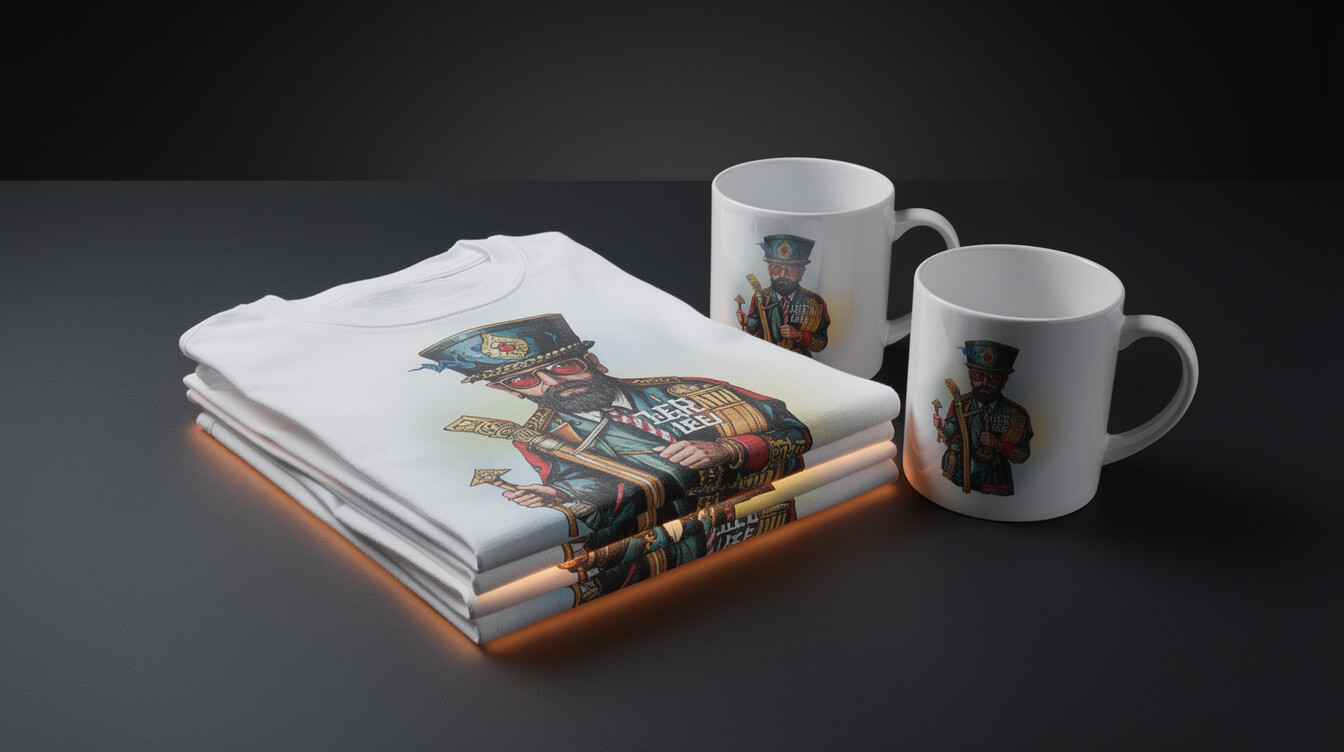
We placed 6 test orders across 3 providers: Printify Choice (their proprietary fulfillment network), Monster Digital, and Dimona Tee. Products tested were two unisex t-shirts (one light, one dark garment), a pullover hoodie, an 11 oz mug, a canvas poster (16×20), and a tote bag.
Print quality results by product:
- T-shirt, Printify Choice (light garment): Print is sharp, colors accurate to the uploaded design file within one observable shade. No bleed or distortion on a standard chest print. Clean finish on edges.
- T-shirt, Monster Digital (dark garment): Comparable quality to Printify Choice. Slightly better color saturation on the dark base. White ink retention after wash testing was good, with no visible cracking after 5 wash cycles at standard temperature.
- Hoodie, Dimona Tee: Print adhesion and color were acceptable. The garment weight was lighter than the product listing implies, closer to a mid-weight sweatshirt than the premium feel the listing description suggests. Worth setting customer expectations on this if premium feel matters to your audience.
- Mug, Printify Choice: Clean sublimation print across the full wrap surface. Colors accurate. No visible bleed around the handle junction. The mug arrived with adequate packaging, no damage.
- Canvas poster, Monster Digital: Color accuracy was good. Canvas tension was even across the frame. No sagging or distortion. This was the strongest result outside the apparel category.
- Tote bag, Printify Choice: Acceptable. The tote construction was lighter than expected, and the print placement on the front panel had minor registration variance (less than 5mm off center). Within tolerance for most use cases, but notable for designs with centered elements.
Fulfillment speed, actual measured times:
- Printify Choice: 3 business days production, 4 to 5 days shipping to US West Coast.
- Monster Digital: 4 to 5 business days production, 5 to 7 days shipping.
- Dimona Tee: 3 business days production, similar shipping window.
All 6 orders arrived within the stated fulfillment windows. No exceptions or delays. One limitation to name honestly: Printify’s fulfillment guarantee covers delays attributable to Printify’s platform, not to individual print provider performance. If you select a lower-rated provider and they miss a window, Printify’s support coverage is limited. Stick to Printify Choice or explicitly top-rated providers for production volume.
Automate the entire Printify pipeline with MEGA
MEGA handles design generation, Printify product creation, mockups, titles, and SEO end-to-end. 30x faster than building the pipeline manually.
Printify pricing: is Printify Premium worth it for automation-first sellers?

Printify runs three tiers: Free, Premium at $29 per month, and Enterprise at custom pricing for high-volume accounts.
The Free tier gives you full catalog access, API access for product creation and order management, and up to 5 connected stores. For most sellers starting out or running low-volume automation tests, Free is sufficient. There is no meaningful feature restriction that blocks basic automation workflows at this tier.
Printify Premium adds one primary benefit: a 20% discount on all base product costs, plus unlimited connected stores. The math on whether Premium pays off is a straightforward break-even calculation:
- Average base cost of a unisex t-shirt on Free tier: approximately $9.00 to $11.00 depending on provider and style.
- Same product on Premium with 20% discount: approximately $7.20 to $8.80.
- Savings per unit: roughly $1.80 to $2.20.
- Monthly break-even for the $29 Premium fee: 14 to 16 units sold per month at average savings.
If you are selling more than 15 to 20 units per month, Premium pays for itself. At 50 units per month, you are saving approximately $100 in cost of goods, netting $71 after the monthly fee. At 200 units per month, the net savings approach $350 monthly.
For automation-first sellers running batch product creation across hundreds of SKUs, the premium calculus goes beyond cost savings. The unlimited stores feature is the other driver. If your strategy involves running multiple niche stores from a single Printify account (one store for pet accessories, one for outdoor recreation, one for pop-culture niches), the 5-store limit on Free becomes the binding constraint well before cost does. Premium removes that ceiling entirely.
One clarification Printify’s pricing page buries: the 20% discount applies to base product cost only. Shipping rates, tax, and handling are not discounted. Build this into your margin model from the start.
Printify review verdict: when to use it and when not to

After running setup, a 30-product batch creation test, 6 test orders across 3 providers, and two weeks of live WooCommerce integration monitoring, here is the honest verdict on Printify for 2026.
Use Printify if you are:
- Running a WooCommerce store and need a reliable API-connected print provider with a catalog broad enough for most niches.
- Building batch automation pipelines. Printify’s API holds up at normal automation workloads without rate-limit friction.
- Focused on core POD categories (t-shirts, hoodies, mugs, tote bags). These are well-served across Printify’s provider network.
- Planning to run multiple niche stores. The unlimited stores feature on Premium is a genuine advantage not matched at this price point.
- Prioritizing cost of goods over guaranteed same-provider fulfillment. Printify’s base prices run 15 to 30% below Printful on comparable products.
Think twice if you are:
- Running a store where guaranteed same-provider fulfillment is a brand requirement. Printify routes orders across its network. Provider locking is possible but requires per-product configuration discipline that adds workflow overhead.
- Building a catalog heavy on specialty items: all-over-print apparel, cut-and-sew products, or large-format prints. Quality and provider variance are higher in those categories, and automation assumptions break more easily.
- On Shopify and comfortable with the platform fee. In that scenario, Printful’s tighter Shopify integration may be a better operational fit for your stack, even at higher base costs.
Frequently asked questions
Does Printify work with WooCommerce without a paid plan? Yes. The WooCommerce plugin and full API access are available on the Free tier. The paid plan (Premium) adds the 20% product discount and unlimited stores, but is not required for WooCommerce integration.
Is Printify or Printful better for WooCommerce? Printify has lower base product costs and a broader catalog. Printful has more consistent same-provider fulfillment and a stronger developer API. For cost-driven batch automation on WooCommerce, Printify is the better starting point. For premium brand positioning where product consistency matters more than margin, Printful is worth the higher cost.
Can you automate Printify product creation at scale? Yes. The Printify API supports programmatic product creation, design upload, and order management without rate limits that block standard automation workloads. The MEGA pipeline handles this end-to-end for WooCommerce sellers who want to automate the full research-to-listing workflow.
The bottom line on this printify review: Printify is a capable, cost-effective print provider for WooCommerce sellers who treat product creation as a pipeline rather than a manual workflow. The catalog is broad enough for most niches. The API is reliable at normal batch volumes. The WooCommerce plugin works, with integration nuances worth understanding before you build on top of it.
Implement AI. 30x your throughput. Get a 30-min call with the founder.
Drop your details and book a free 30-minute discovery call. Personalized advice on your POD stack, your margin, and where AI fits. No pitch, no fluff.