Custom corporate merchandise: how a POD seller can win the Vistaprint customer
Custom corporate merchandise is a billion-dollar category that Vistaprint and 4imprint built on minimum order quantities, weeks-long lead times, and bulk pricing designed for procurement teams ordering 250 units at a time. A small business that needs 12 branded hoodies for its founding team either overpays for the small-lot option or simply goes without.
A WooCommerce print-on-demand store changes that equation completely. No minimums. Per-unit pricing that beats bulk at low volumes. Automated reorder the moment a new hire joins the team. This is how a POD seller captures the custom corporate merchandise buyer that Vistaprint’s catalog was never built to serve.
What corporate buyers actually want from merchandise

Corporate merchandise buyers are not bargain hunters. They are procurement professionals, office managers, and founders who need branded items that reflect the company’s standards. Price per unit matters less than most POD sellers assume. What matters is quality, reliability, and process.
Branded quality over cheap volume
A company distributing branded merchandise at a conference is making a brand statement. A thin polyester polo with a blurry transfer print reflects on the business that handed it out. Corporate buyers will pay $55 per unit for a quality embroidered hoodie. They will not reorder from a supplier that produced mediocre output at $28.
Printful’s embroidered apparel and Printify’s premium DTG options clear the quality bar that corporate buyers expect. The print quality and embroidery precision available through these fulfillment partners is genuinely comparable to what Vistaprint’s premium apparel line produces.
No minimum order quantity
This is the central pain point. A startup with 8 employees does not need 25 units of anything. A department running an internal event for 15 people should not have to pay for 35 extras to hit a supplier minimum. The minimum order quantity problem is so entrenched in the traditional merchandise market that most buyers simply accept it as a cost of doing business.
POD fulfillment eliminates it entirely. Every order, regardless of size, ships through the same pipeline. The unit economics change somewhat at scale, but the option to order one, three, or eight units without a penalty is genuinely differentiated from anything the traditional market offers.
Fast turnaround
Vistaprint quotes 5 to 15 business days on custom apparel. 4imprint’s production window is 5 to 10 days, before shipping. For a company planning a conference or retreat, that window requires lead time most internal teams do not have.
Printful’s standard production time is 2 to 5 business days. Express options exist. For corporate buyers, the difference between a 3-day total fulfillment time and a 15-day window is not incremental. It is the difference between being able to say yes or no to a late-breaking request.
Predictable reorder
Companies hire people. Companies run events on recurring cycles. A WooCommerce product page that stays live is a reorder mechanism. The client comes back in six months when three new team members join. No new quote, no new design approval process. They order from the same product page they used before.
This is the compounding advantage that bulk print operators cannot replicate without building a customer portal. For a WooCommerce POD store, it is free by default.
How Vistaprint and 4imprint handle custom corporate merchandise today

Vistaprint and 4imprint are operationally excellent companies. They process enormous volumes, maintain consistent quality at scale, and have built the logistics infrastructure to ship branded merchandise to businesses across North America. The critique here is not quality. It is model fit.
Vistaprint’s corporate merchandise model
Vistaprint’s custom apparel starts at 25 units for most items. Their pricing ladder is designed to reward bulk. At 25 polos, expect to pay roughly $28 to $35 per unit depending on style. At 100 units, that figure drops to $18 to $22. At 250, it drops further. The economics are optimized for buyers who know they need large quantities and can plan months ahead.
For businesses that consistently order at those volumes, Vistaprint is a strong choice. For everyone else, the model generates waste. Unsold units sit in a supply room. The design from last year’s event does not match this year’s branding. The 50 extra mugs from the conference are still in a box.
4imprint’s promotional products approach
4imprint’s catalog is enormous: pens, mugs, bags, apparel, tech accessories. Minimum orders vary by product, typically 25 to 100 units. They have excellent customer service and genuine customization options. Lead times are comparable to Vistaprint.
The editorial gap in 4imprint’s model is product education. Their site is a catalog. It tells you what you can buy and at what minimum. It does not explain how a small business should approach branded merchandise strategy, what products justify the MOQ, or how to think about merchandise economics. That content gap is where an independent POD seller builds authority and captures intent.
CustomInk and the team-order market
CustomInk has been smart about targeting the team merchandise segment: sports teams, corporate departments, school groups. Their minimum is 6 units for most apparel, a genuine improvement over the 25-unit floor.
CustomInk’s limitation is its product range and the mandatory design review process. Every order goes through their design tool and approval pipeline. Custom designs outside their templated options require more negotiation. For a company with brand guidelines and an existing logo, that process introduces friction that a WooCommerce store built around their specific branding would eliminate.
Where a POD seller has a genuine advantage over bulk merchandise suppliers

The POD seller’s structural advantages in the corporate merchandise market are not hypothetical. They are direct consequences of the fulfillment model itself.
No minimum order quantity at any scale
A WooCommerce store connected to Printful fulfills a single-unit order and a 200-unit order through exactly the same process. The seller’s time investment is identical. The buyer’s experience is consistent. This is structurally impossible for a business whose economics depend on batch printing runs.
The competitor you are displacing here is not just Vistaprint. It is the corporate buyer’s current workaround: buying from a local print shop with 12-unit minimums, settling for inferior decorated apparel from a uniform supplier, or simply not ordering merchandise at all because the minimum order is too wasteful.
Transparent per-unit pricing
Corporate procurement professionals distrust opaque pricing. When a total cost only reveals itself after you select quantity, add rush fees, and choose shipping, procurement managers either abandon the process or send it to legal for review. A WooCommerce product page with a clear per-unit price, stated turnaround time, and a straightforward checkout is built for how these buyers actually want to purchase.
Automated inventory and reorder
A POD product page never goes out of stock. There is no warehouse. There is no minimum reorder quantity from your fulfillment partner. When a corporate client’s team grows, they return to the same product page and order more units. The design is already approved, the mockup is already live, and the order goes directly into the fulfillment queue.
For a seller serving even 10 to 15 corporate clients, that reorder behavior compounds into reliable recurring revenue without any additional sales effort.
WooCommerce economics vs. marketplace models
Selling on a marketplace cedes the customer relationship. The buyer belongs to the platform. A WooCommerce store means you own the product pages, you own the customer data, and you own the reorder relationship. There is no platform take on the margin. There is no risk of a competitor appearing alongside your product.
For a detailed comparison of POD automation economics against bulk ordering, see our breakdown of custom promotional merchandise: POD vs. bulk ordering.
What products to offer a corporate client via print-on-demand

Smash print-on-demand. Join the engine room.
One short email a week. Real numbers, real teardowns, the unfiltered economics behind every move.

Not every POD product is a good fit for the corporate market. Corporate buyers have different priorities than a retail consumer buying a graphic tee. The criteria are quality floor (the product must not look or feel cheap), branding fidelity (logo placement must be precise and durable), and utility (the recipient will actually use it).
Branded apparel
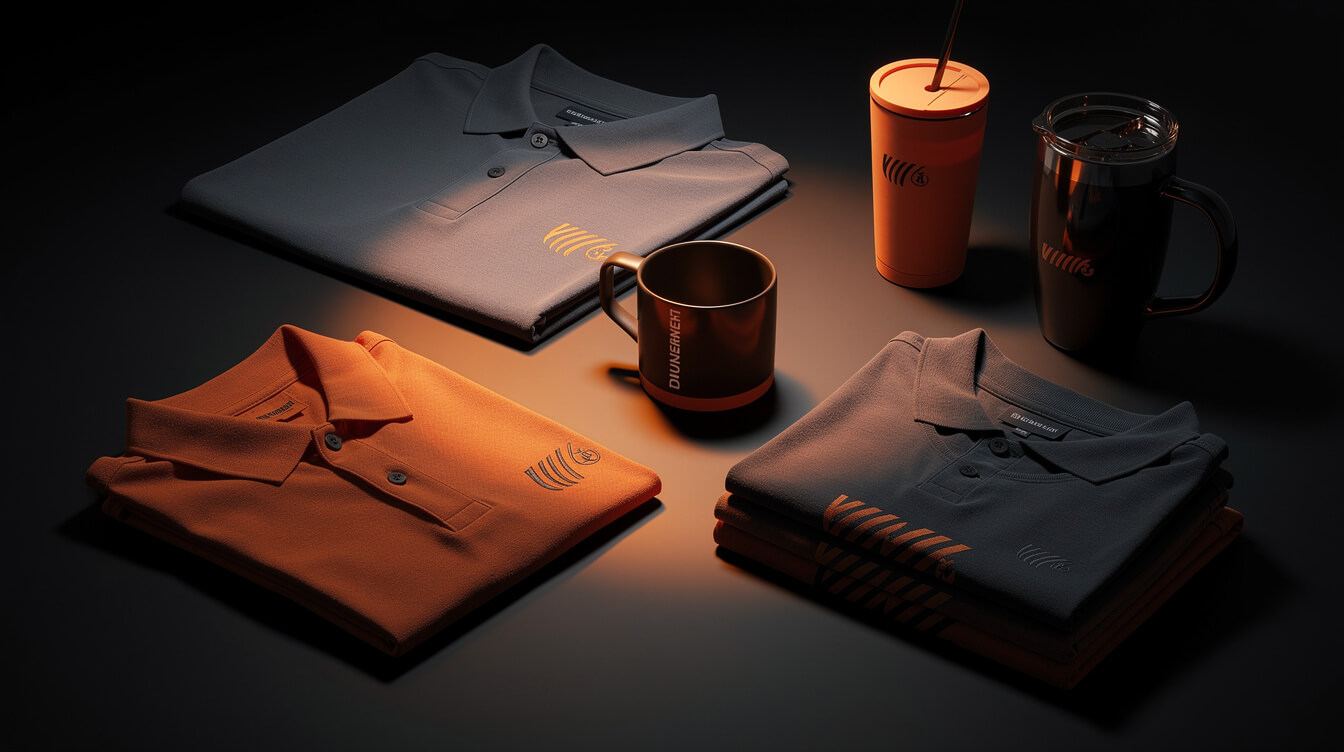
Polo shirts, unisex hoodies, and button-down shirts are the core of corporate merchandise. Printful offers embroidered polo shirts via Bella+Canvas and Gildan Hammer that clear the quality bar. DTG printing on Comfort Colors or Next Level blanks works for t-shirts and lighter-weight items.
Embroidery is the preferred decoration method for corporate apparel because it signals quality. A $42 embroidered polo looks and feels like something a company stands behind. A $22 DTG-printed polo in the same style looks like a promotional giveaway. The price difference in the product page is worth the quality signal for corporate clients.
Drinkware
Ceramic mugs, travel mugs, and insulated tumblers are consistent sellers for corporate merchandise. They are universally used, they display branding prominently, and they hold up well to daily use. Printful’s tumblers and Printify’s premium mug suppliers both deliver reliable output.
An important note on drinkware: the corporate market expects packaging. Shipping a branded mug in bubble wrap inside a plain box reads as wholesale, not premium. Adding a simple gift box option to your WooCommerce product page is a $3 to $5 packaging upgrade that corporate buyers will consistently choose.
Tote bags and accessories
Canvas tote bags are undervalued in the corporate merchandise market. They have obvious utility, low per-unit base cost, and broad demographic appeal. For companies that want to communicate environmental awareness, a canvas tote outperforms a plastic giveaway item with a logo on it.
Printful’s ATC Eco and Bella+Canvas tote bags are strong options. Base prices start around $10 to $12, leaving substantial margin at a $35 to $45 retail price point.
What to skip
Some product categories that work well for retail POD are poor fits for corporate merchandise. Large-format poster printing requires quality that most POD fulfillment cannot match competitively. Embroidered caps from Printful are a viable category, but cap embroidery has specific quality constraints at the stitch count level that require product page transparency.
Start with 4 to 6 products you know your fulfillment partner handles well. Expand once you have corporate clients who provide feedback on the existing range.
MEGA automates the product listing creation process for your WooCommerce store. From a niche brief to a complete set of product listings, the pipeline runs in under 7 minutes per product, which is what makes building out a full corporate merchandise catalog in a single afternoon feasible for a solo operator.
How to price custom corporate merchandise profitably
Pricing is where many POD sellers undercharge for corporate merchandise because they benchmark against retail consumer pricing. Corporate buyers are not buying for themselves. They are buying branded items that represent their company. The margin expectations are different, and the comparison set is different.
The cost model: Printful base plus WooCommerce markup
Start with your fulfillment base cost. For a Printful embroidered polo, that is approximately $23.75 at standard pricing. Add $2 to $3 for packaging and handling. Your all-in cost is roughly $26 to $27 per unit.
At a retail price of $58, your margin is approximately 54%. That is a healthy margin for a physical product where you hold zero inventory. At 10 units, the buyer pays $580. Vistaprint’s equivalent embroidered polo at a 25-unit minimum runs approximately $715 for the minimum order. Your buyer gets 10 units, no surplus, no minimum penalty, and a product that ships faster.
Pricing at different order volumes
Corporate buyers expect some volume pricing consideration, even if they do not demand it. A reasonable structure: standard pricing up to 9 units, 10% discount at 10 to 24 units, 15% discount at 25 and above. WooCommerce handles tiered pricing natively via the pricing fields, or through a lightweight plugin like Wholesale Prices for WooCommerce.
Do not race to the bottom on pricing. A corporate client who pays $58 per polo and receives a high-quality product will reorder. A corporate client who negotiated you down to $38 and receives the same product will still reorder, but your margin is gone and you have trained them to treat your pricing as a negotiation starting point.
Transparent pricing builds procurement trust
Procurement managers are paid to identify hidden costs. If your WooCommerce product page shows a per-unit price that changes dramatically at checkout due to shipping or handling fees, you will lose corporate buyers permanently. State the price. State the shipping estimate. State the turnaround time. A buyer who encounters no surprises at checkout becomes a repeat client.
For a full breakdown of WooCommerce operating costs at different store scales, see our guide to WooCommerce pricing for POD stores in 2026.
Build your corporate merchandise catalog in one afternoon
MEGA runs the full pipeline from research brief to live WooCommerce product listing in under 7 minutes. Build a 15-product corporate catalog without a design team or a full day of manual work.
Setting up a WooCommerce POD store for corporate clients
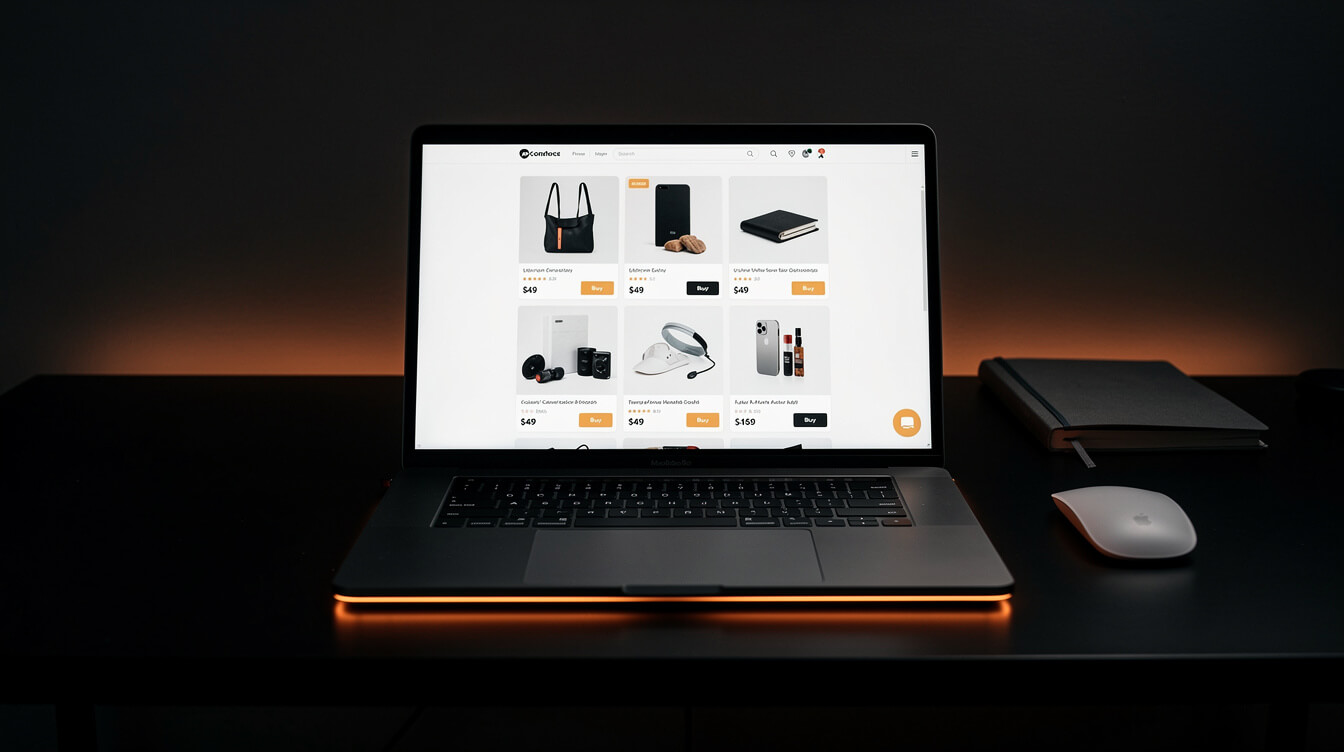
A WooCommerce store optimized for corporate buyers looks different from a store built for consumer retail. The differences are not technical. They are in product page design, B2B positioning, and order process clarity.
Product pages built for procurement
Corporate buyers scan product pages for three data points before anything else: price, turnaround time, and minimum order (or confirmation that there is none). Put all three above the fold. Do not bury turnaround time in a FAQ section. Do not hide the fact that you sell single units inside a body paragraph. State it in the product page headline or subtitle.
Mockups matter more for corporate merchandise than for consumer POD products. Corporate buyers are approving a purchase that will represent their brand. Use Printful’s mockup generator to produce clean, professional product images showing multiple colorways and the logo placement clearly. A buyer who can see exactly what they are ordering at checkout has a much lower return rate and a higher probability of becoming a repeat client.
A dedicated corporate ordering page
Create a standalone WooCommerce page titled something like “Corporate and bulk orders” that explains your process, lists the product categories you support, and links to a quote request form for orders above a threshold or for custom design requests.
This page serves two functions. First, it signals to procurement managers that you work with businesses, not just individual consumers. Second, it creates an internal landing page that can rank for long-tail searches like “custom branded merchandise small business” or “no minimum corporate merchandise,” where none of Vistaprint’s pages appear.
Quote requests and net 30
Corporate purchasing often runs on net 30 payment terms. WooCommerce supports invoice-based checkout via the WooCommerce Payments gateway or a plugin like WooCommerce PDF Invoices and Packing Slips. For larger corporate clients, the ability to receive an invoice and pay within 30 days is not a preference. It is a requirement from their accounts payable process.
Adding net 30 terms for verified corporate accounts puts you ahead of every POD seller who only accepts credit card at checkout. The administration overhead for 5 to 20 recurring corporate clients is manageable, and the retention value is high.
SEO and content for the corporate segment
A WooCommerce POD store serving corporate buyers benefits from a content strategy that supports the product pages. Educational content covering related topics, such as our overview of custom merchandise for your business, drives organic traffic and builds trust before the buyer ever reaches a product page.
The keyword gap in the corporate merchandise space is significant. Vistaprint and 4imprint dominate product and category pages. Zero editorial content exists from any of the traditional players explaining how businesses should approach merchandise strategy. That is the gap where a WooCommerce POD store builds organic authority.
How MEGA automates the product generation step for corporate merchandise

The operational bottleneck for a POD seller entering corporate merchandise is not product quality. It is listing creation speed. Building a corporate merchandise catalog manually, where each product requires a separate design session, mockup generation, WooCommerce listing, and SEO title, takes a full working day per product category.
A seller who wants to offer 15 branded product options across apparel, drinkware, and accessories is looking at 12 to 15 hours of manual work before a single unit is available for purchase. That is not a scalable model for capturing the corporate merchandise market.
From brief to live listing in under 7 minutes
MEGA runs the full product generation pipeline from research brief to live WooCommerce listing in under 7 minutes per product. That includes AI image generation for product visuals, SEO-optimized product titles and descriptions, Printful integration, and WooCommerce listing creation.
For a corporate merchandise catalog of 15 products, that is approximately 105 minutes of pipeline time versus 12 to 15 hours of manual work. The output is not a draft. It is a live, SEO-ready WooCommerce product page with mockups, complete product data, and category taxonomy applied.
Vistaprint can offer 800 product variants at scale because they have a large operations team building and maintaining that catalog. A solo WooCommerce POD seller cannot replicate that product breadth manually. With MEGA, they can build a 30-product corporate catalog in a single afternoon and compete on product range.
That is the competitive shift that matters. Not undercutting Vistaprint on price. Matching their product breadth while eliminating the minimum order quantity that makes their model inaccessible to small business buyers.
Frequently asked questions about custom corporate merchandise via POD
Can POD merchandise quality match what Vistaprint or 4imprint produces?
For apparel with embroidery or direct-to-garment printing, yes. Printful’s embroidered polos and DTG-printed hoodies are produced on the same blank apparel brands (Bella+Canvas, Gildan) that volume printers use. For items requiring specialty finishes like foil printing or woven labels at scale, bulk suppliers retain an advantage.
What is the actual minimum order quantity through Printful?
One unit. Printful fulfills single-unit orders. There is no minimum quantity for any product in their catalog. Volume discounts begin to apply at 25 to 50 units on some product lines, but the floor is always one unit.
How do I handle corporate clients who need net 30 payment terms?
WooCommerce supports invoice-based orders through several plugins. For verified corporate accounts, you can manually create orders with an invoice and set a due date. It requires more administration than a standard checkout, but it is operationally feasible for 5 to 20 recurring corporate clients.
Should I list corporate merchandise products on Etsy or only on WooCommerce?
Etsy drives impulse consumer purchases, not corporate procurement. A corporate buyer researching branded merchandise for a company event is not searching Etsy. A WooCommerce store with its own domain, a dedicated corporate ordering page, and SEO-optimized product pages is the correct channel for corporate merchandise.
What makes WooCommerce better than Shopify for corporate merchandise?
Shopify charges a 1% platform override on every transaction through most third-party payment processors. On a $500 corporate order, that is $5 in pure platform tax, on top of standard payment processing fees. Over a year of corporate sales volume, that cost compounds. WooCommerce has no equivalent platform fee. For the specific economics, see our WooCommerce pricing guide for POD stores.
Building a corporate merchandise business on WooCommerce POD
The corporate merchandise market has not changed much in 20 years. Vistaprint, 4imprint, and CustomInk built dominant positions on the same structural assumption: corporate buyers need volume, and volume means minimums. That assumption is no longer true for a meaningful segment of the market.
Small and mid-size businesses, startups, departments within larger companies, and nonprofit organizations all have branded merchandise needs that the bulk model serves poorly. They need 8 to 30 units, not 250. They need them in two weeks, not six. They need a product page they can return to when the next hire joins the team.
A WooCommerce print-on-demand store built for the corporate segment serves all of that. The structural advantages, no MOQ, transparent pricing, fast turnaround, and automated reorder, are inherent to the POD model. The opportunity is in building a product catalog that signals corporate-grade quality and a store experience that procurement managers trust.
That is where the Vistaprint customer lives. And that is the customer a well-positioned WooCommerce POD store can win.

Implement AI. 30x your throughput. Get a 30-min call with the founder.
Drop your details and book a free 30-minute discovery call. Personalized advice on your POD stack, your margin, and where AI fits. No pitch, no fluff.