Custom ornaments for POD sellers: seasonal demand math, provider options, and the unit cost reality
The search volume for custom ornament sits around 14,800 searches a month in summer. In October it is closer to 150,000. That 10x swing is the entire business case for adding ornaments to your print-on-demand catalog, and most POD sellers either miss it or wait until November to act, which is six weeks too late to index for organic traffic.
This post covers the seasonal mechanics, which POD providers actually support ornament production, what the unit economics look like at 1, 10, and 100 units, and how your platform choice affects your margin during the spike. If you are running your store on Shopify, the December math is worth reading before Q4 kicks in. For a broader look at which POD product categories carry the best margins year-round, see our print-on-demand product margins guide.
Why custom ornaments are a seasonal spike product

Most POD products have fairly stable demand curves. T-shirts peak in spring and early summer, tote bags get a mid-year bump, phone cases trend with new device releases. Ornaments are different. The demand pattern looks almost entirely flat from January through August, then accelerates through September and October before spiking hard in November and December.
DataForSEO keyword data shows “custom ornament” at roughly 14,800 monthly searches in July. By October that figure has climbed past 60,000. By November it can hit 150,000 or more, depending on the year. That is not a gentle seasonal lift, it is a product category that essentially turns on once a year.
The implication for content strategy is clear: if you want organic search traffic for ornament listings in November, you need your product pages indexed in September. If you want your blog content driving email captures and top-of-funnel awareness, you need it published now, in July or August. Search engines need six to eight weeks at minimum to index and rank new content. Waiting until Halloween to publish a custom ornament guide means you miss the entire demand window.
The same logic applies to your product listings. Printful and Printify both require time to propagate new product variants through their catalogs. A listing you set up in late November competes at full price against sellers who built out their catalog in August, optimized their photos, and have three months of sales velocity and review history. The sellers who win Q4 ornament searches started in Q3.
This seasonal concentration is also why ornaments can distort your annual revenue picture. A POD seller doing $3,000 a month in April might see $15,000 in December entirely from the ornament category. That is a good problem to have, but it raises the platform fee question sharply. More on that in section five.
Compare ornaments to a year-round seller like custom photo blankets. Blanket demand is relatively stable across the year, with a smaller holiday lift. Ornaments are the opposite of stable: they are a concentrated bet on six weeks of demand. That means preparation timing and margin discipline matter more than in almost any other POD category. If you are building out a holiday gift cluster on your WooCommerce store, see our custom photo blanket guide for how sublimation-based gift products work more broadly.
Which POD providers support custom ornament printing
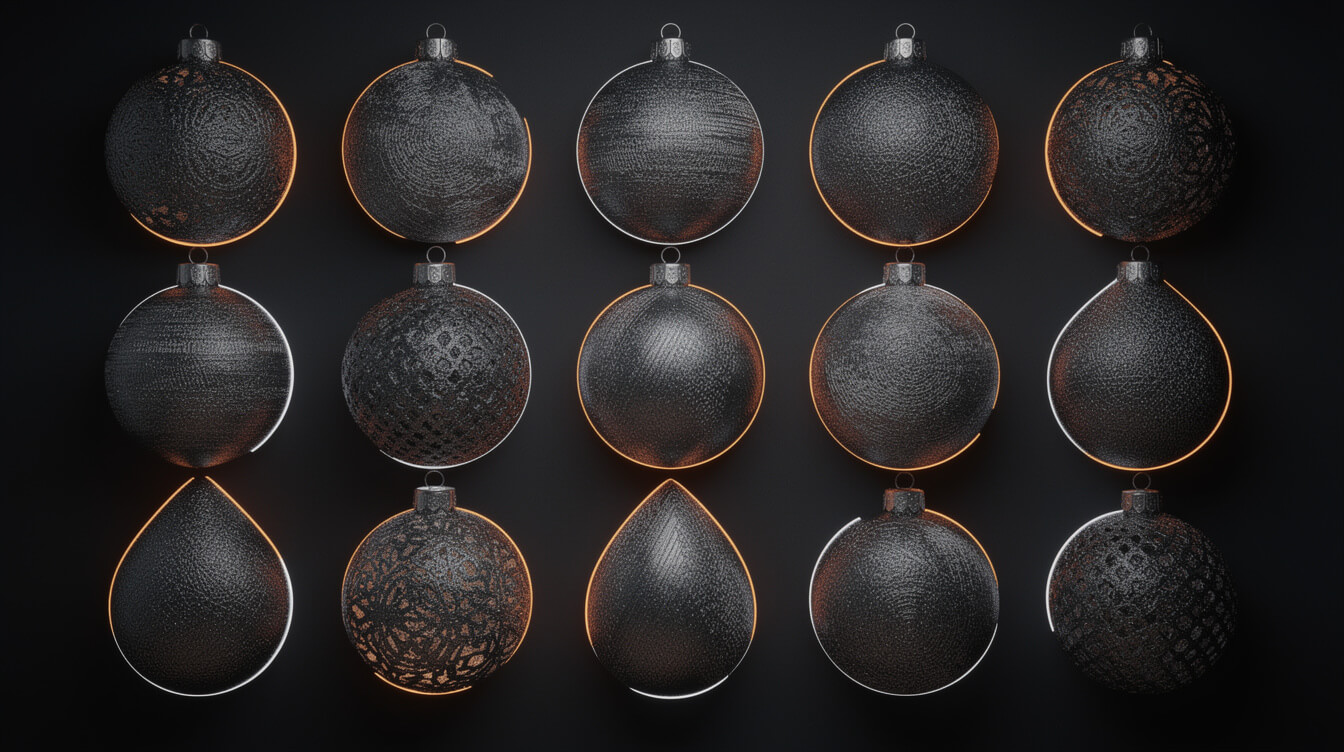
The ornament category is more fragmented than apparel. Not every major POD platform carries ornaments, and the ones that do support different formats, materials, and print methods. Here is what the provider landscape actually looks like.
Printful offers photo ornaments in a round format, sublimation-printed on MDF or metal. Their standard offering is a 2.9-inch circular MDF ornament, single-sided sublimation, with a gold ribbon hanger. It is a clean product for photo personalization: pet portraits, family photos, baby photos. The limitation is format: Printful does not currently offer acrylic ornaments, glass ornaments, or anything with dimensional depth. What they offer is simple and ships reliably, which matters in December when fulfillment timelines are compressed.
Printify has a broader ornament catalog through its print provider network. Depending on the provider you select, Printify can source:
- Round sublimation ornaments (MDF, metal, ceramic)
- Rectangular and custom-shaped acrylic ornaments
- Two-sided ornaments (design on both faces)
- Ornaments with ribbon hangers, jump rings, or metal hooks
The tradeoff with Printify is that you are selecting a specific print provider, not a unified platform. Fulfillment quality, turnaround time, and shipping cost vary between providers. Monster Digital and Awkward Styles both carry ornaments with reasonable track records. Before Q4, order a test sample from any provider you plan to use at scale. A sublimation color shift you discover in November is a returns nightmare in December.
Gooten has limited ornament options but does carry some formats. Worth checking their current catalog if Printful and Printify do not meet your format requirements.
Print methods to understand:
- Sublimation: The most common for photo ornaments. Dye is transferred under heat into a polyester coating, producing vibrant, photorealistic results. Works on MDF, metal, and ceramic. Cannot print on natural wood grain without a white coating layer first.
- Laser engraving: Popular for wood and acrylic ornaments. Monochrome by default (engraved lines, no fill color). Higher perceived premium value, lower color saturation. Good for text-based and minimalist designs.
- Acrylic direct print: UV flatbed printing on acrylic blanks. Full color, high durability. Common in Printify’s acrylic ornament catalog.
For most POD sellers starting with ornaments, sublimation on MDF through Printful is the lowest-friction entry point. The product is simple, the setup is fast, and Printful’s fulfillment is predictable. If you want to differentiate on format, Printify’s acrylic options give you something most competitors on Etsy or Redbubble are not listing.
Unit cost breakdown: what a custom ornament costs at 1, 10, and 100 units

POD pricing is fundamentally different from bulk ornament sourcing, and the math needs to be laid out clearly before you set your retail price.
Printful sublimation MDF ornament (2.9-inch round):
- 1 unit: approximately $8.95 base cost plus shipping
- 10 units: same per-unit cost, no volume break (POD pricing is flat)
- 100 units: same per-unit cost, unless you use Printful’s sample discount for internal orders
Printful does not offer volume discounts in the traditional sense. Their pricing is per-unit and consistent, which is the entire point of the model. You are paying for production flexibility, not for bulk savings.
Printify acrylic ornament (through a provider like Monster Digital):
- 1 unit: approximately $7.50-11.00 depending on size and format
- Printify Premium ($29/month) gives 20% off base costs, which drops that range to approximately $6.00-8.80
- At scale, Printify Premium pays for itself at roughly 4-5 ornament orders per month
Bulk sourcing comparison (Alibaba MOQ at 100+ units):
- Sublimation MDF ornaments: $1.20-2.50 per unit at 100-unit MOQ
- Acrylic ornaments: $1.50-3.00 per unit at 100-unit MOQ
- You hold inventory, manage shipping, coordinate printing separately, handle returns
The break-even point between POD and bulk sourcing sits at roughly 80-100 units for a single design. Below that, POD wins on economics because you carry no inventory risk. Above 100 units of a known-winning design, bulk sourcing can improve margin significantly, but you are making a demand bet before you have validated the design.
For most POD sellers, the right entry strategy is: validate designs through POD first, identify your top 3-5 sellers, then consider bulk sourcing those specific SKUs for Q4 if volume justifies it. The POD version of a $35 retail ornament at an $8.95 base cost gives you a 74% gross margin before shipping and platform fees. That is a workable margin. The question is how much the platform takes off the top.
Pricing strategy: what to charge for custom ornaments at $25, $35, and $45 retail

Smash print-on-demand. Join the engine room.
One short email a week. Real numbers, real teardowns, the unfiltered economics behind every move.

Ornament pricing splits into two categories with different market tolerances and different buyer intentions.
Photo ornaments (pet portraits, baby photos, family photos, anniversary photos) carry a premium because they are personalized and gift-oriented. The buyer is not comparison shopping on price, they are comparison shopping on quality and turnaround. The price anchor in this category sits at $25-45 retail, with $35 being the common sweet spot on Etsy. Above $45 you start losing impulse buyers. Below $25 you are leaving margin on the table and training buyers to undervalue personalization.
Branded ornaments (logo ornaments for corporate gifting, sports team ornaments, event ornaments) operate differently. The buyer may be ordering 10, 50, or 200 units for a specific event or company. Here the per-unit price can compress to $18-25, but the order value is much higher. Corporate gifting ornament orders at $20 each, 100 units, equals a $2,000 sale from a single transaction. That changes the economics entirely.
Pricing a photo ornament at $35 retail:
- Base cost (Printful): $8.95
- Shipping to customer (passed through or built into price): varies
- Platform fee: depends on your platform (see section five)
- Net margin before platform fee: approximately $26.05 on a $35 sale, or 74%
At $45 retail the margin expands to $36.05 before fees, but your conversion rate drops. A/B test your price point with a small run before Q4. Set the price, measure conversion over two to three weeks of real traffic, then lock in the winner before November demand kicks in.
For personalized ornaments, MEGA can generate the product listings for your entire ornament catalog from a single brief, with titles, SEO descriptions, and variant labels built out before you touch Printful or Printify. That matters at scale in Q3 when you are prepping 20-40 ornament SKUs across niches without wanting to spend six hours in a Canva workflow for each one.
The Shopify 1% fee during a seasonal spike: what a $20k December costs vs WooCommerce

Ornaments are a high-volume, concentrated seasonal product. That makes them the perfect case study for understanding what platform fees actually cost at scale.
Shopify charges a 1% platform override on top of Shopify Payments or your payment processor if you use a third-party gateway. On a slow month this is easy to ignore. On a $20,000 December, it is $200 straight off the top, before Shopify Payments’ own transaction percentage, before your payment processor, before fulfillment costs.
Run the math across a full Q4:
- October: $8,000 revenue. Shopify 1%: $80
- November: $15,000 revenue. Shopify 1%: $150
- December: $22,000 revenue. Shopify 1%: $220
- Q4 total: $450 in platform override fees alone
That $450 does not include your Shopify plan ($79-299/month for Shopify or Advanced Shopify), the apps you are paying for (reviews, email, SEO, analytics), or any per-transaction fees from your payment processor. The all-in platform cost on a $45,000 Q4 can realistically hit $1,500-2,000 depending on your app stack.
WooCommerce on a self-hosted server charges none of that. There is no revenue percentage. There is no platform override. You pay hosting ($20-50/month for a properly configured VPS), a WooCommerce license (free for the core plugin), and whatever extensions you need. The extension stack for a POD store running Printful integration, email marketing, and basic analytics costs less than one month of the Shopify Advanced plan.
The seasonal spike argument is the strongest version of the WooCommerce economics case. On a flat-revenue business, the platform fee difference is small enough to debate. On an ornament-heavy Q4 business where monthly revenue can 5x in December, the fee difference is meaningful. See our custom blanket guide for how the same platform math applies to another high-AOV home decor category.
How to set up custom ornament listings for Q4 on WooCommerce
The operational workflow for ornament listings on WooCommerce differs slightly from apparel because of the personalization requirements. Photo ornaments need a photo upload field on the product page, a way to communicate the specific design instructions to your POD provider, and a fulfillment process that handles personalized orders at volume without breaking in December.
Step 1: Set up your Printful or Printify integration. Both providers have official WooCommerce plugins. Install the plugin, connect your account, and sync your product catalog. For Printful, the WooCommerce integration handles order routing automatically. When a customer buys, the order flows to Printful with the customer’s shipping address. You do not touch the fulfillment.
Step 2: Configure the photo upload field. Personalized ornaments require a photo upload at checkout. The cleanest way to handle this in WooCommerce is with a product add-on plugin (WooCommerce Product Add-Ons is the standard option) that adds a file upload field to the product page. The uploaded photo is attached to the order and passed manually or via integration to your POD provider.
This is the step where most POD sellers hit friction: Printful does not automatically process uploaded customer photos for photo ornaments. You receive the order, download the customer’s photo, apply it to the Printful design template in their editor, then submit. At 5 orders a day this is manageable. At 50 orders a day in December it is a bottleneck. Building a workflow for this step before Q4 is non-negotiable if you plan to sell photo ornaments at scale.
Step 3: Write your product listings now. Each ornament variant (round, rectangle, size options, acrylic vs MDF) needs its own listing with distinct title, description, images, and SEO metadata. A catalog of 10 ornament products requires 10 listings, each optimized for a different search angle (pet ornament, photo ornament, Christmas ornament, baby ornament, couples ornament, and so on). Doing this in October means you are setting up listings at peak demand without time to iterate. Doing it in August gives you six weeks to collect early sales data and optimize before the spike.
Step 4: Set up a holiday shipping cutoff calendar. Display your cutoff dates prominently on every ornament product page. Customers make purchasing decisions based on delivery confidence, and missing Christmas delivery is a one-star review waiting to happen.

Build your ornament catalog in minutes, not hours
MEGA generates complete product listings from a niche brief. Titles, SEO descriptions, variant labels, all ready to push to Printful and Printify before Q4. No Canva. No manual workflow.
Ornament niches that actually sell: pets, babies, weddings, sports teams, and corporate gifting
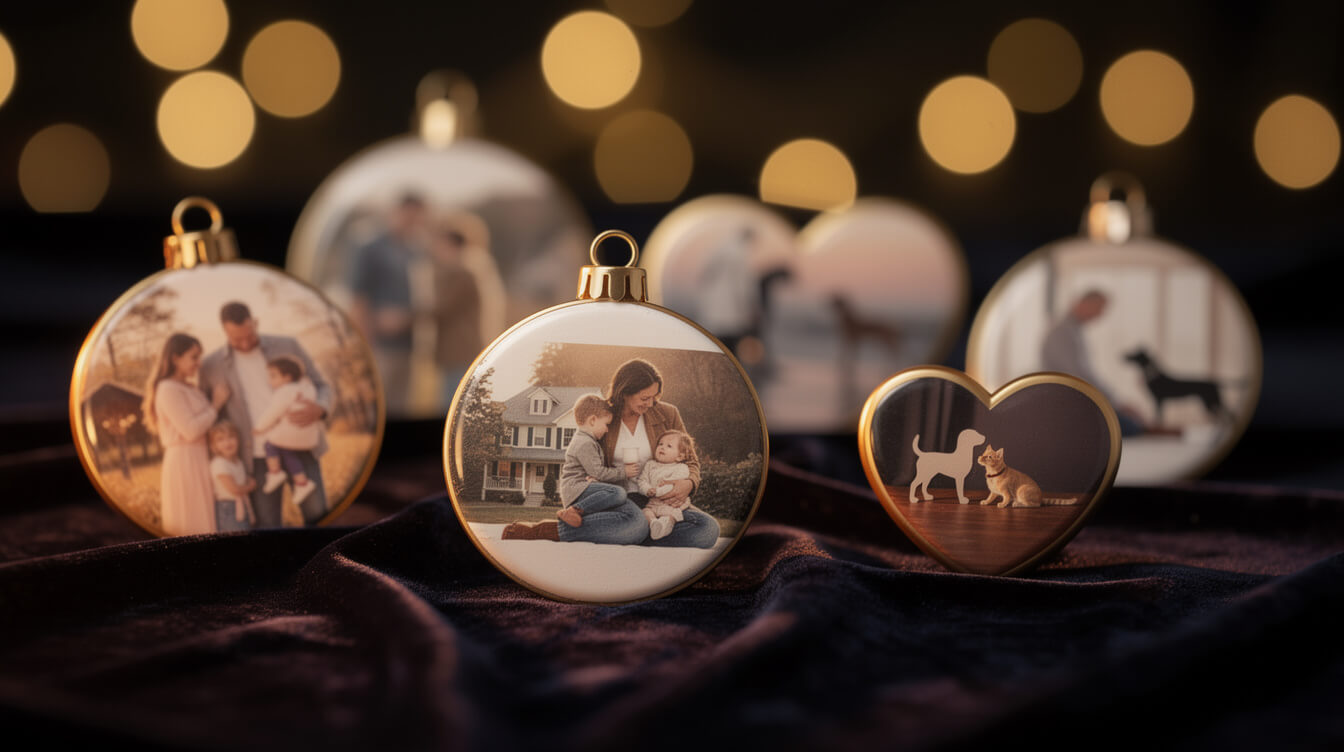
Not all custom ornament niches perform equally. Five categories have demonstrated consistent demand and good unit economics. If you are deciding where to focus your Q3 catalog buildout, start here.
Pet portrait ornaments are the strongest single niche in the custom ornament category. The buyer is emotionally invested, the design brief is simple (upload your pet’s photo, add a name), and the AOV is $35-45. Pet owners gift ornaments to other pet owners. The niche also has a longer buying window than generic Christmas ornaments because it serves birthday gifting and “gotcha day” celebrations year-round. If you sell in this niche on Etsy or your WooCommerce store, you already know the demand. The opportunity in POD is capturing it with zero inventory risk.
Baby’s first Christmas ornaments peak hard in November through mid-December. Parents and grandparents are the buyer. The design typically includes the baby’s name, birth date, and a photo. This is one of the highest-conversion photo ornament niches because the emotional urgency is real: there is exactly one “first Christmas” per child. Urgency plus personalization equals conversion.
Wedding ornaments have a different demand curve. They are not purely December products. Couples order custom ornaments as wedding favors and keepsakes for guests, and weddings happen year-round. The peak for wedding ornament searches is March through June (wedding season preparation), with a secondary lift in fall. If you are building a broader wedding niche POD store, ornaments fit naturally alongside custom drinkware and other wedding favor formats. For a comparison of how drinkware fits that same gifting cluster, see our custom water bottle guide.
Sports team ornaments serve two audiences: youth sports parents who want keepsakes at the end of a season, and adult fans who treat team ornaments as collector items. The design brief for youth sports is typically the team name, a jersey number, and a sport graphic. These orders often come in small batches (a parent buying one for each player on the team), which is exactly where POD no-minimum fulfillment wins over bulk ordering.
Corporate gifting ornaments are the highest-value order type but require the most B2B positioning. Companies order branded ornaments for clients, employees, and event giveaways. Order sizes of 50-200 units are realistic. The design is usually the company logo on a clean background with a holiday message. To win corporate gifting business through your WooCommerce store, you need a clear bulk order process, a simple quote request form, and a turnaround commitment. Corporate buyers are less price-sensitive than consumer buyers, but they need certainty on delivery and quality before they commit to 100+ units.
Preparing your custom ornament catalog before the demand window opens

The summary version of everything above is this: the custom ornament category rewards sellers who prepare in Q3, not Q4.
The demand surge is real and concentrated. It starts in early October and peaks in late November. Any store that goes live with ornament listings in October already has a head start on November openers. Any store that goes live in August has a head start on October openers. The compounding effect of early indexing, early reviews, and early sales history is the sustainable moat in this category.
The provider options are workable. Printful’s MDF sublimation ornament is a reliable starting point with low setup friction. Printify’s broader catalog gives you format differentiation if you want acrylic or two-sided options. Test both, order samples, and make your production decision before demand arrives.
The economics work. A $35 photo ornament on WooCommerce at an $8.95 Printful base cost gives you a 74% gross margin before shipping. That is one of the best gross margins in the POD catalog. The Shopify 1% fee erodes it meaningfully at scale, which is why sellers with serious Q4 volume increasingly run WooCommerce. The platform savings on a $45,000 Q4 can fund the next year’s catalog development.
And the niches are specific. Pets, babies, weddings, sports teams, and corporate gifting are each distinct markets with distinct buyers and distinct design requirements. Trying to serve all five simultaneously with a generic ornament listing loses to sellers who specialize. Pick one or two niches, build out your catalog in those niches, and set up your Q4 before August ends.
Implement AI. 30x your throughput. Get a 30-min call with the founder.
Drop your details and book a free 30-minute discovery call. Personalized advice on your POD stack, your margin, and where AI fits. No pitch, no fluff.