Custom photo blankets for POD sellers: sublimation method, provider options, and the real unit cost math
If you search “custom photo blanket,” every result is a consumer gift site. CanvasDiscount, Printerpix, Walmart Photo, Mpix. They are all selling to grandmothers buying anniversary gifts. Zero of them are talking to a POD seller trying to decide whether to add photo blankets to a WooCommerce store, what it actually costs to fulfill one, and what margin is left after the platform takes its cut.
This post is the editorial that does not exist anywhere else on that SERP. It covers the print method that makes a custom photo blanket possible, which POD providers actually support it, what the unit economics look like at real order volumes, and where Shopify’s 1% override fee quietly erases your margin before you have noticed it.
If you are building a home decor product line or looking for a high-AOV gift item that photographs well and ships flat, this is the analysis you need before you add the first listing.
What makes a custom photo blanket different from a standard blanket
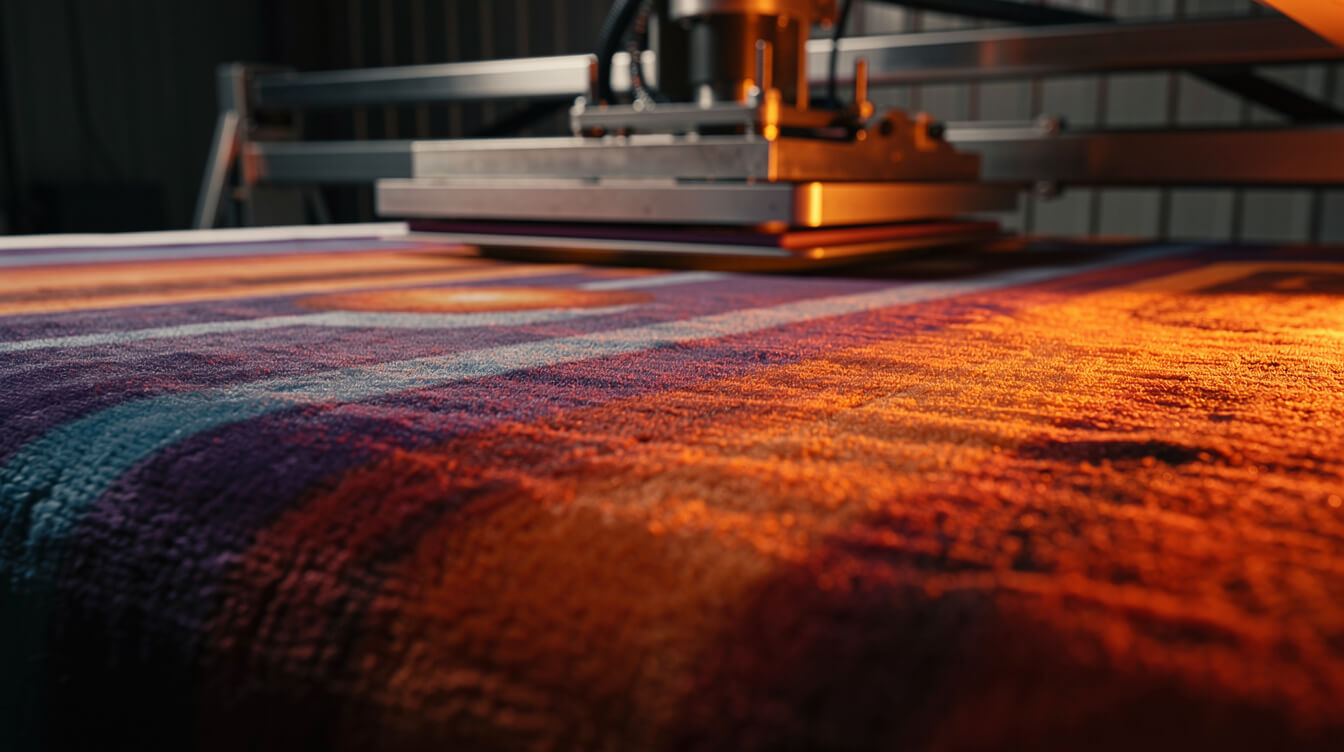
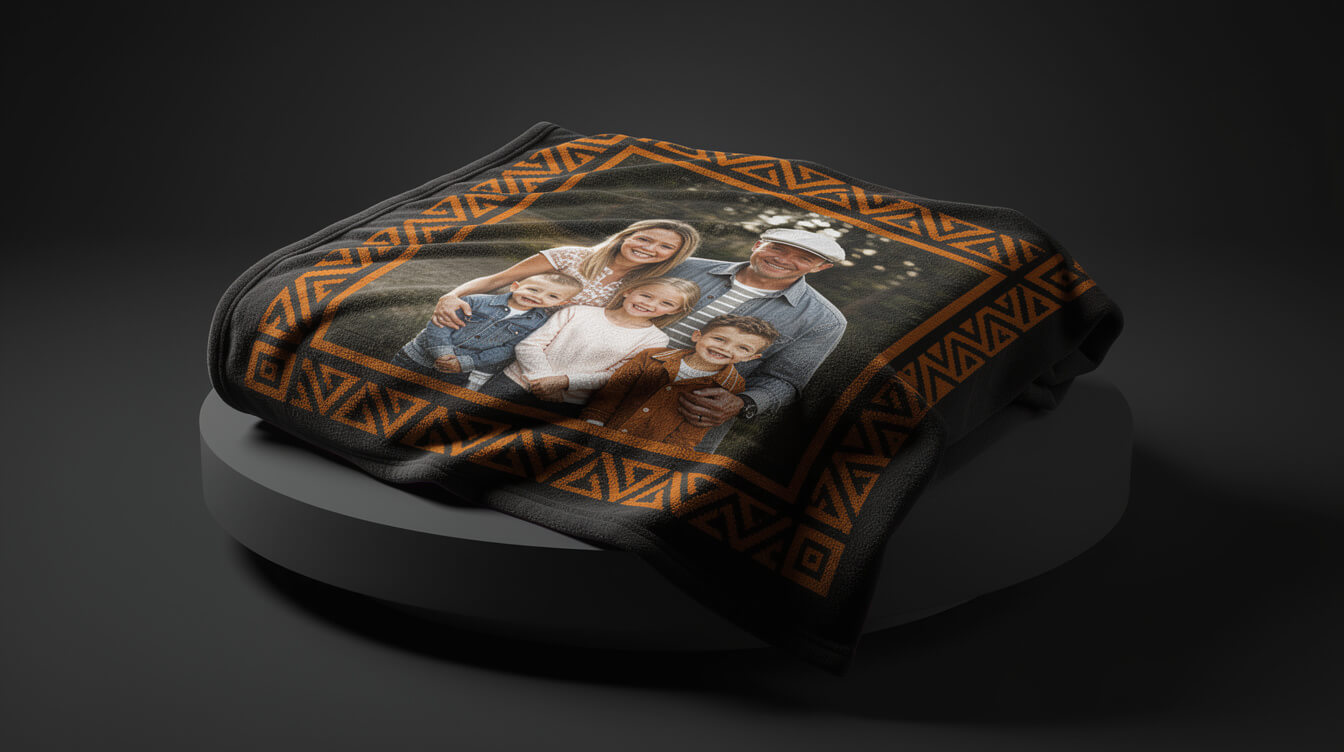
The term “photo blanket” implies full photographic reproduction across the entire face of the blanket. That is a sublimation job. It is not a DTG job, and understanding that difference changes every purchasing and pricing decision you make downstream.
DTG (direct-to-garment) printing uses aqueous inkjet technology to spray pigment-based ink directly onto a fabric surface. It works well on cotton. The ink bonds to cotton fibers through a pretreatment process and produces rich, washable results. The catch: it requires a relatively flat, absorbent surface. A blanket — particularly the soft fleece or sherpa constructions that customers expect for home use — is not that surface. The pile structure of fleece fabric scatters the ink before it can cure properly, and the result lacks the saturation and detail that a photo-quality print demands.
Sublimation works differently. The process uses heat-activated dyes on a transfer paper. Under high heat and pressure, those dyes convert to a gas and bond molecularly with synthetic fibers, primarily polyester. The result is a print that is embedded in the fabric, not sitting on top of it. It does not crack, peel, or fade with washing the way an applied ink film can. On a 100% polyester fleece blanket, the print covers the entire surface with continuous color — edge to edge if the design calls for it — with photographic fidelity.
That is why every consumer photo-gift service uses sublimation for blankets, and why the polyester content of a blanket blank matters so much when you are sourcing. A 50% polyester fleece will produce a visibly less saturated result compared to a 100% polyester construction. The higher the polyester percentage, the better the print quality. Most of the blanket SKUs you will find in Printful and Printify are engineered specifically for this — they run 100% polyester or polyester-dominant blends on the print face.
The practical implication for your store: if a customer orders a custom photo blanket with a detailed family portrait or a high-resolution landscape, the sublimation process is the reason it can reproduce that detail faithfully. If you were to run that same image through a DTG printer onto cotton, you would get muddy color and poor edge definition. Sublimation on polyester is the only reliable path to photo-quality results on a soft goods item.
One more difference worth noting: sublimation supports all-over print (AOP) constructions as a standard feature, not a specialty add-on. The entire print area of the blanket — front, back, edges — can carry the design. Standard blanket printing at a local print shop often means a centered rectangular print on a solid background. A sublimated photo blanket means the image goes everywhere the design specifies. That is the product your customer is paying for.
Which POD providers support photo blanket printing
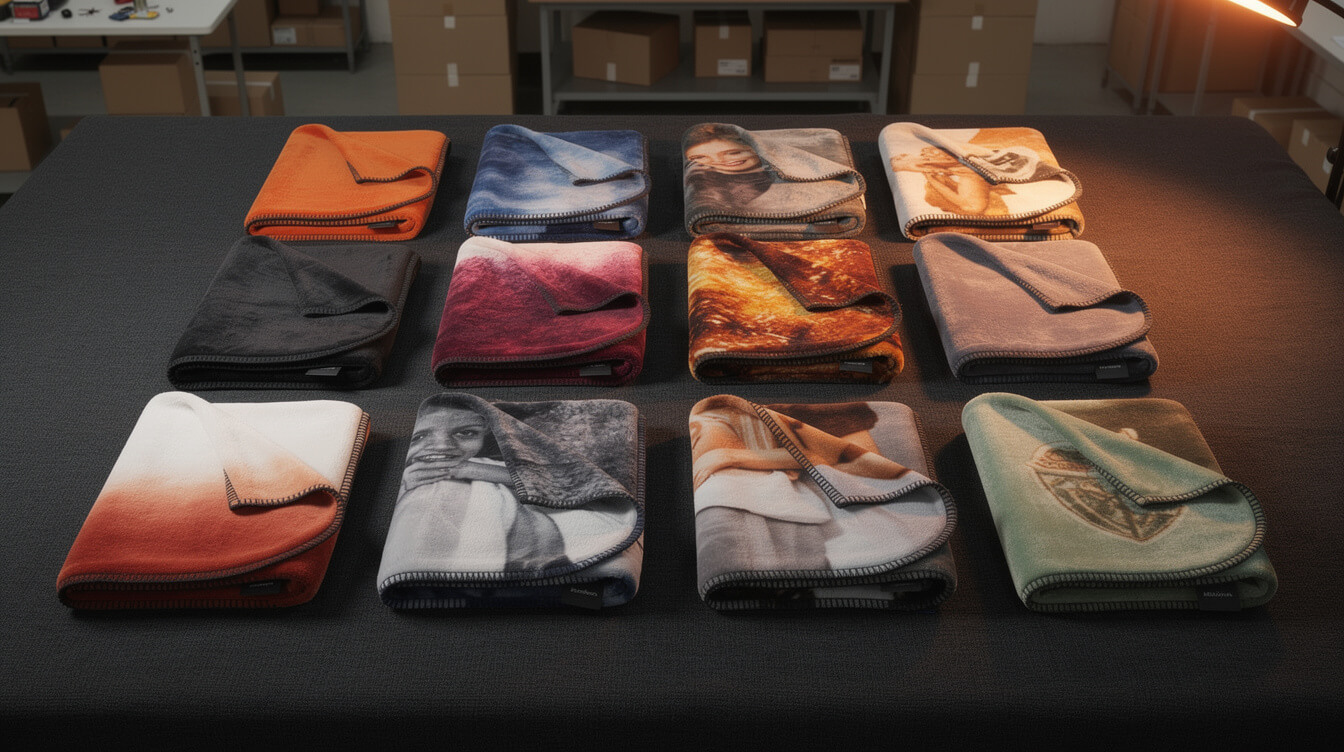
Three providers dominate the conversation for POD sellers who want to offer custom photo blankets without holding inventory: Printful, Printify, and Gooten. Each takes a different position on the product, and those differences matter when you are deciding which integration to run.
Printful
Printful carries a blanket catalog built around sublimation, with their primary offering being the all-over-print fleece blanket. Their standard size runs 50×60 inches, with a 60×80 option available. The construction is 100% polyester on the print face with a sherpa or velveteen reverse depending on the SKU. Base prices start around $24 for the 50×60 and approach $35 for the 60×80.
Printful’s production for blankets is handled through their in-house facilities, which means turnaround times are predictable — typically two to five business days for production, with shipping on top of that. Their WooCommerce plugin supports automatic order routing so that when a customer places a blanket order through your store, it goes straight to Printful’s queue without manual intervention. That is the throughput advantage for sellers with a functioning WooCommerce integration.
One limitation worth flagging: Printful’s blanket catalog is not as deep as their apparel catalog. The SKU selection is narrower, color options for the blank itself are limited (most blankets are sold as a white print-face blank, with the customer’s image as the design), and there is no embroidery option for blankets. Photo blankets on Printful are a sublimation-only product.
Printify
Printify’s approach is network-based. Rather than running their own print facilities, they connect sellers to a network of print partners. For blankets, the relevant partners include MyLocker, AOP Plus, and SwiftPOD, among others. The product offering is similar — 50×60 and 60×80 fleece sublimation blankets — but the base price varies by print partner and can be lower than Printful’s catalog price, particularly for higher-order volumes or sellers on Printify Premium ($24.99/month).
The trade-off with Printify’s network model is variability. Because different print partners handle production, quality control and turnaround can differ across orders if you are not locked to a specific partner. Printify lets you choose your preferred partner for each product, which mitigates this somewhat, but it requires more active management than Printful’s single-facility model. For sellers who prioritize margin over consistency control, Printify’s lower base prices can be meaningful at volume.
Gooten
Gooten sits in a slightly different segment. Their catalog includes blankets with sublimation capability, and their pricing is competitive with Printify’s network partners. The main differentiator is their API-first approach and B2B orientation. If you are building a custom integration or running a high-volume store that needs programmatic order management, Gooten’s technical stack is more flexible than either Printful or Printify for non-standard workflows.
For a typical WooCommerce seller who wants to add photo blankets as a product category, Printful’s reliability and Printify’s pricing create the natural comparison pair. Our full Gooten analysis covers where they fit in a multi-provider setup for sellers who need both breadth and API control.
All three providers support the same core product: a sublimated polyester fleece blanket with your customer’s image printed across the surface. The differences are in base cost, production time, and integration depth. Run the math in Section 3 against your target margin before choosing.
Unit cost breakdown: what a custom photo blanket actually costs your store

Actual numbers, not ranges. Here is what a 50×60 sublimated fleece blanket costs through each provider at different order volumes, using 2026 catalog pricing as a reference point.
At 1 order (single customer purchase)
- Printful (50×60): $24.00 base + $6.95 standard US shipping = $30.95 total fulfillment cost
- Printify with AOP Plus partner (50×60): $21.50 base + $6.50 standard shipping = $28.00 total
- Printify Premium (same partner): $19.35 base (10% discount) + $6.50 shipping = $25.85 total
For a 60×80 size, add approximately $7-10 to the base price across all providers.
At 10 orders/month
Volume does not change per-unit cost on these provider structures — you pay the same catalog price whether you sell 1 blanket or 100 in a month, unless you are on Printify Premium. Printify Premium’s 10-20% discount across the catalog makes a real difference at this volume. Ten blankets at $19.35 versus $21.50 saves $21.50/month. That is $258/year just from the subscription, which costs $24.99/month ($299.88/year). The break-even is 14 blankets per month to justify Premium purely on blanket orders.
At 50 orders/month
At 50 blanket orders per month, Printify Premium’s economics become clear. Assuming an average 50×60 at $19.35 versus Printful’s $24.00, the per-unit difference is $4.65. Across 50 units, that is $232.50/month in base cost savings. Subtract the $24.99 Premium subscription and you are netting $207.51/month in incremental margin purely from the provider switch. Annualized: $2,490.
That difference does not account for shipping costs, which vary by customer location. Use it as a directional figure, not a precise calculation. The actual number at your specific order mix will differ.
What this means for a new seller
Start on Printful if you are under 10 blanket orders per month. The reliability and simpler WooCommerce integration are worth the slightly higher base cost when volume is low and you cannot afford fulfillment variability. Move to Printify Premium when your blanket orders consistently exceed 15 per month. The margin difference compounds materially at that point.
See our broader analysis of custom blanket providers for POD stores for a full comparison across blanket types, including standard sublimation blankets, sherpa options, and larger format SKUs.
Pricing strategy and margin math: what to charge

Smash print-on-demand. Join the engine room.
One short email a week. Real numbers, real teardowns, the unfiltered economics behind every move.
The consumer gift market for photo blankets has an established price anchor. CanvasDiscount runs promotions at $29.95-$44.95 for a 50×60. Printerpix advertises “76% off” against inflated list prices. Walmart Photo prices are in the $25-$45 range. These are discount-heavy, promotional price points for consumer gift buyers.
Your POD store is not competing in that market. You are not running mass-scale promotions and absorbing the margin hit. You are selling a unique, on-demand product to a customer who wants a specific image on a specific blanket. The premium for that is real, and the pricing should reflect it.
At $45 retail
Against Printful’s $30.95 fulfillment cost (50×60 with standard US shipping), a $45 retail price leaves $14.05 gross margin. That is a 31% margin, which is workable but thin for a home decor product. Payment processing (Stripe or PayPal at approximately 2.9% + $0.30) takes roughly $1.61 on a $45 sale, leaving $12.44 in net margin per order. At 50 orders per month, that is $622/month — before any marketing spend. The $45 price point works for a promotional entry price or a smaller 40×50 format, not as your standard positioning.
At $55 retail
Against the same $30.95 fulfillment cost, $55 retail delivers $24.05 gross margin — a 43.7% margin. After processing fees ($1.93), net margin is $22.12 per order. At 50 orders per month, that is $1,106/month. This is the standard positioning for a 50×60 custom photo blanket. It sits above the consumer gift site promotions but well within the range that gift buyers readily accept for a personalized item. The $55 price point is where most POD sellers land after testing.
At $65 retail
At $65, gross margin against a $30.95 fulfillment cost is $34.05, or a 52.4% margin. After processing ($2.19), net margin is $31.86. This pricing works for premium constructions — a 60×80 sherpa-reverse blanket, for example, or a niche where gift-buyers are accustomed to premium pricing (weddings, pet memorial gifts, corporate gifting). The product justifies $65 when the customer is buying it as a significant gift, not an impulse purchase.
The margin math on photo blankets is favorable compared to low-AOV items like custom mugs or standard tees. Our analysis of custom mug printing economics shows mugs often land at $18-22 retail with $6-8 in net margin. A blanket at $55 produces three times the net margin per transaction. The higher fulfillment cost is real, but the margin-per-transaction is proportionally better at the right price point.
The Shopify 1% override fee on a $55 blanket

Shopify charges a 1% transaction fee on every sale when you do not use Shopify Payments. For most POD sellers outside the United States, or those who prefer Stripe for payout timing, that 1% is a standing cost. On a $55 blanket, the Shopify override takes $0.55 per transaction. That sounds minor until you look at it across a month or a year.
At 50 blanket orders per month at $55 each, the Shopify 1% override costs $27.50/month. Over a year, that is $330. Against the $22.12 net margin per order at the $55 price point, you are handing Shopify 2.5 cents of every dollar of net margin you earn on that product. That is before the monthly Shopify plan fee ($39-$399 depending on your tier), any Shopify app costs, and theme licensing.
The calculation gets more significant when you factor in a full store, not just blankets. If your $10k/month store runs 50% on a $55 AOV product mix, the Shopify 1% override costs $100/month. That is $1,200/year in fees that exist purely because Shopify charges for the privilege of using a third-party payment processor. It is a tax on your payment preferences.
WooCommerce does not have an equivalent fee structure. The platform itself is free and open source. Payment processing fees are whatever your processor charges — Stripe’s 2.9% + $0.30 on every transaction, the same rate you would pay on Shopify if you used Shopify Payments anyway. The 1% override simply does not exist. For a $10k/month store switching from Shopify to WooCommerce, that is $1,200/year in reclaimed margin before you count anything else. For a blanket-heavy store with high AOV, the number is proportionally larger.
This is not a theoretical argument. It is arithmetic. If you are selling custom photo blankets at $55 each and doing 100 transactions per month, the 1% override costs you $660/year on blankets alone. That is money that stays in your pocket on WooCommerce and goes to Shopify’s revenue line on their platform.
Setting up custom photo blanket listings on WooCommerce
WooCommerce’s native product management, combined with the Printful or Printify plugin, handles the core mechanics of a custom photo blanket listing. The customer uploads their image, selects size, and places the order. The plugin routes the order to your fulfillment partner automatically. For a straightforward one-SKU listing, this setup is manageable manually.
The complexity increases when you want to run multiple blanket variants — different sizes, different fabric constructions, personalization options — across a catalog of several dozen home decor products. That is where the manual approach starts to break down. Building each product listing individually, writing unique SEO-optimized titles and descriptions for each variant, generating mockup images for each size, and keeping the pricing matrix updated as provider costs shift is a multi-hour task per product. At scale, it is a part-time job.
MEGA automates this end-to-end. The pipeline takes a product type and niche specification, generates the listing content, pulls provider pricing, creates the WooCommerce product with proper variant structure, generates product images, and sets the fulfillment routing. For a blanket catalog expansion — adding 20 new photo blanket listing variants across two sizes and two fabric constructions — that is a pipeline run, not a week of manual work. You can see the full product creation workflow at mega.management.
For the manual WooCommerce setup, the key product configuration points are:
- Product type: Simple product for a single-size SKU. Variable product for multi-size.
- Personalization field: Use a product add-on plugin (like WooCommerce Product Add-Ons) to create an image upload field. This field captures the customer’s photo and attaches it to the order for manual forwarding to the print partner, or it can be handled automatically if your fulfillment plugin supports personalization.
- Pricing: Set the base price at your $55 or $65 target. If you offer multiple sizes, set variation pricing with $10-12 increments between the 50×60 and 60×80 variants.
- Mockup images: Generate lifestyle mockups showing the blanket in a home setting — folded on a couch, draped over a bed, packaged as a gift. These dramatically increase conversion rate compared to plain product shots.
The WooCommerce advantage on photo blankets is specifically in repeat order economics. A customer who buys one photo blanket for a family gift and has a good experience is a candidate for another purchase — a different size, a different photo, a gift for someone else. On WooCommerce, you own that customer relationship directly. You can email them, offer them a re-order discount, and build a relationship that generates repeat revenue without paying a referral or marketplace commission. On Shopify, the same mechanics apply but the 1% override follows every transaction.
When custom photo blankets win and when to look at other product types
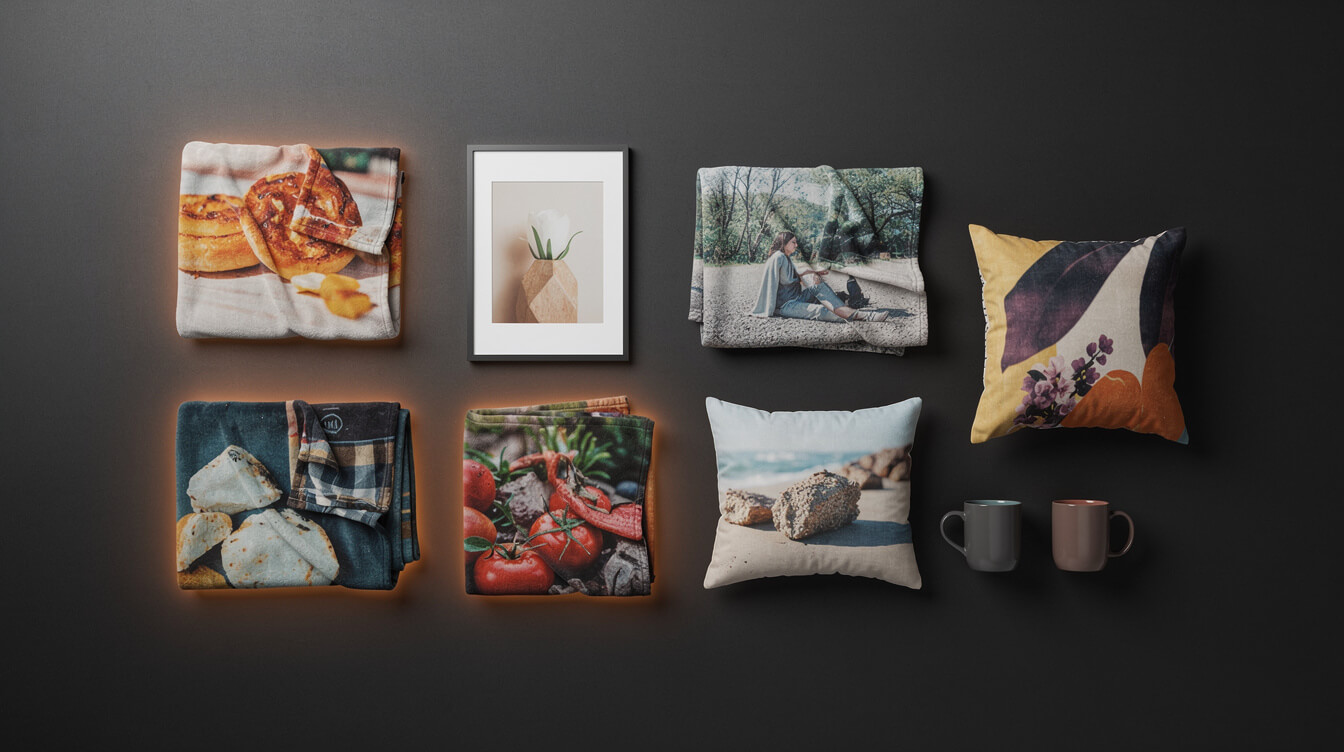
Custom photo blankets are not a universal answer for every POD store. They win in specific contexts and underperform in others. Knowing the difference before you build the listing saves you the sunk cost of a product that does not convert in your niche.
Where photo blankets win
Pet portraits and pet memorial gifts. This is the single highest-converting niche for custom photo blankets. Customers are emotionally invested, willing to pay $55-75 for a quality product, and frequently reorder for gifts to other pet owners they know. The average order value is high, the conversion rate on photo uploads is strong, and the product photographs well in lifestyle settings that resonate on social media.
Family portrait and milestone gifts. New babies, weddings, anniversaries, grandparent gifts. The photo blanket as a keepsake product consistently converts in the $45-65 range. Seasonal demand spikes around Mother’s Day, the winter holidays, and Valentine’s Day. If your store has a gift category, this product belongs in it.
Sports teams and fan communities. A custom blanket featuring the team roster photo, the championship game photo, or a personalized player image finds a ready market at youth sports clubs, high school athletics programs, and recreational leagues. These are often group orders, which changes the fulfillment economics but also the revenue per customer interaction.
Corporate and event gifting. A company ordering 25-50 custom photo blankets as a team or client gift is a meaningful B2B revenue event. The order volume is too small for screen printing minimum orders but too large to be cost-effective at consumer gift sites. POD at the 25-50 unit scale with WooCommerce handling invoicing is a clean fit.
Where photo blankets underperform
Generic design-forward apparel niches. If your store sells graphic tees, hoodies, or print-heavy streetwear, a photo blanket product line is orthogonal to your existing catalog and customer psychology. The buyer who wants a custom photo blanket is buying a personalized gift, not an expression of their aesthetic. The product lines do not cross-sell well.
Low-AOV impulse purchase environments. A blanket at $45-65 requires a considered purchase decision. If your traffic is primarily mobile, impulse-driven, and priced at the $15-25 range, the blanket conversion rate will be low. The economics only work when customers are actively seeking a gift item and have the intent and AOV to match.
Markets where print quality is not the differentiator. If your primary audience shops on price first and is comparing your blanket to the Walmart Photo promotion, you are in a margin-destroying competitive set. Compete on quality, niche specificity, and customer experience, not on matching the Printerpix discount. If that positioning does not fit your market, the blanket product will underperform.
For a broader view of which POD product categories offer the best margin profiles before you commit to a niche, our full POD product category breakdown runs the numbers across 20+ product types with margin ranges, AOV data, and niche fit guidance.
The bottom line on custom photo blankets
The custom photo blanket category has no editorial competition targeting POD sellers. Every article ranking for the keyword is a consumer product page. That is the opportunity: the seller who builds an authoritative, genuinely useful product category on a WooCommerce store, priced correctly, fulfillment routed through Printful or Printify, stands in a niche with near-zero direct competition in organic search.
The unit economics work at $55 retail against a $24-30 fulfillment cost. The margin per transaction is materially better than standard apparel at lower AOV. The WooCommerce-over-Shopify math is straightforward and significant at any meaningful monthly volume. The niche fits — pet portraits, family gifts, sports teams, corporate gifting — are well-defined and accessible.
What it requires is a clean store setup, quality product images, and a fulfillment integration that handles personalization without manual intervention at every order. That is an engineering problem, not a marketing problem. Solve the engineering and the product sells itself to the customers who are actively searching for it.
Implement AI. 30x your throughput. Get a 30-min call with the founder.
Drop your details and book a free 30-minute discovery call. Personalized advice on your POD stack, your margin, and where AI fits. No pitch, no fluff.