Custom water bottles for POD stores: which providers support it, what the unit cost looks like, and the WooCommerce math
Adding drinkware to a print-on-demand store sounds simple. You pick a design, plug it into a custom water bottle template, and list it. The reality is a bit more layered. Sublimation behaves differently from direct-to-garment printing. Not every POD provider carries stainless steel drinkware. And the unit cost math looks different at one order versus fifty. This guide walks through everything: which providers stock custom water bottles, how the print method works, what the numbers look like at real order volumes, and why WooCommerce changes the margin calculation in your favor.
Why custom water bottles are worth adding to a POD store
Search volume for “custom water bottle” sits at 14,800 per month in the US. That is a meaningful signal. The audience searching that term is split: some are corporate buyers needing 50 units with a logo, and some are individual consumers. Neither group is your customer. Your customer is the POD seller who wants to add drinkware to an existing product catalog without holding inventory.
The gap in the market is real. Type “custom water bottle” into Google and the first page returns HydroFlask ($27-50, consumer-focused), DiscountMugs (from $0.81/unit but with 50-unit minimums and a $99 setup fee), and Takeya (a DTC brand). There is no editorial content for the POD seller who wants a no-minimum, fulfill-on-demand drinkware product tied to their WooCommerce store. This post is that resource.
Average order values for custom drinkware run $25-35 for a single bottle at retail. That is higher than a t-shirt ($18-22) and lower than a hoodie ($45-65). It is a middle-tier product that adds product depth to any store already selling apparel. The fitness audience, in particular, buys multiple SKUs. If someone buys your custom gym shirt, they are a natural candidate for a matching water bottle.
Custom water bottles also hold margin better than cheaper impulse items because the perceived value is tied to function. A bottle that keeps drinks cold for 24 hours commands a premium. Sublimation printing lets you cover the entire exterior with a design, which makes the product feel custom rather than just slapped-on branded merchandise.
Which POD providers carry custom water bottles
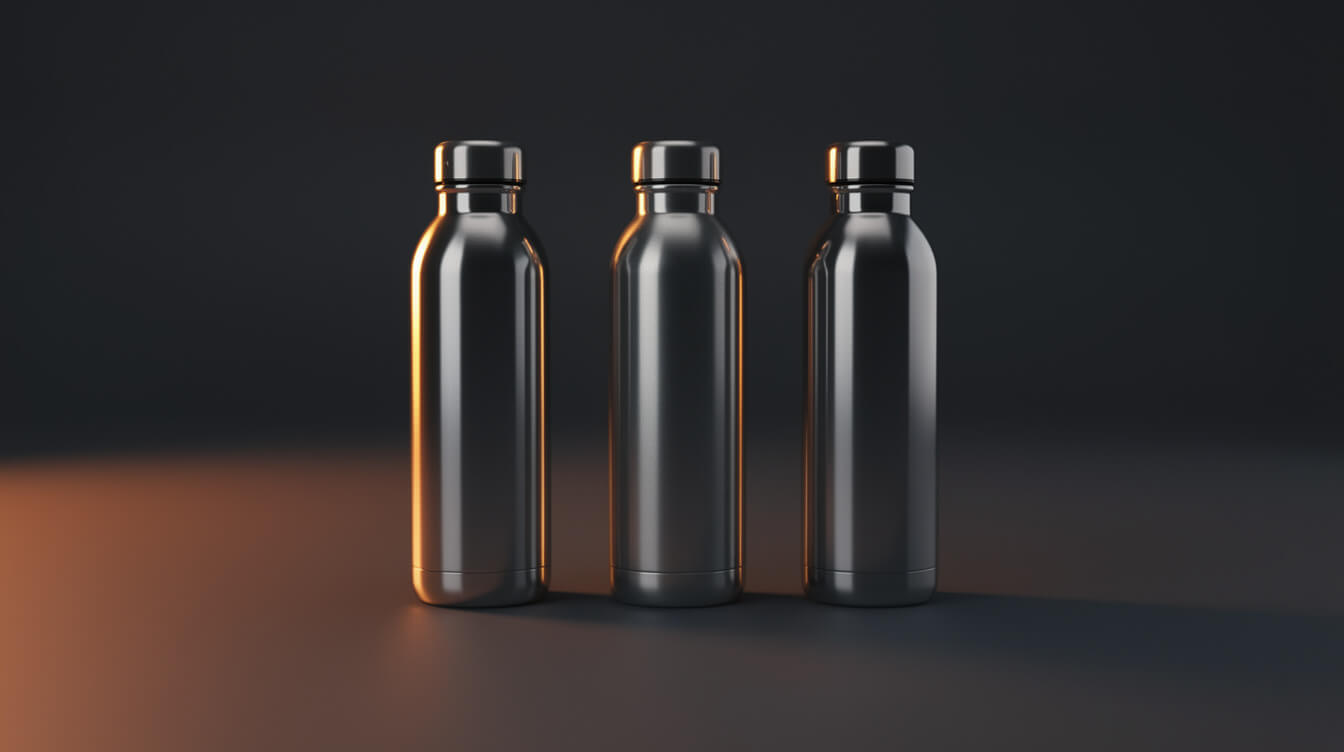
Not every print-on-demand provider stocks drinkware. Here is the current catalog landscape for the three providers most commonly paired with WooCommerce stores.
Printful carries a drinkware line that includes stainless steel tumblers (20 oz), stainless steel travel mugs (17 oz), and insulated water bottles in the 17-21 oz range. Products are fulfilled by sublimation printing. Printful ships from the US, Europe, and Mexico. Integration with WooCommerce is direct via the Printful plugin, and the API supports automatic order routing. Product pages on Printful include mockup generation, so your listing images require no separate design software.
Printify offers drinkware through its print provider network. Because Printify is a network aggregator rather than a single fulfillment house, the specific water bottle SKUs available depend on which provider you select. Providers like Monster Digital and SPOD carry insulated bottles. One advantage of the Printify network model: if your primary provider runs out of stock, Printify can reroute. One disadvantage: print quality and color consistency can vary slightly between providers, which matters more for drinkware than it does for t-shirts (sublimation ink on steel is unforgiving of color calibration differences).
Gooten is the third option worth considering for higher-volume stores. Gooten carries custom sublimation bottles and connects to WooCommerce via API. Their catalog tends to run narrower than Printful in terms of SKU variety, but their production times are competitive for US fulfillment.
For most WooCommerce stores starting their drinkware catalog, Printful is the lowest-friction entry point. The plugin handles everything from mockup to order routing. Once you reach consistent monthly volume (30+ units/month in drinkware alone), it is worth comparing Printify provider pricing head-to-head.
The print method: how sublimation works on drinkware
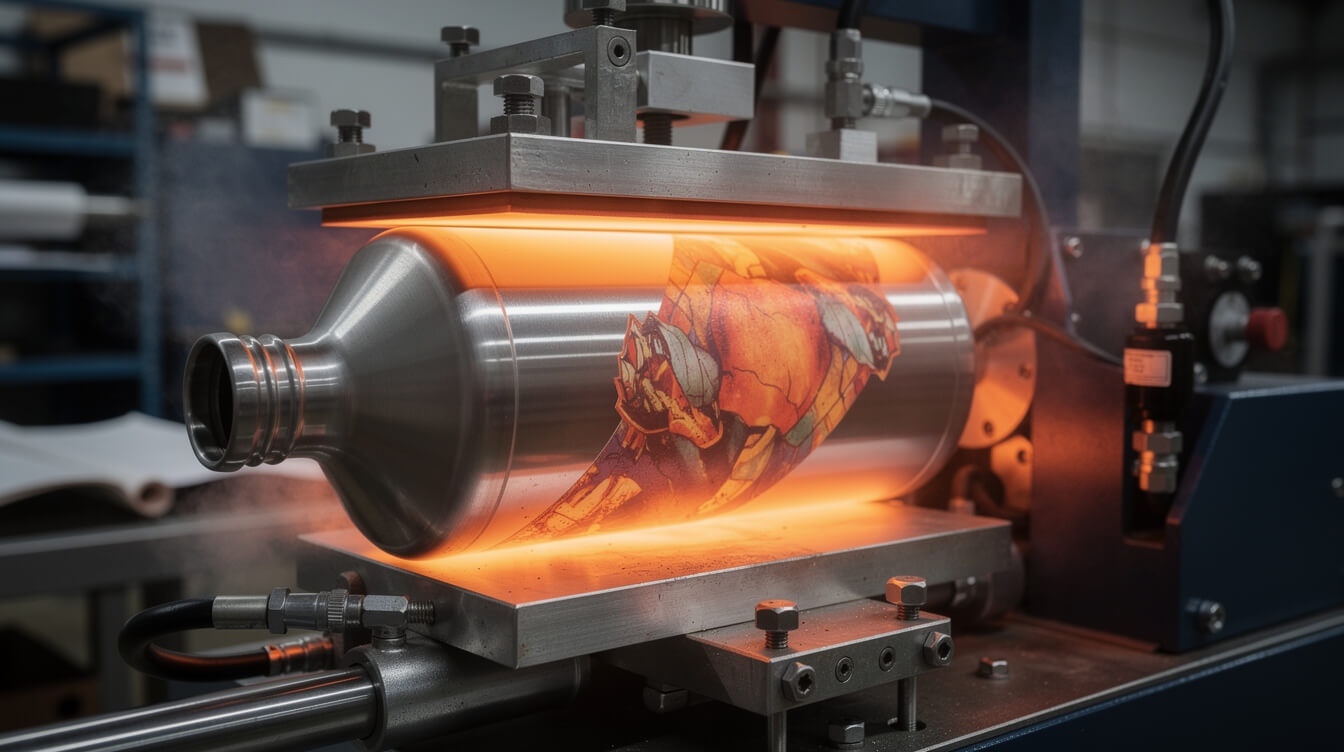
Custom water bottles are printed via sublimation, not direct-to-garment. This is a fundamentally different process, and it affects everything from design requirements to color output.
Sublimation works by converting solid dye into gas using heat and pressure. The gas penetrates the surface of the substrate and solidifies inside it. The result is a print that is embedded in the material rather than sitting on top of it. For drinkware, that means no peeling, no cracking, and no texture difference between printed and unprinted areas. The design becomes part of the surface.
The catch: sublimation only bonds with polyester and polymer-coated surfaces. A stainless steel water bottle is coated with a sublimation-receptive polymer layer on the exterior. That coating is what makes the process work. It also means the print is permanent and dishwasher-safe on the exterior (most insulated bottles are hand-wash-only for the interior regardless of print method).
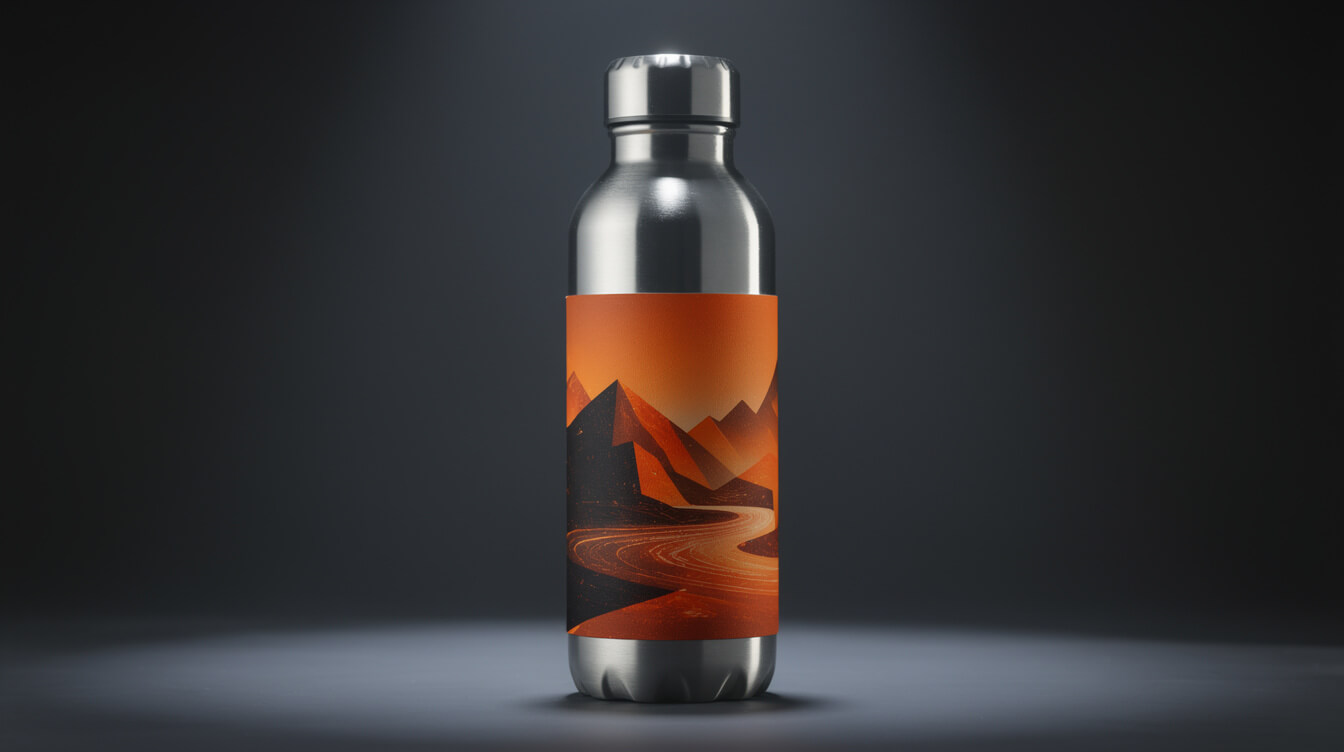
Full-wrap vs panel printing: Some providers offer full-wrap sublimation, where your design covers the entire cylindrical exterior. Others offer panel printing, where the design is applied to a flat front panel that is then formed around the bottle. Full-wrap looks more premium and sells better in photography because the design carries around the whole product. Panel-printed bottles are cheaper to produce but show seams. For a WooCommerce store competing on design quality, full-wrap is the better choice even at a slightly higher base cost.
Design requirements: Sublimation requires designs saved as high-resolution files (300 DPI minimum) in CMYK color mode. RGB designs will shift in color after printing. The wraparound template for a standard 20 oz bottle is roughly 2.5 inches x 9.3 inches when laid flat. If you are generating designs with AI tools, make sure you convert to CMYK and verify the file meets the provider’s resolution spec before submitting. Unlike DTG printing, there is no white ink layer, so transparent areas in your design will show the base color of the bottle.
For a deeper look at how sublimation compares to other print methods across drinkware categories, the custom mug printing guide covers the unit economics in detail alongside ceramic substrates.
Unit cost breakdown: what a custom water bottle costs at 1, 10, and 50 orders

Smash print-on-demand. Join the engine room.
One short email a week. Real numbers, real teardowns, the unfiltered economics behind every move.
The economics of POD drinkware depend heavily on which provider you use and at what order frequency. Here is a realistic cost breakdown using Printful as the benchmark, with Printify network pricing as context.
Single unit (1 order):
- Printful 20 oz insulated bottle: approximately $14-16 base cost, depending on the SKU
- Printify network (Monster Digital, comparable spec): approximately $12-15 base cost
- Shipping to US customer: $4-6 for standard ground via Printful
- Total fulfillment cost per unit: $18-22
Ten units (10 separate orders):
At 10 orders per month, your per-unit cost does not change in a POD model (there is no volume discount at this level with Printful). However, your effective margin improves because you are generating enough revenue to offset Shopify platform fees or WooCommerce hosting costs more easily. At 10 units per month, a $30 retail price generates $300/month in revenue and roughly $80-120 in gross profit after fulfillment costs.
Fifty units per month:
At 50 units per month, the POD model still does not offer volume pricing through Printful. This is where the Shopify 1% override fee starts to hurt. At $30 AOV and 50 units, that is $1,500/month in revenue. Shopify’s 1% transaction fee on top of Shopify Payments processing (if you are on a lower plan) adds $15-50/month in pure platform tax. WooCommerce charges no transaction fee regardless of volume.
Comparison with bulk ordering:
DiscountMugs lists custom water bottles from $0.81/unit in bulk quantities of 100+, but that price requires a $99 setup fee, a 100-unit minimum, and pre-production payment. You are holding inventory, betting on a design, and managing storage. For a POD store that wants to test whether drinkware resonates with its audience before committing capital, the POD unit economics at $14-16 base cost are worth the premium. Once a specific design is proven (you have sold 30+ units of that exact SKU), you can evaluate whether a bulk run makes economic sense alongside your POD catalog.
Setting a retail price: the $28-35 AOV and Shopify fee math
Pricing custom water bottles for a POD store requires accounting for your fulfillment cost, your platform fees, and what the market will bear. Here is how the math works.
Fulfillment cost: $14-16 base (Printful) + $4-6 shipping = $18-22 all-in per order
Target retail price: $28-35 is the sweet spot. At $28, your gross margin is roughly $6-10 per unit (27-36%). At $35, it is $13-17 per unit (37-49%). The higher price requires stronger product photography and brand positioning, but it is achievable for fitness-branded or niche-design drinkware.
Shopify platform math: Shopify’s transaction fee structure matters here. If you are on Shopify Basic and using a third-party payment processor (not Shopify Payments), you pay a 2% transaction fee per order. At $30 retail, that is $0.60 per order. At $35, that is $0.70. It sounds small until you run the monthly math. At 50 orders per month, that is $30-35/month in pure transaction fees, on top of your $29/month Basic plan. The Shopify Plus plan eliminates third-party transaction fees but costs $2,300/month, which is only justified at significant volume.
The more meaningful Shopify cost for growing stores is the 1% override fee that applies when your store is on Shopify Basic or Standard and you want to use a third-party payment processor. For a $1,000/month drinkware revenue stream, that is $10/month that WooCommerce does not charge at any volume.
Pricing at $32-34 tends to be the conversion-optimized sweet spot for custom drinkware in the fitness and outdoor niches. It reads as premium without hitting the psychological resistance point of $35+, while still delivering margins that justify the product.
WooCommerce vs Shopify fee comparison for a $1,000/month drinkware product
Let us run the specific numbers for a drinkware product line doing $1,000/month in revenue. This is a realistic target for a store that has been running drinkware for six to twelve months with one or two proven designs.
Shopify Basic ($29/month plan):
- Monthly plan: $29
- Payment processing (Shopify Payments, 2.9% + 30c per transaction at roughly 33 orders): approximately $32
- Transaction fee if using external processor (2%): $20
- Total platform cost: $61-81/month
- Annual platform cost: $732-972
WooCommerce (self-hosted):
- Hosting: $15-25/month (managed WordPress, sufficient for a POD store doing $1k/month)
- WooCommerce plugin: free
- Payment processing (Stripe at 2.9% + 30c, same as Shopify Payments): approximately $32
- Transaction fee: $0 (WooCommerce charges no platform transaction fee)
- Total platform cost: $47-57/month
- Annual platform cost: $564-684
Annual difference: $150-300 at $1,000/month revenue.
That gap widens at higher volumes. At $5,000/month in drinkware revenue, Shopify’s transaction fees alone (if you are on a basic plan with an external processor) run $100/month. WooCommerce: $0. Over a year, that is $1,200 in pure savings from a platform fee you never had to pay.
There is one honest caveat: WooCommerce requires you to manage hosting, plugin updates, and security. Shopify handles that infrastructure for you. The question is whether the $150-300/year savings (at $1k/month revenue) justifies the self-managed overhead. For stores already on WooCommerce for apparel, adding drinkware costs nothing extra in platform fees. For the full breakdown at $5k, $10k, and $20k/month, the WooCommerce vs Shopify comparison for POD sellers runs those numbers in detail.
MEGA automates the drinkware product listing pipeline for WooCommerce stores, from generating the design to sizing it for the provider’s template to creating the live Printful-synced WooCommerce product. Try MEGA if you want to launch a drinkware product line without the manual setup overhead.
When custom water bottles work: niche verticals and product fit
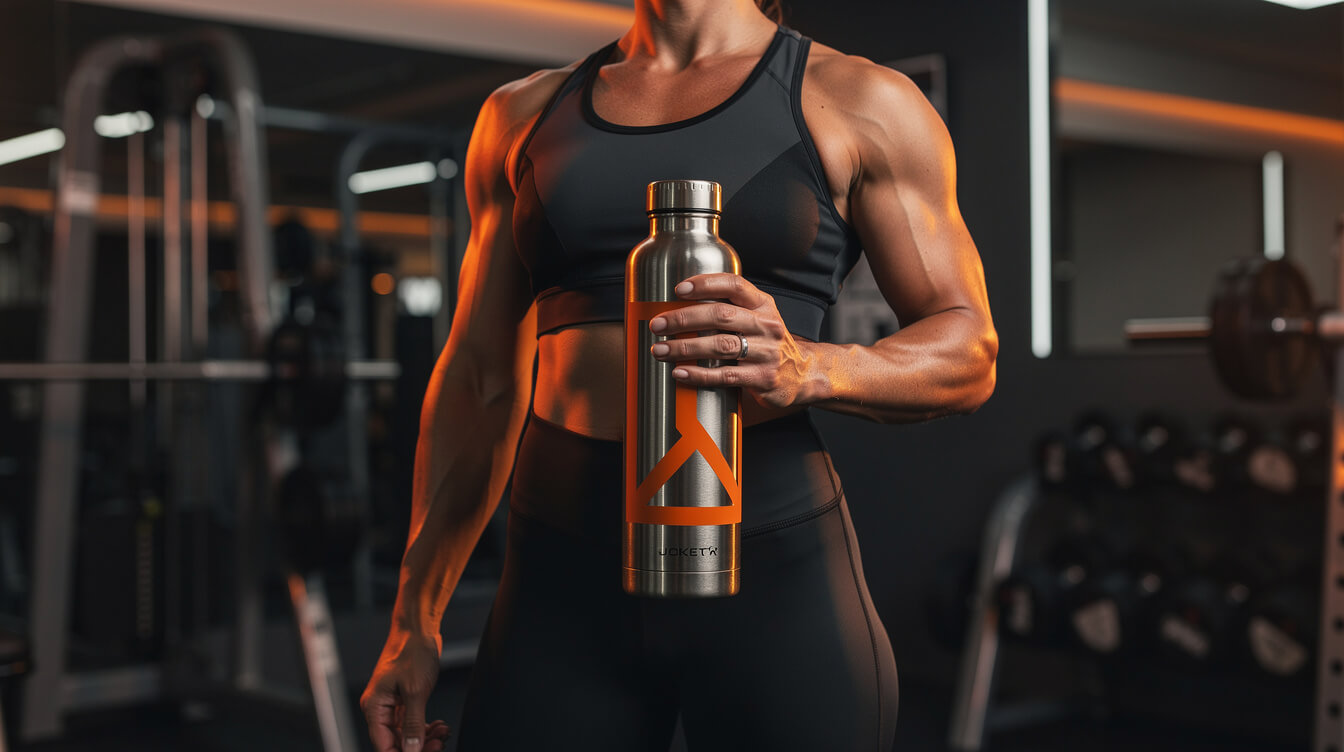
Custom water bottles are not universally suited to every POD store. They work well in specific niche verticals where the product fits the audience lifestyle. Here are five that convert well.
Fitness and gym: The strongest performing niche for drinkware. Gym-goers already carry water bottles. A design that matches their identity (powerlifting culture, specific sport, body-positive fitness, CrossFit community) has purchase intent built in. Fitness POD stores doing well on Instagram and TikTok can drive bottle sales by showing designs in context during workouts.
Hiking and outdoor: Similar purchase intent to fitness, with slightly different aesthetic preferences. Outdoor audiences want earthy tones, topographic designs, and wildlife motifs. Full-wrap sublimation lets you do a landscape-wrap design (mountain range across the full bottle) that looks genuinely premium.
Pet portraits: One of the most consistent converters in custom product categories. Pet owners commission custom designs of their animals. A water bottle with a pet portrait wrapped around it is a gift purchase (for themselves or for a friend who loves their dog). This niche works well on Facebook and Pinterest where buyers tend to spend more per purchase.
Wedding favors: The wedding market is seasonal but high-intent. Couples buying custom water bottles for a wedding favor order in volume (50-100 units for a wedding party). This means you are competing with bulk promo vendors, but you have an advantage: no-minimum, fast-turnaround fulfillment. If you can position your store as the custom wedding favor option with no minimum order and 7-10 day fulfillment, you capture buyers who missed the bulk-order window. The custom tote bags bulk vs POD breakdown covers the same no-minimum positioning logic applied to bags.
Corporate gifting: Companies buy branded merchandise for employees and clients. Custom water bottles are a popular corporate gift because they are useful, visible, and perceived as premium. The challenge for a POD store is competing with bulk-order vendors on price at high quantities. The advantage is no MOQ, no setup fee, and the ability to do personalized runs (per-employee name) that bulk vendors make complicated.
Automate your drinkware product line with MEGA
MEGA generates custom water bottle listings end-to-end: design, sizing, Printful sync, and live WooCommerce product. Pick a niche, run the pipeline, go live.
Frequently asked questions about custom water bottles for POD stores
Can I sell custom water bottles with no minimum order quantity?
Yes. Printful and Printify fulfill single units. There is no minimum order quantity on either platform. You list the product, a customer places an order, and the provider prints and ships it. You never touch inventory.
What file format does sublimation drinkware printing require?
Most providers accept PNG files with transparent backgrounds. Resolution should be 300 DPI minimum. Designs should be created in CMYK color mode (not RGB) to prevent color shift during printing. Provider template dimensions vary by bottle size; always download the provider’s specific template before finalizing your design.
Is sublimation printing on water bottles dishwasher-safe?
The sublimation print on the exterior of most polymer-coated stainless steel bottles is dishwasher-safe. However, insulated bottles (double-wall vacuum-insulated) are generally recommended for hand wash only to protect the insulation and the seal. This applies regardless of print method. Always check the care instructions from your specific provider’s product page and pass them along in your product listing.
How long does fulfillment take for custom water bottles?
Printful’s production time for drinkware is typically 2-5 business days, plus shipping. For US customers via ground shipping, total delivery runs 7-12 business days. Expedited options are available but add cost. If you are selling in a gift or wedding context where timing is critical, communicate this clearly in your product listing and offer express shipping as an option.
Can I put a photo on a custom water bottle?
Yes. Sublimation prints photographic images with accurate color reproduction. For pet portrait and custom photo products, sublimation is actually superior to direct-to-garment because the print is embedded in the surface rather than sitting on top of fabric. File quality matters: low-resolution photos will print blurry. Require customers to upload high-resolution images (at least 1200 x 1200 pixels for a photo-based design).
The bottom line on custom water bottles for your POD store
Custom water bottles fill a real gap in a POD product catalog. They sit at the $28-35 retail sweet spot, appeal to multiple high-intent niches (fitness, pets, outdoor, wedding, corporate), and are fulfilled at no minimum through Printful and Printify. The print method (sublimation) requires understanding full-wrap design templates and CMYK color requirements, but those are one-time learning costs.
The platform decision matters more at scale. WooCommerce saves $150-300/year at $1,000/month in drinkware revenue compared to Shopify Basic, and the savings compound as volume grows. For stores already running WooCommerce, adding a drinkware line is a zero-overhead expansion. For stores on Shopify watching the 1% fee stack up month after month, the WooCommerce migration math is worth running.
MEGA handles the product creation pipeline: design generation, template sizing, and WooCommerce listing. Pick the niche. The engine builds the product.
Implement AI. 30x your throughput. Get a 30-min call with the founder.
Drop your details and book a free 30-minute discovery call. Personalized advice on your POD stack, your margin, and where AI fits. No pitch, no fluff.