Custom promotional merchandise in 2026: POD automation vs. bulk ordering (the cost breakdown)
Every year, thousands of business operators make the same mistake with custom promotional merchandise: they treat it as a vendor question when it is actually a model question. They compare Vistaprint to 4imprint and miss the bigger shift happening underneath both of them.
POD automation changes the economics of custom merchandise entirely. WooCommerce connected to Printful gives you branded products with no minimum order quantity, no inventory to store, and automated fulfillment per customer. You do not commit capital until someone places an order.
This post covers the real cost of custom promotional merchandise in 2026: what bulk ordering actually charges, how the POD model compares, and where the two models cross at 50, 200, and 500 units. By the end you will know exactly which model fits your situation, and how to set up the POD version in under a day.
What custom promotional merchandise actually costs
The sticker price on any merchandise vendor site is not the real number. Here is the full cost stack most buyers do not account for until they have already placed an order.
Minimum order quantities
Most bulk promo vendors have hard minimums. Printed T-shirts typically require 12 to 24 units minimum. Embroidered caps start at 12. Custom mugs rarely ship in quantities under 24. Branded tote bags often start at 50.
That minimum is a forced inventory bet. If you order 50 mugs for a product launch and sell 30, you are storing 20 mugs indefinitely. That is not a problem until you multiply it across your full product range.
Setup fees
Most vendors charge a one-time setup fee per design, per colorway, per garment type. Standard rates run $20 to $80 per screen setup for screen printing. Embroidery digitization adds another $25 to $100 per design. If you want three colorways of the same logo on two different garment types, that is six setup fees before you print a single unit.
Per-unit pricing at volume
The per-unit cost drops significantly with volume. A single-color screen-printed T-shirt might cost $18 per unit at 12 pieces, $12 at 50 pieces, and $7.50 at 500 pieces. That per-unit cost curve is where bulk ordering makes its entire argument.
Shipping and handling
Bulk merch ships heavy. A 50-piece T-shirt order weighs 10 to 15 kg. Standard shipping from most US suppliers adds $25 to $60, and expedited shipping doubles it. International shipping to Taiwan, Australia, or the UK adds $80 to $150 for similar weights.
Storage and carrying costs
Most operators do not assign a dollar value to storage, but rented storage runs $50 to $150 per month per shelf unit in major cities. Even home storage has opportunity cost. Merchandise that sits for six months is capital you could have deployed elsewhere.
Reorder and disposal
Popular designs sell out. Slow designs sit. Both create problems. Fast sellers mean another setup fee cycle. Slow sellers mean markdowns or disposal costs. Neither shows up on the vendor’s quote page.
When you add it up, a 50-unit T-shirt run at a legitimate $12 per unit includes $0 setup (assume one free digitization included), $45 shipping, and $30/month storage for three months. Your real cost per unit is closer to $14.90, not $12. That changes the margin math.
The bulk ordering model: when it works and when it bleeds margin

Bulk is not a bad model. It is the right model for specific situations and the wrong model for most situations POD sellers and business operators find themselves in.
When bulk actually works
Large conferences and events with known attendance. If you are sponsoring a 400-person conference and you know the audience, 400 identical branded T-shirts make sense at bulk pricing. You know the quantity. You know the timeline. You have a single distribution moment.
Staff uniforms in single-size and single-design runs. A company that hires 20 people per quarter and outfits them all in the same navy polo can batch-order quarterly and realize genuine per-unit savings. The design does not change. The size distribution is predictable.
Long-running, single-variant promotional items. A branded pen or keychain that you include in every shipment for two years at volume 10,000 per run makes economic sense in bulk. The demand is continuous, the product does not go stale, and the unit economics at volume are genuinely better than per-unit fulfillment.
When bulk bleeds margin
Testing new designs. The only way to know if a design resonates is to offer it. Bulk forces you to bet before you test. POD lets you publish a design in 24 hours and find out before you commit inventory capital.
Multi-variant products. Merchandise that comes in five colors and six sizes creates an inventory matrix of 30 SKUs. Ordering 12 minimums across all 30 variants means 360 units before you sell one. Most of those variants will be wrong. Bulk punishes you for product variety.
Response to customer demand. If a customer mentions they want a specific color or a different product type, the POD model can add it in hours. The bulk model requires a new minimum order cycle with a new setup fee.
Seasonal and trend-driven products. A design tied to a current event or cultural moment has a short window. Bulk orders take 10 to 21 days to produce and ship. By the time the product arrives, the moment may have passed. POD produces in 2 to 7 days per order.
The POD model for custom promotional merchandise: no minimums, automated fulfillment

The POD model does not optimize for the lowest per-unit cost. It optimizes for the lowest risk per product launch, which is a different objective and usually the right one for operators testing the market.
How per-unit fulfillment works
With WooCommerce and Printful, you build a product listing and set it live. No inventory is produced. When a customer places an order, Printful receives it automatically, produces the item, and ships it directly to the customer. You never touch the merchandise.
Your cost is per-unit only, triggered by each sale. Printful’s base cost for a Gildan 64000 T-shirt with a front-center print is approximately $12.00 to $13.00 depending on size and color. You set your retail price. The margin is the difference.
No minimum order quantity
You can publish a product and sell one unit. You can test six designs simultaneously and discontinue the three that do not convert, at zero sunk cost. The inventory risk is zero because there is no inventory.
WooCommerce as the owned storefront
Running WooCommerce instead of Shopify means no platform override fee. Shopify charges a 1% additional fee on top of Stripe’s processing fee if you use any payment processor other than Shopify Payments. On a $10,000 monthly merchandise revenue, that is $100 per month in platform fees alone, before apps. We covered the full cost of Shopify’s transaction fees for POD sellers in an earlier breakdown.
WooCommerce charges nothing for transaction volume. You pay for hosting (typically $20 to $50 per month for a VPS) and the WooCommerce core plugin is free. The Printful integration plugin is free. The savings compound significantly at scale.
We compare both platforms in detail for POD operators in our WooCommerce vs. Shopify for POD sellers breakdown.
Break-even math: bulk vs. POD at 50, 200, and 500 units

Smash print-on-demand. Join the engine room.
One short email a week. Real numbers, real teardowns, the unfiltered economics behind every move.

The break-even analysis is where most articles stop at vague claims. Here are actual numbers using a standard branded T-shirt as the product (one color, one design, Gildan or equivalent).
Scenario: 50 units
| Cost component | Bulk ordering | POD (Printful) |
|---|---|---|
| Base unit cost | $12.00 | $13.00 |
| Setup fee (amortized) | $1.20 | $0 |
| Shipping per unit | $0.90 | Included |
| Storage (3 months) | $1.80 | $0 |
| Unsold units (10% estimate) | $1.33 | $0 |
| Real cost per sold unit | $17.23 | $13.00 |
At 50 units, POD wins on total real cost per sold unit by $4.23. The bulk quote looks cheaper, but the full stack does not.
Scenario: 200 units
| Cost component | Bulk ordering | POD (Printful) |
|---|---|---|
| Base unit cost | $9.00 | $13.00 |
| Setup fee (amortized) | $0.30 | $0 |
| Shipping per unit | $0.70 | Included |
| Storage (3 months) | $1.50 | $0 |
| Unsold units (8% estimate) | $0.85 | $0 |
| Real cost per sold unit | $12.35 | $13.00 |
At 200 units with confirmed demand, bulk edges ahead by $0.65 per unit. This is where you see the crossover point. If you have reliable demand, bulk becomes viable at 200 units. But note the phrase “confirmed demand.” Most operators are not there when they start.
Scenario: 500 units
| Cost component | Bulk ordering | POD (Printful) |
|---|---|---|
| Base unit cost | $7.50 | $13.00 |
| Setup fee (amortized) | $0.12 | $0 |
| Shipping per unit | $0.60 | Included |
| Storage (3 months) | $1.20 | $0 |
| Unsold units (5% estimate) | $0.47 | $0 |
| Real cost per sold unit | $9.89 | $13.00 |
At 500 units with reliable demand, bulk wins clearly. The $3.11 per unit difference at scale matters. But selling 475 of 500 units requires confidence in your demand forecast. Get the demand confirmed via POD first, then consider a bulk run to improve your margin on proven winners.
The strategic sequence: launch via POD, validate demand, switch proven designs to bulk at 500+ unit runs. Use POD for new launches, variants, and tests. Keep both models active.
Setting up WooCommerce + Printful for custom business merchandise

Setting up the WooCommerce and Printful pipeline takes less than a day. Here is the practical sequence.
Step 1: Install WooCommerce
WooCommerce installs from the WordPress plugin directory. After activation, the setup wizard walks through currency, shipping zones, and payment processors. Stripe and PayPal both integrate via free plugins. For most POD operators, the entire WooCommerce setup takes two to three hours including payment testing.
Step 2: Connect the Printful plugin
Printful provides a dedicated WooCommerce plugin. Install it from the plugin directory, then authenticate with your Printful account. Printful’s app will show your WooCommerce store as a connected storefront within minutes of authentication.
Step 3: Design your product in Printful
Inside Printful’s product creator, select your product type, upload your design file (minimum 150 DPI for print, 300 DPI recommended), and position it on the mockup canvas. Printful generates a mockup automatically. You can add multiple print locations (front, back, sleeves) and configure all available sizes and colors.
Step 4: Sync to WooCommerce
In Printful, push the product to your WooCommerce store. This creates a product draft in WooCommerce with variants pre-populated from Printful’s available sizes and colors. Review the product page, set your retail price (Printful’s base cost shows on each variant), write your product description, and publish.
Step 5: Configure shipping
Printful handles fulfillment, so you configure shipping rates in WooCommerce that cover Printful’s shipping costs plus your margin. Printful’s shipping rates are available in their API and dashboard. Most operators set a flat shipping rate of $4 to $7 for domestic T-shirts and $10 to $18 for international, which covers Printful’s actual charges with a small buffer.
We covered the full Printful integration in our Printful review for WooCommerce sellers, including the gotchas around design file requirements and the products where Printful’s margins are tightest.
Run your full POD pipeline in under 7 minutes
MEGA handles research, design generation, sizing, mockups, and live WooCommerce listings end-to-end. No Canva workflow, no manual file prep, no Shopify fees eating your margin.
Which promotional products work best through POD (and which still need bulk)

Not all merchandise categories are equal on POD. Here is a practical breakdown.
Strong POD fits
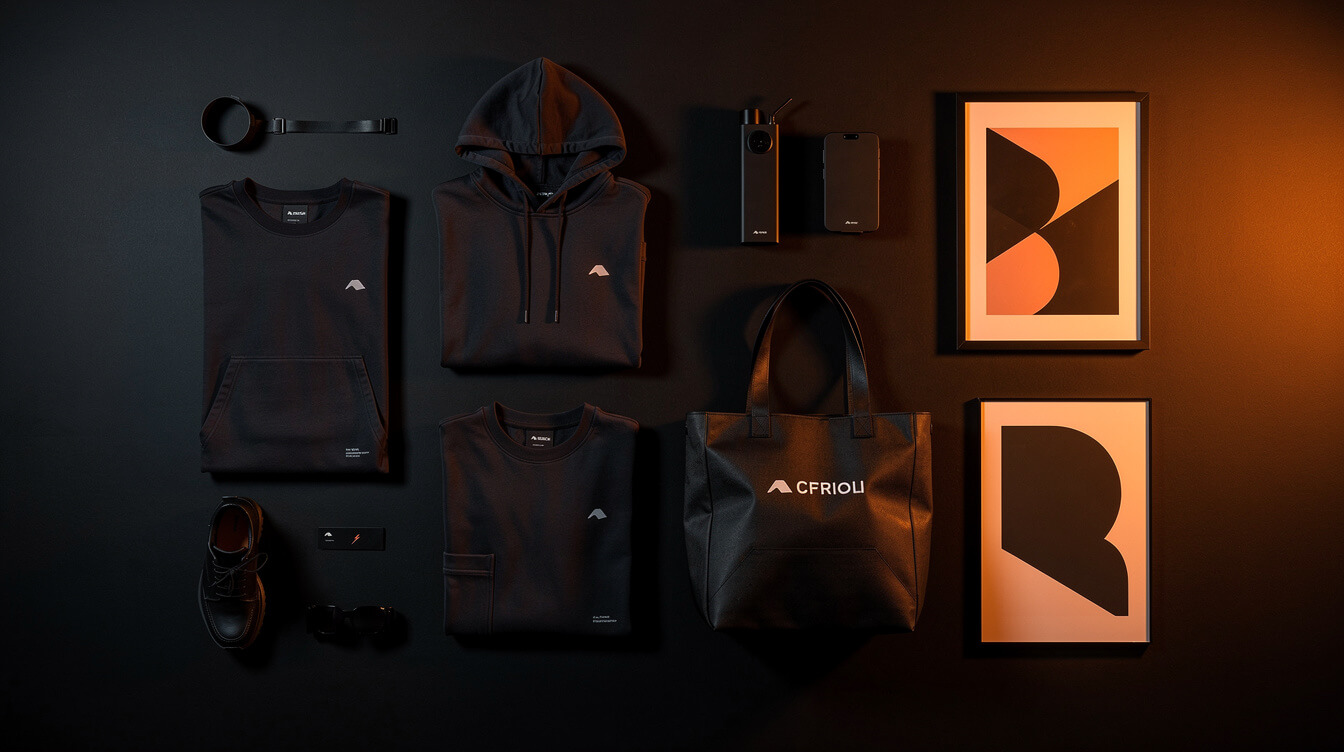
T-shirts and hoodies. Printful’s core product, strongest margin-to-base-cost ratio, broadest size availability. A well-designed T-shirt at a $25 retail price costs $12.00 to $13.00 in base fulfillment. That is a $12 to $13 gross margin per unit without touching inventory. Hoodies follow the same pattern at higher retail prices.
Mugs. Base cost around $7.95 for an 11 oz white mug, including packaging. A $22 retail price delivers a $14 margin. Mugs are the highest-percentage margin product in most Printful catalogs and are one of the easiest promotional items to design.
Tote bags. Base cost $8 to $12 depending on material and print area. Tote bags have broad appeal across audiences and strong gifting use cases. They ship flat and light, which keeps Printful’s fulfillment costs lower than bulkier items.
Art prints and posters. Printful’s poster and art print line ships in tubes. No minimum, per-order fulfillment, and competitive base costs for premium paper options. For companies with visual brand assets, posters and prints are a natural extension. We covered the unit economics of Printful art prints in a dedicated breakdown.
Phone cases and tech accessories. Low base cost, high perceived value. Phone cases retail at $25 to $40. Printful handles the variant complexity (every phone model is a separate SKU). POD makes phone case catalogs practical in a way that bulk never could, because no sane operator orders 12 of each phone model in inventory.
Products that still need bulk
Pens, keychains, and small promo items. These are not in Printful’s catalog, and with good reason. The economics of on-demand pen fulfillment do not work. A bulk pen at $0.35 per unit at 500 quantity cannot be matched by per-order fulfillment of any kind. For commodity swag at conference volumes, bulk vendors remain the right choice.
Custom packaging. Branded boxes, tissue paper, and custom mailers are still largely a bulk category. There are emerging POD packaging providers, but unit costs remain 3x to 5x higher than bulk at volume. If custom packaging is core to your brand experience, budget for bulk runs.
Embroidered hats at conference volume. Embroidery is the weakest link in Printful’s cost structure. Base cost for an embroidered cap runs $16.95 to $22.95. At retail you need to price at $35 to $40 to preserve margin. If you are ordering 500 hats for a trade show, a traditional embroidery vendor at $8 to $10 per unit will undercut Printful significantly.
The MEGA pipeline: from custom merchandise idea to live listing in under 7 minutes

The bottleneck for most operators setting up custom promotional merchandise via POD is the design and listing production step. Creating a well-designed product in Printful, writing the product description, sizing the mockup correctly, and setting up the WooCommerce listing takes 30 to 60 minutes per product when done manually.
MEGA runs that full pipeline in under seven minutes. The workflow:
- Niche and keyword research. MEGA pulls research from its keyword engine to identify what your audience is searching for. For promotional merchandise, this means finding the specific product types, design themes, and use cases with proven search demand.
- AI design generation. MEGA generates the product design via Flux AI, applying brand color guidance and composition rules. The design goes through a Tinify compression pipeline before any upload, so file quality and size are optimized automatically.
- Automatic sizing and mockup generation. Printful’s API returns mockup images for every variant. MEGA handles the sizing calculations and positions your design correctly on the print area without manual canvas adjustment.
- Product listing creation. Title, description, meta description, tags, and category assignments are generated and applied. The listing goes live on WooCommerce immediately.
- Printful sync. The WooCommerce product syncs to Printful automatically. Order fulfillment is active the moment the listing publishes.
The seven-minute runtime is not a marketing claim. It is the measured output of the pipeline running end-to-end, as documented in the MEGA stack itself. This blog post was produced using the same system. MEGA automates this entire pipeline for POD operators who want research-to-live-listing throughput without the manual workflow.
The practical impact: instead of spending a Saturday setting up 10 products, you run MEGA for 70 minutes and have 10 live, SEO-optimized, Printful-synced products on your WooCommerce store. Each one researched, designed, sized, and listed. Each one with a unique design, unique product description, and correct variant configuration.
For operators who are still doing this by hand in Canva, that time difference is the gap between a catalog of 12 products and a catalog of 300.
Which model fits your situation
If you are starting out or testing new designs: POD via WooCommerce and Printful. No capital risk, no inventory, immediate market feedback. The per-unit cost is higher, but your risk-adjusted cost is lower because you will not be disposing of 200 units of a design that did not resonate.
If you have a proven design at 200 plus units per quarter with consistent demand: consider a hybrid model. POD for new designs and variants, bulk for your proven winners at scale.
If you are running a large event with 500 plus identical items and no product variants: bulk ordering is the right economic choice. Use a vendor like 4imprint or a local screen printer who can deliver to your schedule.
The operators who struggle most are the ones who default to bulk for everything and then discover their design assumptions were wrong. POD removes that assumption risk entirely.
If you want to see the exact setup flow for WooCommerce and Printful with a live product example, we covered it in detail in our guide to custom merchandise for your business.
Implement AI. 30x your throughput. Get a 30-min call with the founder.
Drop your details and book a free 30-minute discovery call. Personalized advice on your POD stack, your margin, and where AI fits. No pitch, no fluff.