Custom mug printing for POD sellers: sublimation explained, unit economics, and the drinkware margin no one talks about
If you search for custom mug printing right now, you will find Walgreens, Snapfish, Walmart Photo, and DiscountMugs filling the top results. Every one of those pages exists to sell a single photo gift to a grandmother. None of them are talking to you. You are a POD seller deciding whether to add mugs to your WooCommerce or Shopify store, and the internet has almost nothing useful to say about that decision. This post covers the actual custom mug printing mechanics, provider economics, margin math at three retail price points, and how the Shopify 1% override fee eats into drinkware margin more than sellers expect.
Why custom mug printing is dominated by consumer photo sites (and why that is your opportunity)
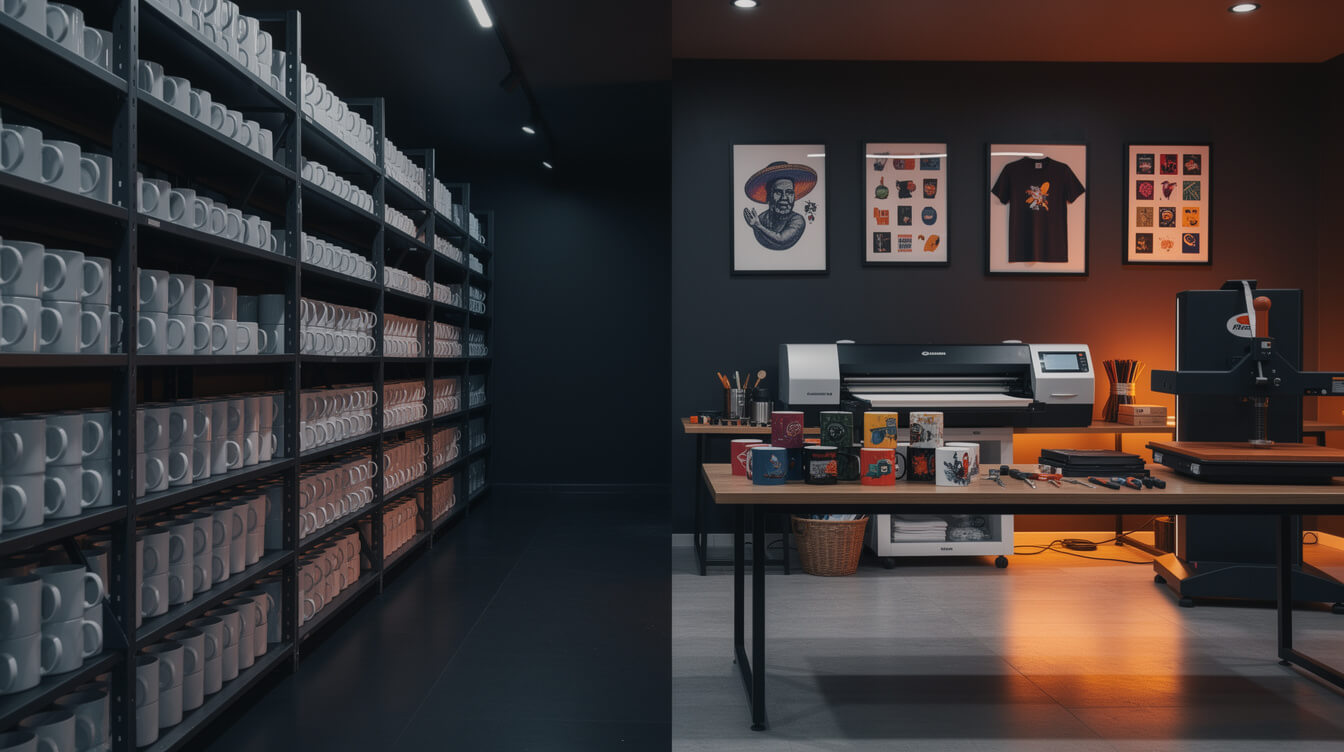
The consumer photo gift market is large. Walmart Photo and Snapfish spend real money on SEO to capture the person who wants a mug with a photo of their dog. That is not your customer. Your customer is someone who found your brand, your niche, your aesthetic, and wants to extend that into their daily ritual of morning coffee.
The SERP gap is real: there is almost no editorial content aimed at POD sellers who want to add mugs as a product line. No one explains which Printful or Printify providers do sublimation well. No one runs the margin math at realistic retail prices. No one shows how the Shopify transaction fee hits harder on a $18 mug sale than on a $45 hoodie sale.
That gap is the opportunity. Mugs carry strong repeat-purchase signals. A buyer who loves a store’s design aesthetic is very likely to buy a mug that matches the tee they already own. The average order value is lower than apparel, but the utility is daily and the emotional touchpoint is every morning. For niche stores with a loyal audience, mugs are a natural add-on rather than a new product vertical.
The key insight: you are not competing with Walgreens photo mugs. You are offering a product that expresses a community identity. That is a different buyer, a different need, and a much higher willingness to pay relative to the cost of goods.
How POD mug printing actually works: sublimation vs screen print vs laser engraving
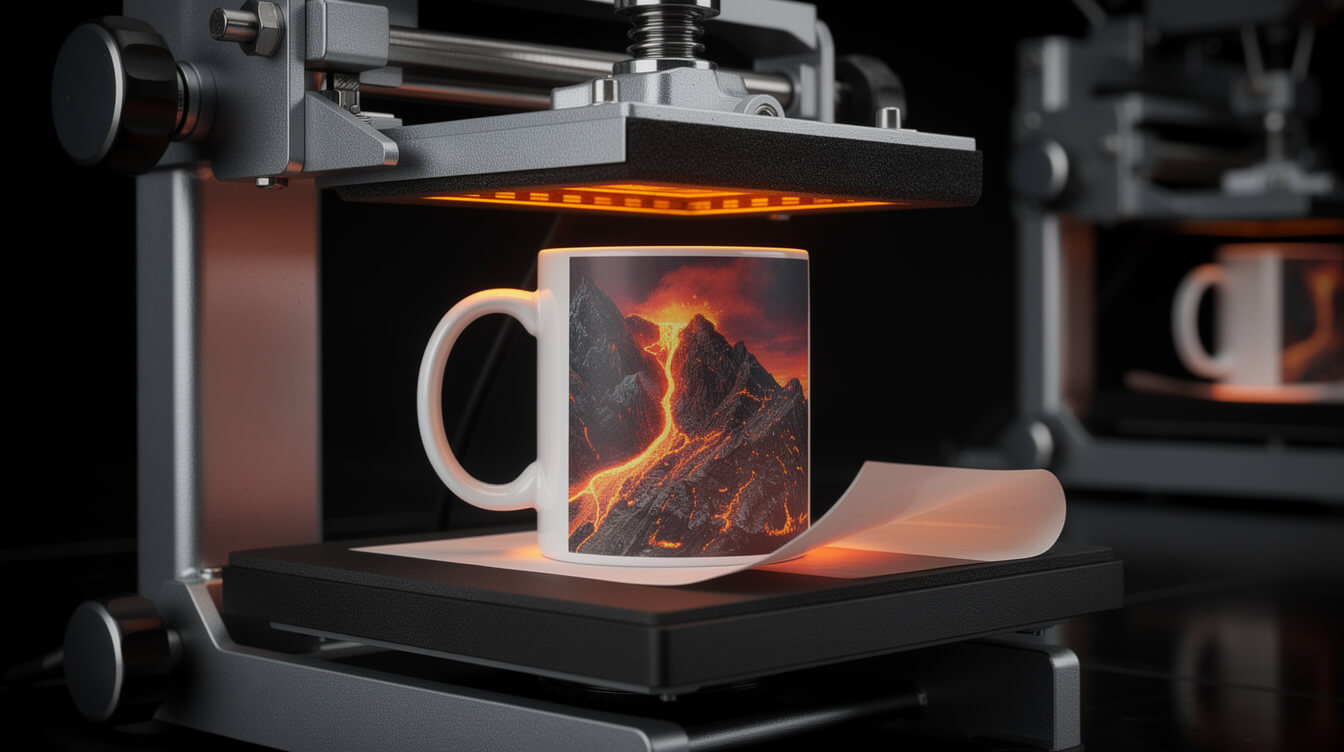
Most POD mugs use dye sublimation. Understanding the method matters because it determines what designs will look good, what substrates work, and why some providers cap coverage at the printable wrap area.
Sublimation works by using heat and pressure to transfer dye from a transfer paper into a polymer-coated substrate. The dye bonds at a molecular level with the polyester coating, which is why sublimation mugs have vivid, scratch-resistant prints that will not peel or crack. The coating is why most sublimation mugs are white or light-colored. The dye cannot lighten the base color, only tint it. A navy mug cannot receive a bright sublimation print. White ceramic is standard.
The printable wrap is typically the full 360 degrees of the mug cylinder, excluding the handle and a narrow seam line. Most POD providers offer a wrap area of roughly 8 inches wide by 3.75 inches tall. This is enough space for a full bleed design or a large graphic with negative space.
Screen printing on mugs exists but is uncommon in POD because it requires setup fees per color, minimum quantities, and cannot produce the continuous-tone imagery that sublimation handles easily. You will not find screen-printed mugs in the major POD catalogs.
Laser engraving removes the surface material to expose the substrate below. It is used on stainless steel tumblers and travel mugs where sublimation is not an option. Engraved designs are monochrome by nature. Some POD providers offer color-filled laser engraving at a premium. Ceramic mugs are rarely laser engraved in the POD channel because the economics favor sublimation for full-color output.
For your store, the practical takeaway is this: design your mug art for a white ceramic substrate and expect full-color sublimation. Design files should be at least 300 DPI and match the provider’s template wrap dimensions. Most providers supply Photoshop or PDF templates in their product catalog.
Which print-on-demand providers offer custom mugs
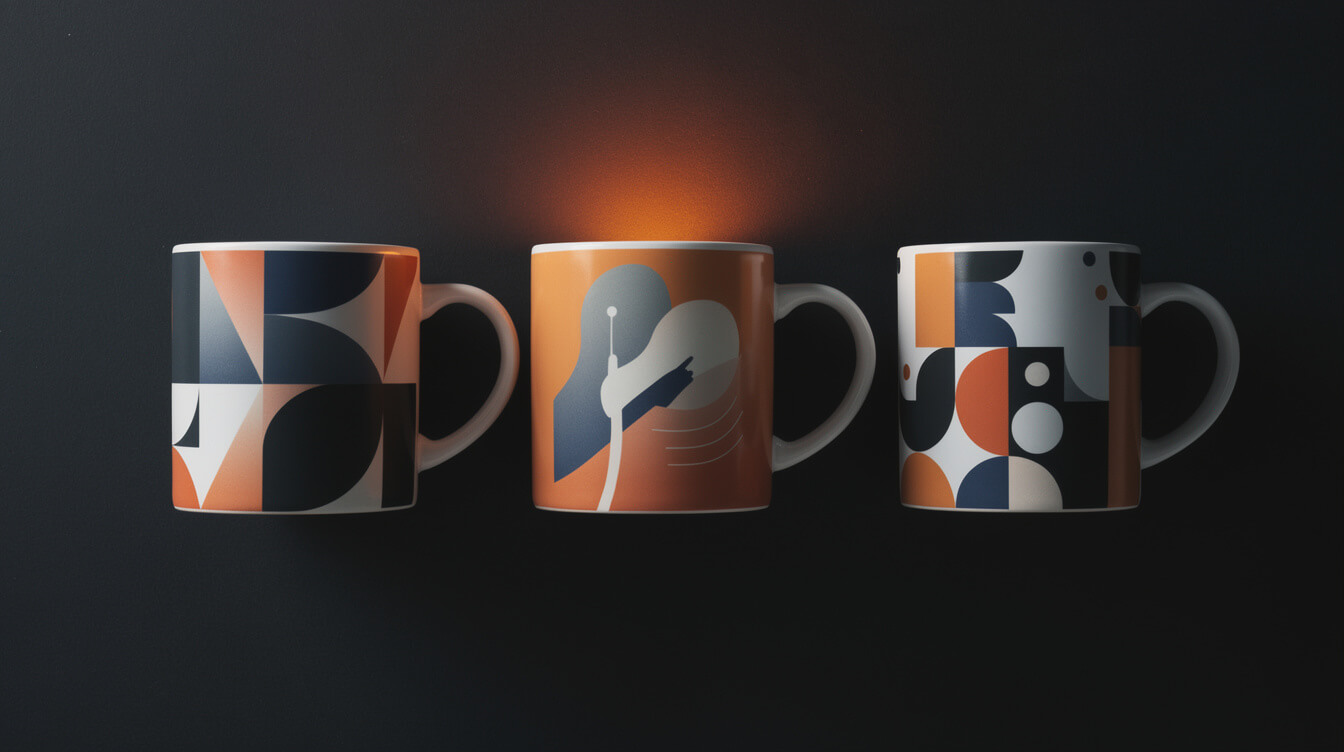
The three major POD providers each offer mugs, but the catalog depth and pricing vary significantly.
Printful
Printful carries the standard 11 oz white ceramic mug as their entry drinkware item. They also offer a 15 oz variant and a black mug option with inverted print area constraints. Printful’s base price for the 11 oz white ceramic mug is $5.95, which is mid-range for the category. Print quality is consistent because Printful produces in-house at their own facilities rather than routing to third-party printers. Their WooCommerce integration is mature and supports automatic product sync, variant management, and order routing without manual intervention. If you already run Printful for apparel, adding mugs is a low-friction catalog extension. See the full Printful products catalog overview for what else they carry in the drinkware category.
Printify
Printify gives you access to a network of print providers, which means mug pricing varies from roughly $3.50 to $6.50 depending on which partner you select. The cheapest options are typically from China-based providers with longer shipping windows. US-based providers on Printify’s network run $4.50 to $6.00 and offer faster domestic shipping. The trade-off with Printify is that print quality varies across the network. Two buyers ordering the same design from two different fulfillment centers may receive slightly different color accuracy. For a niche store where brand consistency matters, this is worth weighing against the cost savings.
Gelato
Gelato routes orders to local print partners worldwide, which gives the shortest shipping times for international buyers. Their standard 11 oz white ceramic mug runs approximately $6.00 base, slightly higher than Printify’s network average. Gelato’s edge is European fulfillment: if your audience skews UK or EU, Gelato can ship locally rather than routing from a US warehouse with 2 to 3 week transit. Their WooCommerce plugin is available though less mature than Printful’s integration in terms of automation depth.
Which provider to choose
For a WooCommerce store with a US-primary audience, Printful’s 11 oz mug at $5.95 is the default choice. The integration is proven, the print is in-house, and the quality floor is reliable. For sellers with a significant international buyer base, Gelato’s local fulfillment reduces shipping time and cost. Printify makes sense if you are highly price-sensitive and willing to vet individual print partners manually.
Unit economics: what a custom mug actually costs your store at $15, $18, and $22 retail

Smash print-on-demand. Join the engine room.
One short email a week. Real numbers, real teardowns, the unfiltered economics behind every move.

Margin math is where mug decisions actually get made. Using Printful’s 11 oz ceramic mug at $5.95 base cost as the reference point, here is how the numbers look at three common retail price points.
At $15 retail (entry-level, impulse purchase range)
Base cost: $5.95. Gross margin before shipping and fees: $9.05, or 60.3%. If you offer free shipping on orders over $30 and the buyer picks up a mug standalone, you absorb roughly $4.50 in shipping. Net margin drops to $4.55 per mug, or 30.3%. At this price point mugs work as a low-friction entry to your store but require volume to matter. If the mug drives a larger cart, the buyer also grabs a tee, the shipping absorption is covered and the mug margin holds.
At $18 retail (sweet spot for branded community stores)
Base cost: $5.95. Gross margin before shipping and fees: $12.05, or 66.9%. Charging $4.99 shipping on mugs brings net margin to $7.06 per unit, or 39.2%. This is the most defensible price point for a branded mug. The buyer expects to pay for a distinctive product and the price signals quality without hitting the cognitive barrier that $20 or more can create for an add-on item.
At $22 retail (premium positioning, gift market)
Base cost: $5.95. Gross margin before shipping and fees: $16.05, or 73%. Charging $5.99 shipping: net margin $10.06, or 45.7%. The $22 price point positions the mug as a considered gift rather than an impulse buy. It works well in niches with strong gift-purchase behavior: pet themes, fan communities, professional identity niches. At this price, buyers are comparing to Etsy handmade alternatives, so your design quality carries more weight than price.
The common thread across all three scenarios: mugs are high-margin goods when the print cost stays under $7 and you manage shipping correctly. The variable that most POD sellers miscalculate is shipping absorption. A standalone mug order with free shipping will hurt margin. Set a free-shipping threshold above the mug price and offer flat-rate shipping on single-item orders.
The Shopify 1% fee at $18 AOV: what it takes out of mug margin and how WooCommerce compares
Platform fees bite harder on low-AOV products. A hoodie at $45 absorbs a $0.45 Shopify override fee without much pain. A mug at $18 absorbs a $0.18 fee on thinner gross margin to begin with. The percentage impact is the same but the absolute margin is smaller, so the fee takes a larger share of what is left.
At 200 mug orders per month at $18 average order value, the Shopify 1% override adds up to $36 per month in pure platform tax. That is $432 per year in fees that go to Shopify regardless of your plan tier. A seller running 500 mug orders per month loses $1,080 annually on the override alone, before counting Shopify’s app fees for the POD integration, email marketing, reviews, upsells, and the base monthly plan cost.
WooCommerce charges no transaction override on order revenue. There is a payment processor fee (Stripe, PayPal, or your preferred gateway), which exists with Shopify too. But the platform-level revenue share that Shopify takes on top of payment processing does not exist on WooCommerce. Every $0.18 that Shopify takes from a mug sale stays in your margin on WooCommerce.
The compound effect matters at drinkware-level AOVs. Because mugs are a volume product where buyers may return quarterly, especially when you rotate seasonal or limited designs, the annual fee impact compounds faster than it does with a one-time apparel purchase. The full breakdown of how Shopify fees calculate across different order volumes for POD stores is in the post on Shopify transaction fees for POD sellers. The fee math on WooCommerce is covered in the WooCommerce pricing guide for POD stores.
The Shopify fee argument is not the only reason to consider WooCommerce for a drinkware line, but it is a concrete, calculable number. Run your projected volume at your target AOV and see what the override costs annually. That number is a direct comparison to the cost of a WooCommerce hosting plan.
When to add mugs to your POD store (and which customer already wants one)

Not every POD store should add mugs. The fit depends on your niche, your buyer behavior, and how your existing catalog is structured. Here is the framework for deciding.
Niches where mugs are a natural add-on
Community identity niches perform best with mugs. Professions with strong in-group culture, nurses, teachers, engineers, firefighters, already buy mugs to signal identity at work. Fan community niches covering specific sports teams, music genres, or TV fandoms have buyers who collect multiple items across a product line. Pet niches have very strong gifting behavior and mugs are a common gift format. If your store already sells tees or hoodies in these niches and you have a repeat buyer base, mugs are an obvious catalog extension.
Niches where mugs are a harder sell
Streetwear and fashion-forward brands typically do not extend well into mugs. The aesthetic of a premium streetwear brand clashes with the domestic utility of a coffee mug. Hyper-niche trend-based stores built on meme designs or viral moment prints may not have the shelf life for a product with longer lead time and lower impulse-buy velocity. Mugs require the buyer to picture using the product daily, which means the design must have staying power.
Bundle angle with other accessories
Mugs pair well with tote bags in a gifting bundle. A branded tote and matching mug at a combined $35 to $45 is a compelling gift set that lifts AOV above either item alone. If you already have a canvas tote in your catalog, consider whether a mug rounds out a coherent accessories collection. The custom canvas tote bag printing guide covers the economics of that product line if you are evaluating the bundle angle.
Timing: when to add in your store lifecycle
Do not add mugs as your first product. Apparel has higher margin and higher perceived value as a brand anchor. Add mugs when you have at least 5 to 10 apparel SKUs live and an established design library. At that point you already have designs that will translate directly to mug wrap format with minimal additional creative work. The incremental effort to add a mug SKU on Printful or Printify to an existing design is under 15 minutes once you have the catalog setup configured.
How MEGA automates mug product listings end to end
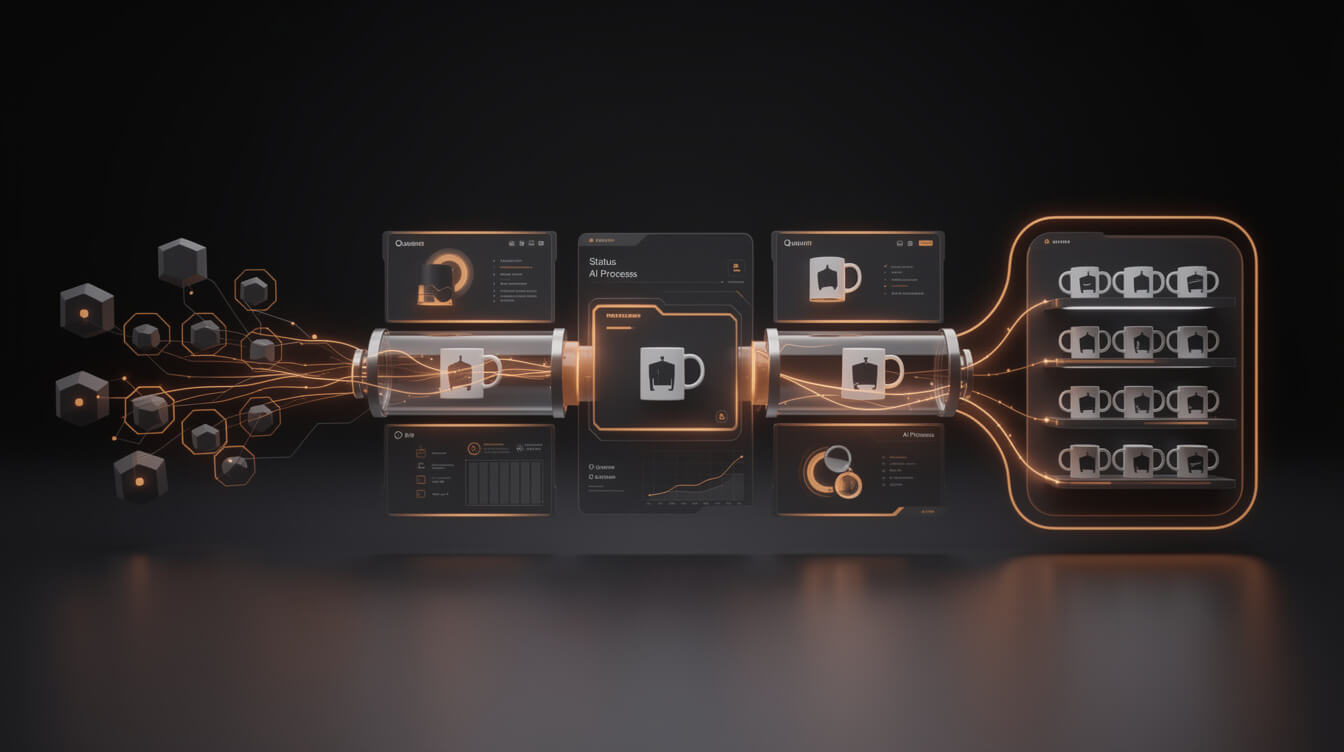
Adding a mug to your store is low effort once your design library exists. The bottleneck most sellers hit is not the design itself but the listing work: resizing the artwork to fit the mug wrap template, generating a realistic mockup, writing a product title optimized for both Printful’s internal search and your store’s SEO, crafting a description that converts, and setting the right variant structure and pricing. That is 30 to 45 minutes per SKU of manual work that compounds quickly if you are adding mugs across multiple designs or seasonal collections.
MEGA automates this pipeline from design to live listing. You provide the niche and the design brief. MEGA generates the mug artwork to the correct wrap dimensions, creates SEO-optimized product titles and descriptions, generates mockup images for your store, and pushes the completed listing to both your WooCommerce store and Printful simultaneously. The entire process runs in under 7 minutes per product. MEGA automates this step entirely, which means adding 10 mug SKUs takes the same wall-clock time as adding one.
For sellers evaluating whether mugs are worth the catalog expansion overhead: the overhead is the main reason not to add them. If you can eliminate the overhead, the economics are straightforward. The MEGA pipeline removes the friction entirely, which is why drinkware expansions work better with automation than without it.
Sellers running WooCommerce get one more advantage: the listing creation, SEO meta, and category structure can be managed through the WooCommerce REST API without the manual Shopify admin workflow. MEGA writes directly to WooCommerce via the API, which means no manual copy-paste steps between the automation output and your store’s product management interface.
Generate mug listings in under 7 minutes
MEGA handles artwork sizing, mockups, SEO titles, and descriptions for every POD product in your drinkware lineup. No Canva, no copy-paste, no manual Printful sync.
Frequently asked questions about custom mug printing for POD

What is the minimum order for POD mugs?
There is no minimum order with Printful, Printify, or Gelato. You can sell a single mug and it will be produced and shipped on demand. This is the fundamental difference between print-on-demand and a traditional promotional merchandise order, where minimum quantities of 36 to 144 units are standard.
Can I use a full-color design on a sublimation mug?
Yes. Sublimation handles full-color, photographic, and gradient designs with no additional cost per color. Unlike screen printing, there is no per-color charge. Your design cost is the same whether you use one color or twenty. This makes sublimation particularly well-suited to complex illustrated designs or photo-realistic artwork.
What file format should I use for mug designs?
Printful accepts PNG files at 150 DPI minimum, though 300 DPI is recommended for crisp output. The template file specifies the exact pixel dimensions for the wrap area. Most providers offer a Photoshop PSD template with guides and safe zones marked. Design to the safe zone to avoid artwork being cut at the handle seam.
Do POD mugs survive the dishwasher?
Sublimation prints on ceramic mugs are generally dishwasher-safe, though hand washing extends the life of the print. The polymer coating can degrade over many dishwasher cycles at high heat. This is a question buyers sometimes raise, and it is worth noting in your product description that hand washing is recommended to preserve print quality long-term.
What is a good starting retail price for a custom mug?
$18 is the most defensible starting point for a branded custom mug on a POD store. It reflects the actual cost of goods plus a realistic margin without pushing into premium territory that requires a stronger brand anchor to justify. Adjust upward to $22 if your niche has strong gift-purchase behavior or if you are pricing a limited edition or seasonal design.
How does custom mug printing compare to ordering mugs in bulk?
Bulk mug orders from promotional suppliers typically start at 36 to 72 units minimum and require upfront capital for inventory. At 50 units, a promotional ceramic mug runs $2.50 to $4.50 each landed, which is cheaper per unit than POD. The trade-off is inventory risk, storage cost, and the inability to offer unlimited design variety. POD custom mug printing has a higher per-unit cost but zero inventory and unlimited SKU variation. For stores in early stages or niches with diverse design libraries, POD wins on total cost basis despite the higher per-unit rate.
Implement AI. 30x your throughput. Get a 30-min call with the founder.
Drop your details and book a free 30-minute discovery call. Personalized advice on your POD stack, your margin, and where AI fits. No pitch, no fluff.