Merch by Amazon: tier limits, royalty math, and when to move to your own store
Merch by Amazon promises zero inventory, Amazon’s fulfillment network, and a design-to-live-listing pipeline that takes under 10 minutes. For sellers who have spent hours on Canva and weeks managing Shopify product variants, that sounds like the deal of the decade.
The reality is more nuanced. Merch by Amazon operates on a tier system that throttles your upload capacity until you earn your way up through sales. The royalty math at each tier caps your earnings more tightly than Amazon’s homepage suggests. And the customer data you build: zero. Amazon owns every email address and purchase history.
This is not an anti-Amazon argument. Merch by Amazon is a legitimate, low-risk entry point for POD sellers. The goal here is the math. Tier limits, royalty calculations at real prices, and the precise point where migrating to an owned WooCommerce store pays better than staying on Merch.
How Merch by Amazon actually works (and what the tier system costs you)

Merch by Amazon is Amazon’s print-on-demand fulfillment service for independent designers. You upload artwork, set a price, and Amazon handles production, shipping, and customer service. Your only job is to generate and upload designs.
The entry barrier is an application. Amazon periodically opens Merch to new sellers; acceptance can take weeks or months depending on demand. Once accepted, you land in Tier 10.
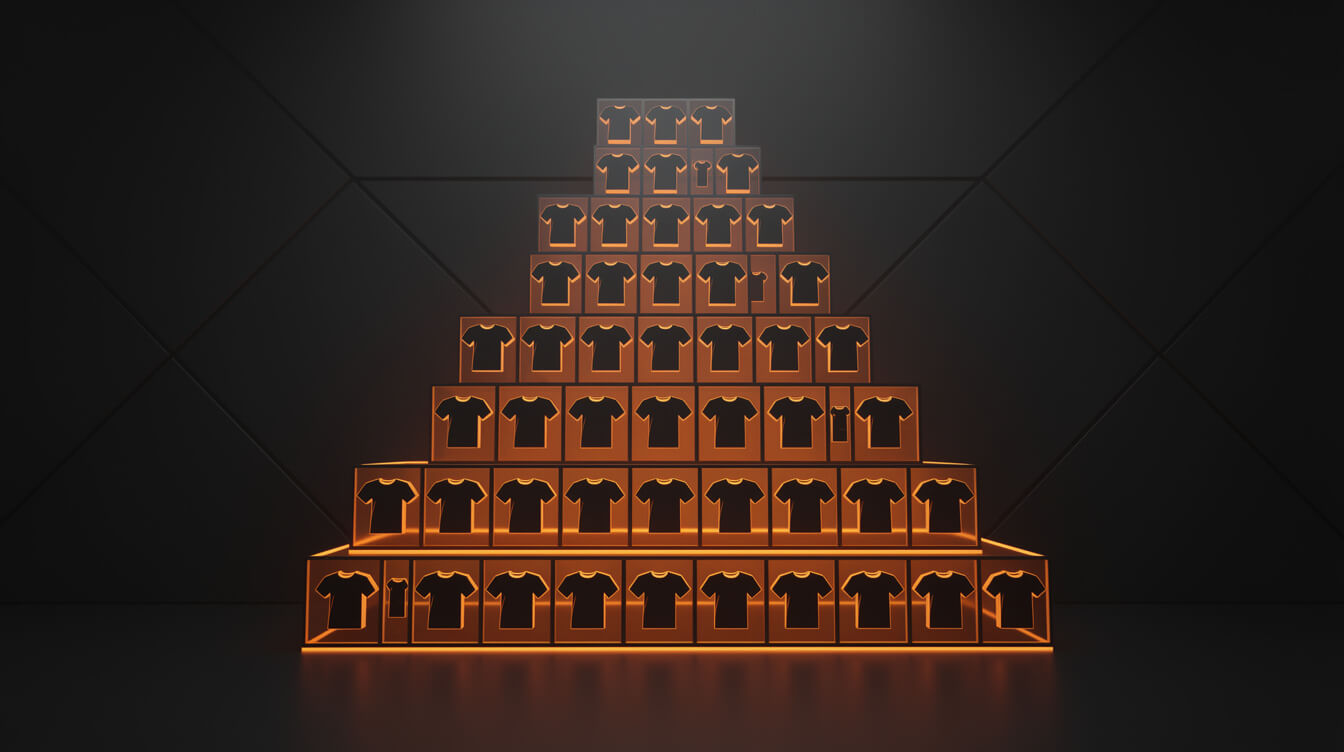
The tier system works like this: you start with 10 design upload slots. To move to Tier 25, you need approximately 10 sales. To reach Tier 100, you need around 25 sales from that Tier 25 base. To reach Tier 500, you need roughly 100 more. Each tier-up unlocks more upload capacity, and the upload slots matter because the 500+ designs threshold — consistently cited on r/AmazonMerch as the inflection point where income becomes meaningful — is locked behind a progression that takes most sellers 6 to 18 months at normal organic sell-through rates.
| Tier | Upload slots | Approx. sales to tier up | Time at 1 sale/week per slot |
|---|---|---|---|
| 10 | 10 | ~10 | ~10 weeks |
| 25 | 25 | ~25 | ~7 months |
| 100 | 100 | ~100 | ~12 months |
| 500 | 500 | ~100+ | 12–18 months |
The time column assumes one sale per week across your entire slot portfolio. Sellers who upload consistently competitive designs clear these faster. Most do not.
There is no time-based tier-up. You cannot wait your way out of Tier 10. Sales are the only unlock mechanism. And because your early designs compete in Amazon’s full marketplace from day one, a low-quality batch at Tier 10 can mean months of slow progress before you have the slot capacity to test enough designs to find winners.
Royalty math at each tier: what you actually earn on a $20 t-shirt

Every product on Merch by Amazon has a base cost — what Amazon charges for production. The royalty is the difference between your listing price and that base cost, after Amazon’s service fee (approximately 15% of the listing price for most standard product types).
For a standard fit men’s t-shirt, Amazon’s production base cost runs approximately $15.50 per unit. At a $19.99 listing price, Amazon’s service fee is roughly $3.00. Your royalty at that price: approximately $1.49 per sale.
At higher listing prices the math improves, but conversion rate typically drops on commodity niches. Merch data and community tracking consistently show conversion falling sharply above $25 for basic tees in competitive categories.
| Listing price | Approx. base cost | Amazon fee (~15%) | Your royalty | Monthly at 4 sales |
|---|---|---|---|---|
| $19.99 | $15.50 | $3.00 | ~$1.49 | ~$5.96 |
| $21.99 | $15.50 | $3.30 | ~$3.19 | ~$12.76 |
| $24.99 | $15.50 | $3.75 | ~$5.74 | ~$22.96 |
| $27.99 | $15.50 | $4.20 | ~$8.29 | ~$33.16 |
Note: Amazon’s exact base costs and fee structure vary by product type and change periodically. These are representative approximations based on publicly documented ranges as of 2026.
The headline number sellers on Reddit cite is “$3–5 per sale” for standard tees priced competitively. That is accurate for the $21–25 range. Pricing higher — $27.99 to $29.99 — adds per-unit margin but reduces conversion on commodity designs.
At Tier 500, with 500 designs, assuming 1 sale per week per design at $24.99: 500 sales per week times $5.74 equals $2,870 per week, or roughly $149,000 per year. That math looks compelling on paper. The flaw is distribution. Most designs in a 500-design portfolio do not sell once per week. Pareto applies hard. A realistic distribution sees roughly 10% of designs driving 80% of sales. The floor estimate — 50 designs selling once per week — produces $287/week, or $14,924/year before accounting for the time invested in uploading 500 designs.
The 500+ designs rule: why volume is the only lever you control
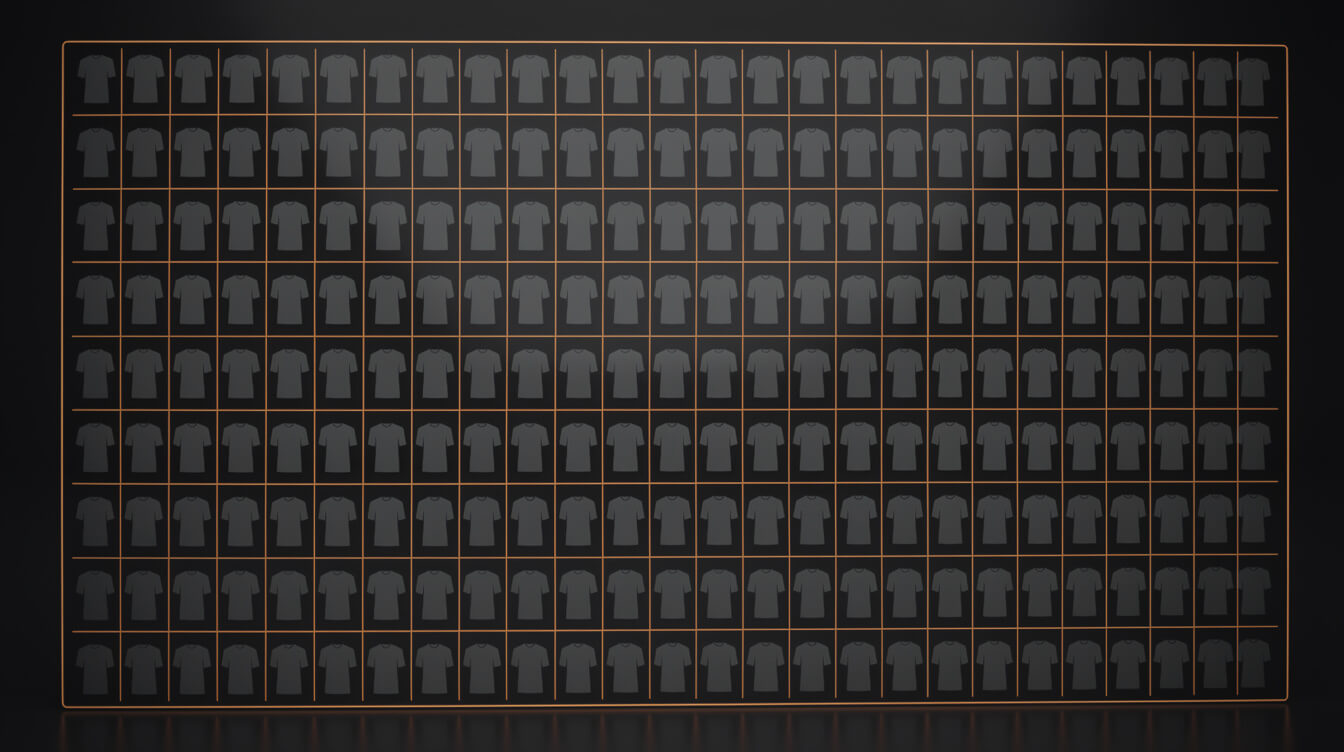
Amazon’s pricing and base costs are non-negotiable. You cannot optimize your way to better royalties on Merch by Amazon. You cannot run discounts, build customer relationships, or accumulate SEO equity on Amazon product listings. The only variable entirely within your control is how many designs you upload.
This is why r/AmazonMerch consensus is so consistent: “real fun starts at 500+.” At 500 designs with competitive art in scalable niches, the probability of sustained sell-through across the portfolio goes up enough to produce reliable income.
The problem is time. Uploading a single design manually — sourcing or creating artwork, resizing for each product type, writing a title, setting a price, writing a product description — takes 15 to 30 minutes per design. 500 designs at 20 minutes each: 167 hours of upload work before a single sale.
AI-assisted design generation changes this arithmetic. Instead of 167 hours of manual creation, a pipeline that generates, resizes, and pre-fills product metadata cuts per-design time to under 3 minutes. 500 designs becomes a 25-hour project instead of a 167-hour one.
MEGA automates exactly this: prompt-to-product in under 7 minutes, with AI-generated artwork sized for every product type, SEO-ready titles, and a direct pipeline to WooCommerce and Printful. The same workflow that accelerates your Amazon Merch upload queue also prepares your designs for migration when you are ready to move to an owned store.
For sellers still building toward Tier 500, the immediate bottleneck is not art quality. It is throughput. Designs that are good enough to sell once per week are far more valuable than perfect designs uploaded one at a time.
Amazon Merch vs WooCommerce + Printful: side-by-side economics

Smash print-on-demand. Join the engine room.
One short email a week. Real numbers, real teardowns, the unfiltered economics behind every move.

Both platforms produce the same physical product. A $25 t-shirt with your design, printed on demand, shipped to a customer. The economics at scale diverge substantially.
At 500 designs, one sale per week per design average, pricing at $24.99:
| Factor | Merch by Amazon | WooCommerce + Printful |
|---|---|---|
| Listing price | $24.99 | $24.99 |
| Production cost | ~$15.50 (Amazon base) | ~$13.25 (Printful tee) |
| Platform fee | ~15% (~$3.75) | 0% (you own the store) |
| Transaction fee | 0% | ~2.9% + $0.30 (Stripe) |
| Your margin per sale | ~$5.74 | ~$10.74 |
| Customer email | No (Amazon owns) | Yes (you own) |
| Repeat purchase rate | Minimal (no relationship) | Yes (email marketing) |
| SEO equity | Amazon’s domain | Your domain |
| Ad capability | Amazon PPC only | Google, Meta, Pinterest |
The margin difference is approximately $5 per unit at equivalent pricing. At 500 sales per week, that is $2,500 per week in additional margin — roughly $130,000 per year — at equivalent volume. This is the number that changes the migration calculation.
The counterargument is legitimate: Amazon’s traffic is free. On WooCommerce, you build your own traffic from scratch. Day 1 on Amazon Merch, your designs are discoverable to Amazon’s Prime members. Day 1 on WooCommerce, your store gets zero visits.
This is not a binary choice. The practical path most successful sellers describe: use Amazon Merch as a zero-cost design validation platform, identify winners, then migrate those proven designs to an owned WooCommerce store where the margin and customer data belong to you. Our breakdown of the WooCommerce vs Shopify economics for POD sellers covers the full fee math if you are also evaluating Shopify as the migration target.
Automate your design pipeline. Reach 500+ designs faster.
MEGA generates complete POD products — AI designs, sized for every product type, with SEO-ready titles — and pushes them live to your WooCommerce store. The same pipeline works for your Amazon Merch upload queue.
3 signals you have outgrown Amazon Merch’s tier ceiling

Not every seller needs to migrate. Some are well-served by Amazon Merch’s platform indefinitely. These three signals indicate the economics have shifted and an owned store would pay better.
Signal 1: You are at Tier 500 or higher, and royalty income has plateaued
At Tier 500, you have enough designs uploaded to generate meaningful volume. If royalties are not growing proportionally with new uploads, the platform’s internal competition — not your design quality — is the bottleneck. Amazon Merch competes your own listings against thousands of similar designs. Owning your traffic through SEO and email removes that internal competition entirely.
Signal 2: You cannot retarget or email your customers
A sale on Amazon Merch generates zero customer data on your side. No email address. No purchase history you control. No retargeting pixel. If your Amazon Merch income dropped to zero tomorrow, you could not contact anyone to recover it. That is a fragile business. Your WooCommerce store builds an email list from the first order.
Signal 3: Your best designs have proven demand, but Amazon’s pricing rules limit your ceiling
Amazon Merch enforces minimum pricing floors and informal platform pressure toward commodity pricing. On your own WooCommerce store, a design generating $8 royalty on Merch at $27.99 can be listed at $34.99 with better product presentation and your own brand context, earning $21 per unit instead. The customer who bought it on Amazon did not set a ceiling for what someone who finds it through Google will pay.
Sellers who check at least two of these three boxes will find the comparison table in the previous section already shows the answer.
The migration path: from Merch by Amazon to an owned store you control

Migration does not mean abandoning Amazon Merch. It means building a parallel channel that earns better margins on the designs you have already proven.
Step 1: Audit your Amazon Merch performance
Pull your royalty report and sort by design. The top 10–20% of your portfolio by sales is your migration shortlist. These are proven designs with demonstrated buyer intent. Migrating these first gives your WooCommerce store its first products with the highest probability of converting traffic you have not yet built.
Step 2: Set up WooCommerce + Printful integration
Printful’s WooCommerce plugin connects your store to Printful’s fulfillment network in under an hour. You set product prices, Printful handles printing and shipping, and your margin is the spread between your price and Printful’s base cost — without Amazon’s platform fee. The full Printful WooCommerce setup is covered in our WooCommerce vs Shopify comparison for POD sellers.
Step 3: Migrate winning designs first
Take your top-performing Amazon Merch designs, upload to Printful, create WooCommerce product listings, write optimized product descriptions, and publish. The product page is yours to design, optimize, and iterate. Amazon’s constrained listing format disappears. You control pricing, presentation, photography, and SEO. If you want to understand the economics at different volume tiers for your own store, the real cost analysis of print on demand vs Shopify fees walks through the math on owned store economics.
Step 4: Build the customer capture infrastructure Amazon blocked
Every WooCommerce order now builds your email list, retargeting pixel, and repeat purchase potential. A customer who bought a $25 tee from your WooCommerce store and joins your email list has a 20–30% repurchase probability within 12 months. The same customer on Amazon: zero chance of a direct follow-up relationship.
Step 5: Let both channels run simultaneously
Keep the Amazon listings live. Amazon’s traffic continues to generate royalties while your WooCommerce store builds SEO and email equity. The goal is not to replace Amazon Merch income on day one. It is to build a channel where incremental growth happens on your terms, not Amazon’s tier ceiling. Once your WooCommerce revenue exceeds your Amazon Merch royalties, you can make the prioritization decision with actual data.
If you are adding merch revenue to an existing business, the guide on adding a $2k per month merch revenue stream covers the full WooCommerce setup from scratch, including the niche and design selection process that gets products live fast.
Merch by Amazon: the honest summary
Merch by Amazon is not a scam, and it is not a passive income lottery. It is a volume game with documented math. Tier 10 earns very little because you have too few upload slots to build a portfolio that generates meaningful sell-through. Tier 500 earns better, but the ceiling is real: Amazon’s fees cap your per-unit royalty, you own no customer data, and every design competes inside Amazon’s own ecosystem where Amazon can surface a cheaper competitor on the next scroll.
The sellers who build durable POD income use Amazon Merch as a validation tool. Upload designs. Let Amazon’s traffic tell you which ones sell. Migrate the winners to an owned store where the margin, the customer relationship, and the SEO equity belong to you.
The math at Tier 500 — 500 designs times one sale per week times $5.74 — is achievable. The same 500 designs on WooCommerce + Printful at equivalent pricing nets closer to $10.74 per sale. The difference is not marketing expertise or brand equity. It is the platform fee and customer data that Amazon keeps.
The right question is not “Amazon Merch or WooCommerce?” The right question is: how do you validate designs fast, identify winners, and migrate them to a platform where the economics compound over time? That is what the MEGA pipeline is built for: AI-generated designs at throughput, WooCommerce integration out of the box, and a research-first approach that starts with what people are already buying.

Implement AI. 30x your throughput. Get a 30-min call with the founder.
Drop your details and book a free 30-minute discovery call. Personalized advice on your POD stack, your margin, and where AI fits. No pitch, no fluff.