How to start a t-shirt business: the setup most guides skip
Most guides on how to start a t-shirt business give you the same 10-step checklist. Pick a niche. Make a design. Connect Printful. Set up a Shopify store. Launch. That checklist is not wrong. It is just incomplete in the ways that cost you the most money later. The platform decision gets one paragraph. The fee math does not appear at all. The word “automation” is missing entirely.
This guide covers the parts the standard t-shirt business playbook skips: the infrastructure decision that compounds, the Shopify fees you will not see coming, the Canva throughput ceiling you will hit at 10 to 20 products, and what a research-first approach to product development actually looks like in practice.
Why the standard t-shirt business guide sets you up for a painful pivot later

Every guide to starting a t-shirt business follows the same structure because every platform sponsor has the same goal. Printful wants you on Shopify. Squarespace wants you on Squarespace. Printify wants you running Printify apps.
The conflict of interest is not subtle. When Printful publishes a guide to starting a t-shirt business, the guide recommends Shopify. Not because Shopify is the most cost-effective platform at scale. Because Printful has an integration to sell, and Shopify has the highest mainstream name recognition.
Here is what those guides skip.
Shopify charges a 1% platform override fee on every transaction, on top of Stripe’s 2.9% plus $0.30 per order. At $3,000 per month in sales, that is an extra $30 per month in pure platform overhead. At $10,000 per month, it is $100 per month. Before you have paid for your Shopify plan ($39 to $399 depending on tier) or your app stack (Printful app, email marketing, reviews, upsells), you are already giving Shopify 1% of every dollar you earn.
None of the standard guides mention this. They are written to get you started, not to keep you profitable at scale.
The second gap is the design workflow. Guides tell you to use Canva or hire a designer on Fiverr. They do not tell you that Canva’s free tier runs out fast, that a Canva Pro subscription at $15 per month still requires you to produce every design manually, and that at 10 to 20 products you will hit a throughput ceiling that makes adding new SKUs feel like a second job.
The third gap is niche research. Most guides tell you to “pick a niche you are passionate about.” That is personal advice dressed up as business advice. Passion does not validate demand. Data does.
Starting a t-shirt business is easy. Starting one on infrastructure that scales without rebuilding everything 12 months in is the question this guide answers.
Choosing your niche: what actually sells vs. what you think will sell

The most common t-shirt business mistake is choosing a niche based on personal interest rather than market data. You like hiking. You design hiking t-shirts. You launch. Nothing sells.
The problem is not the niche. The problem is choosing without evidence that a paying audience exists and is actively shopping.
Niche research for a t-shirt business follows the same logic as any product research: look for communities with high emotional investment and a demonstrated willingness to spend. The richest niches for print-on-demand t-shirts are often not the obvious ones.
Fishing, hunting, and outdoor sports communities have large enthusiast markets with average order values above $35. Occupational identity (nurses, teachers, firefighters, welders) creates strong gifting demand year-round. Rescue dog owners, marathon runners, and competitive gamers are communities with proven spend patterns on branded apparel.
The highest-margin starting point is community-first niche selection: identify a community before designing anything, validate that it has active buyers rather than just followers, and then design for that community’s internal language and references. A design that uses the real terminology and in-jokes of a specific culture will outsell a generic design every time.
Subreddits are a research resource that most guides ignore. Communities like r/Printful, r/Printify, and r/streetwearstartup show what is actually selling and what buyers are complaining about. The complaints are especially valuable. If a buyer posts that they cannot find a shirt that accurately represents a specific subculture, that is a product gap someone will pay to fill.
Search volume data adds another layer. Keywords like “nurse retirement gift” or “welder dad shirt” tell you that people are actively searching for products in a niche. That is different from people talking about a niche on social media. High search volume combined with active community engagement is the strongest signal that a niche is worth entering.
Before you design a single shirt, spend two to three hours in the communities you are targeting. Read the posts. Look at what products are being praised or criticized. Build a list of five to ten specific design concepts before you open any design tool.
The platform decision that matters more than your first design
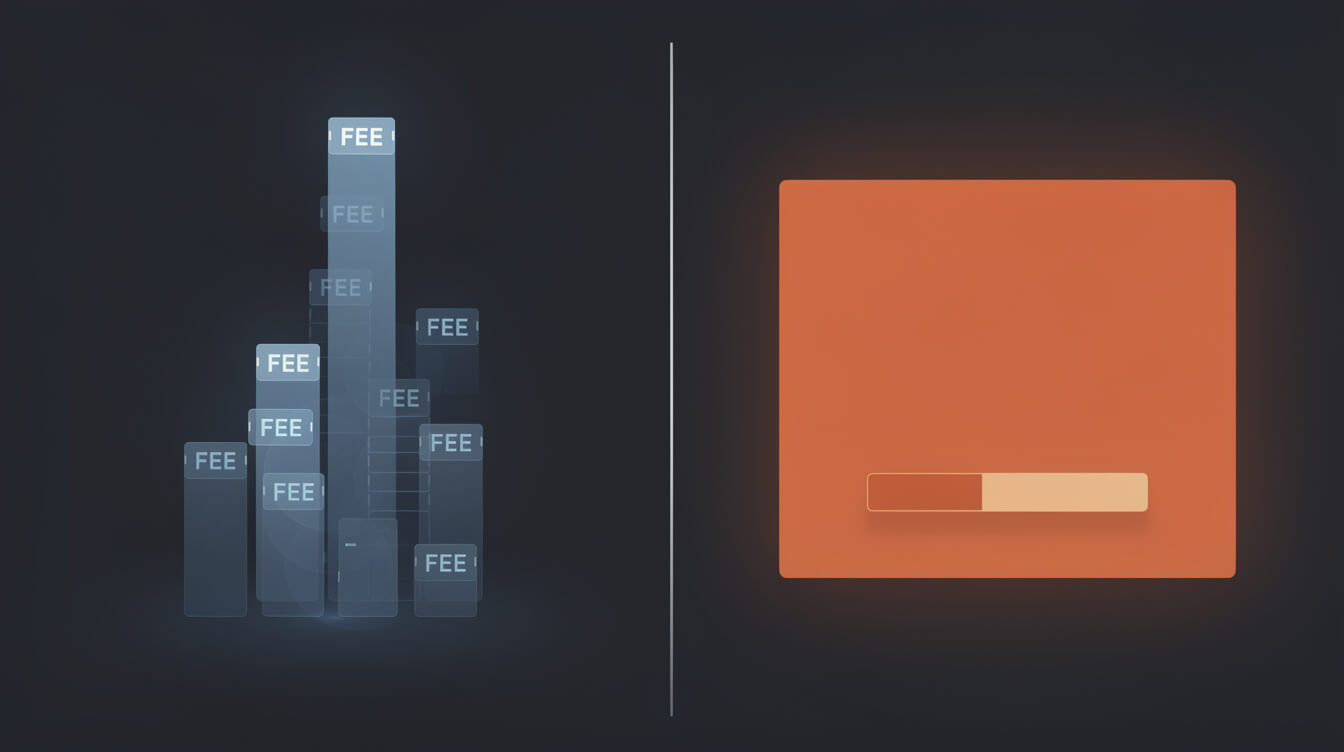
The most consequential decision you make when starting a t-shirt business is not your first design. It is the platform underneath your store.
Most guides bury this in one paragraph, pointing you toward Shopify because it is the most marketed option. Here is the math that paragraph does not include.
Shopify’s base plan is $39 per month. At that tier, Shopify charges a 1% transaction fee on every sale, on top of payment processor fees. The $105 plan drops that to 0.5%. The $399 plan drops it to 0.25%. If you use Shopify Payments, Shopify waives the transaction fee, but Shopify Payments is not available in every country, and it still charges the standard Stripe rate of 2.9% plus $0.30 per transaction.
Running the numbers at different revenue levels tells the real story:
- At $3,000 per month: Shopify base plan ($39) plus 1% fee ($30) equals $69 minimum platform overhead. Before the app stack (Printful, email marketing, reviews, upsells), which typically adds $30 to $60 more per month.
- At $5,000 per month: $39 plus $50 equals $89 minimum platform cost.
- At $10,000 per month: $39 plus $100 equals $139 minimum platform fee, before the app stack.
WooCommerce on a standard hosting plan costs $10 to $20 per month for hosting, and WooCommerce itself is free. There is no percentage transaction fee beyond the payment processor. At $10,000 per month in sales, you pay Stripe and your host. No platform override.
The gap compounds. At $10,000 per month over 12 months, the 1% Shopify platform override alone is $1,200 per year. Over three years at that revenue level, it is $3,600. If you grow to $20,000 per month, it is $2,400 per year in pure platform overhead that WooCommerce does not charge.
This is what the Shopify tax costs POD sellers over time. The full breakdown is covered in detail in the WooCommerce pricing breakdown for POD stores, including how the cost differential behaves at different revenue tiers and how to calculate your break-even point on the migration.
The right platform decision depends on where you are starting and where you intend to go. If you are testing a niche with minimal technical investment, Shopify’s speed to launch is a real advantage. If you are building a store you intend to scale above $3,000 to $5,000 per month, WooCommerce’s flat cost structure is worth the slightly higher setup friction.
How to build your first 10 products without a Canva subscription or a designer

Smash print-on-demand. Join the engine room.
One short email a week. Real numbers, real teardowns, the unfiltered economics behind every move.
The most common question after choosing a platform is how to make designs. The default answer is Canva. The better answer depends on your volume goals.
Canva works for your first five to ten designs. The interface is accessible, the template library is large, and the free tier covers basic use. Canva’s limitations become clear at scale: every design requires manual production time, the same templates appear across thousands of competitor stores, and at 10 to 20 products you hit a throughput ceiling where adding a new SKU costs more in your time than it earns back in margin.
For a t-shirt business aiming at more than 20 products, the design production question is actually an automation question.
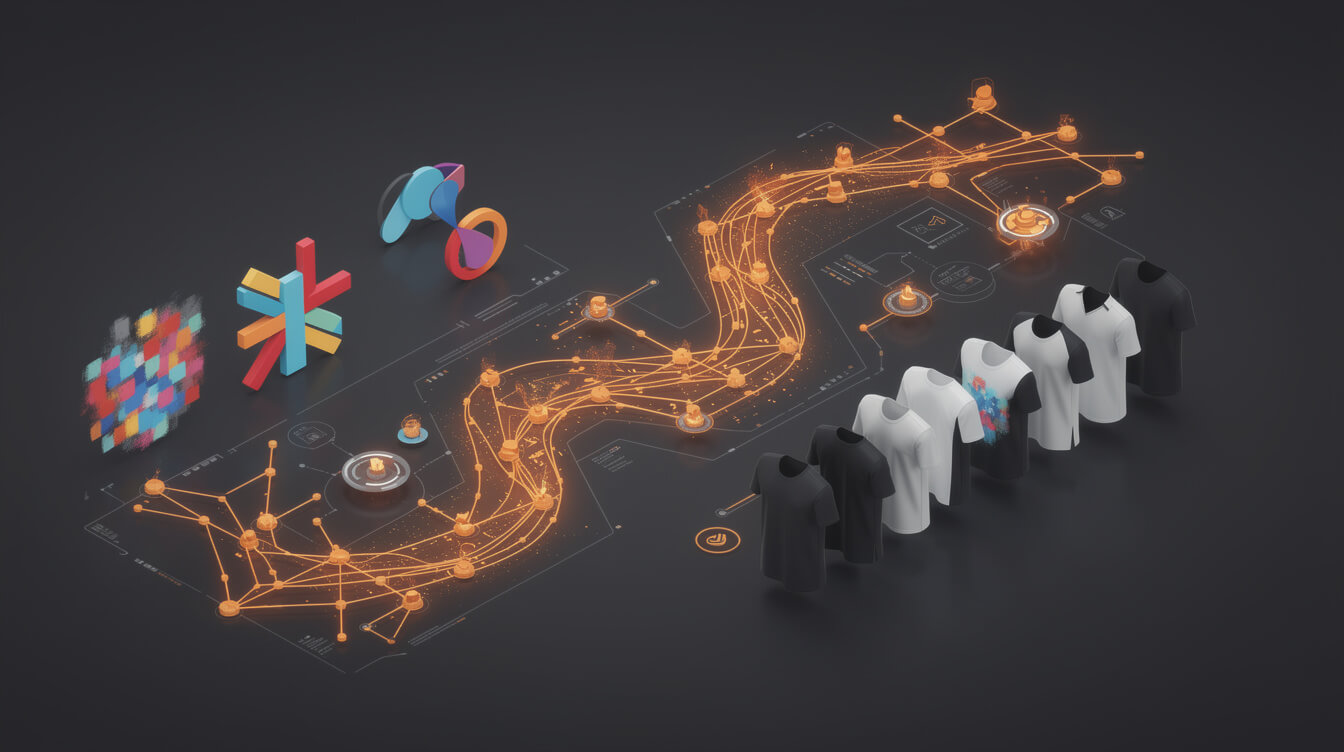
AI image generation tools can produce print-ready artwork at a fraction of the time manual design takes. The best models for print-on-demand designs produce original artwork at resolution and quality levels suitable for DTG printing. The basic pipeline is: write a text prompt describing the design concept, generate in 20 to 30 seconds, review and select the best output, then upload to your POD platform’s product listing tool.
At the manual level, this workflow is still faster than Canva for custom artwork. At the automated level, the entire pipeline (research, image generation, compression, mockup creation, listing, SEO metadata) can run without touching a design tool at all. MEGA automates this workflow end to end, from a niche keyword input to a complete WooCommerce product listing with Printful integration, in under seven minutes. MEGA handles this step entirely, covering image generation, sizing, cropping, mockup generation, title creation, and SEO metadata as a single connected pipeline.
The arithmetic changes significantly when a complete product listing takes seven minutes instead of two hours. A manual Canva workflow might produce three to five new SKUs per day at full effort. An automated pipeline can produce 40 to 50 per session. The difference is not just speed. It is the ability to test more niches, cover more design variants, and iterate based on actual sales data rather than assumptions.
For your first 10 products, the practical choice is: manual Canva workflow (three to four hours total), Fiverr designer ($15 to $50 per design), or AI-assisted generation (20 to 30 minutes with iteration). The economics of each option shift dramatically as your product count grows past 20.
Printing methods: what you own, what the POD partner owns, and why it matters
When you start a t-shirt business using print-on-demand, you are outsourcing manufacturing. That is not a criticism. It is the correct model for a business that does not want to manage inventory, equipment, or fulfillment logistics.
What matters is understanding exactly what you own and what the POD partner owns.
You own: the store, the customer relationship, the brand, the designs, and the margin between your retail price and the fulfillment cost.
You do not own: the printer, the facility, the inventory, the shipping infrastructure, or the manufacturing quality control. This is the correct tradeoff for a lean POD business. It also means your brand carries the consequence of your partner’s execution quality on every order.
This distinction shapes how you design. DTG printing and DTF printing have different color reproduction characteristics, different fabric compatibility, and different price points. A design that looks perfect on screen may print differently depending on which method your fulfillment partner uses for that product. Understanding the difference before you finalize designs saves expensive surprises post-launch.
For most t-shirt businesses starting out, Printful and Printify are the two most common POD partners. Both integrate with WooCommerce and Shopify. The differences are in pricing, product catalog depth, and fulfillment speed. Printful’s product catalog leans toward premium quality at higher fulfillment costs. Printify’s network offers more price variety with more variability in quality across different print partners in the network.
The right choice depends on your margin targets and your tolerance for quality variation. Designing specifically for DTG printing means understanding color mode (RGB for screen preview, CMYK awareness for print output), minimum resolution requirements (300 DPI), and the print area dimensions for each garment. Getting this right before launching prevents the most common print quality complaints.
Research-first. Automated. Profitable at scale.
MEGA generates complete product listings in under seven minutes. Niche research, AI design, mockups, SEO, and WooCommerce listing in one automated pipeline. 30x the throughput of a manual Canva workflow.
Pricing your t-shirts: the full cost stack

Pricing a t-shirt wrong is one of the fastest ways to stall a t-shirt business before it has traction. Most guides give you a simple formula: fulfillment cost times three equals retail price. That formula is not complete enough to run a real business on.
The full cost stack for a POD t-shirt sale looks like this:
Fulfillment cost: $12 to $18 for a standard Printful DTG t-shirt, depending on the garment and your plan level. Premium blanks (Bella+Canvas 3001, Next Level) sit at the higher end. Budget blanks sit lower but with different quality characteristics.
Shipping cost: $4 to $6 for standard domestic US shipping. You can build this into the product price or charge it separately. Charging separately reduces checkout conversion. Building it in raises the apparent price point but simplifies the buying decision for the customer.
Platform fee: 0% to 1% depending on your platform. On Shopify’s base plan, that is 1% of the sale price on every order. On WooCommerce, it is zero. This is the Shopify tax appearing directly in your per-unit margin calculation.
Payment processing: 2.9% plus $0.30 per transaction for Stripe. This applies on every platform regardless of where you host your store.
Returns and chargebacks: Budget 2% to 3% of revenue for disputes, refunds, and damaged items. POD products have relatively low return rates compared to fashion retail, but this buffer keeps your projections realistic.
Ad spend: New t-shirt businesses running Facebook or Instagram ads need a customer acquisition cost below 30% of the sale price to be profitable. With average order values around $25 to $30, that means keeping ad spend under $7 to $9 per customer acquired. Most beginners exceed this while learning paid traffic platforms.
Running the numbers on a specific example: A t-shirt priced at $28 with an $18 fulfillment cost, $5 shipping built in, a 1% Shopify fee ($0.28), and a 3.2% Stripe fee ($0.90 plus $0.30) leaves approximately $3.52 per sale before ad spend. If your customer acquisition cost is $7 via paid ads, you are losing money on each sale.
That math reveals why organic traffic (SEO, community content, social presence) has a fundamentally better margin structure than paid traffic for a t-shirt business in its first year, and why the platform fee matters more as your revenue grows.
Scaling your t-shirt business beyond 10 products: when automation changes the economics
The first 10 products in any t-shirt business are a test. You are validating that your niche has buyers, that your print quality meets customer expectations, and that your pricing generates enough margin to justify continuing. That phase is exploratory, and slow production is acceptable.
Once those basics are validated, the question changes. Can you produce enough product variety to find your real winners without spending all your available hours in a design tool?
The manual ceiling is real. If every product requires two to three hours of design time, a 50-product catalog has consumed 100 to 150 hours of your time. At a $50 hourly opportunity cost, that is $5,000 to $7,500 invested before you know what sells. Most of those products will not perform well. The few that do justify the investment, but only if you can produce at a fast enough rate that the time cost per winning SKU stays manageable.
Automation changes this calculation. When a new product takes seven minutes instead of three hours, you can test 10 times as many design concepts in the same time window. You can cover more niches, run more variants against the same audience, and iterate based on actual sales data faster. The products that sell rise to the surface faster because your test surface is larger.
This compounding advantage is the core difference between a manual t-shirt business and an automated one. The manual workflow hits a ceiling at 10 to 20 products because the cost of producing each new SKU approaches or exceeds the expected return. The automated workflow does not hit that ceiling in the same way because the marginal cost of a new listing drops from hours to minutes.
At 50 products, the automated store has tested more niches, found more winners, and built more data about its audience. At 200 products, the gap between the two approaches is no longer a productivity gap. It is a data depth and catalog coverage gap that determines who dominates organic search results for the niche.
The decisions you make on day one compound into either a scalable operation or an expensive hobby. The infrastructure decision is not easily reversible once you have customers and catalog built on it, which is why the standard 10-step t-shirt business guide sets up a costly rebuild for anyone who follows it to scale.
Final thoughts on starting a t-shirt business
The standard t-shirt business guide gets you started. It does not get you profitable at scale. The gaps it leaves around platform fee math, design throughput limits, and research-first product development are exactly where most t-shirt businesses stall between month 6 and month 18.
The decisions that matter most happen before you design anything: which platform you build on, how you will produce designs at volume, and whether you are starting with data about what sells or with an assumption. Each of those decisions has a compounding effect on your margin, your time, and your ability to grow past the point where manual workflows break.
The setup described in this guide costs more effort upfront. WooCommerce has a steeper initial learning curve than Shopify. Research-first niche selection takes longer than opening Canva and designing what feels right. But the math holds up, and the infrastructure does not need to be rebuilt when your revenue grows.
Implement AI. 30x your throughput. Get a 30-min call with the founder.
Drop your details and book a free 30-minute discovery call. Personalized advice on your POD stack, your margin, and where AI fits. No pitch, no fluff.