Custom socks with logo for POD sellers: which providers carry them, what sublimation costs, and the fan merch math
Custom socks with logo sits behind two very different products, and which one you are building for determines everything: the print method, the provider you use, the retail price, and the margin you keep. This guide is for POD sellers who want to add printed socks to their store at no minimum order quantity, not corporate buyers ordering hundreds of pairs for company retreats.
Here is what we cover: which providers carry custom socks with logo at the individual-order level, how the sublimation process interacts with fabric content, why all-over-print outperforms logo-only on margin, the unit cost math from base price to retail, the six niche verticals with the strongest conversion rates, and what the Shopify 1% platform tax does to a $20 AOV product line.
What custom socks with logo means in two different markets
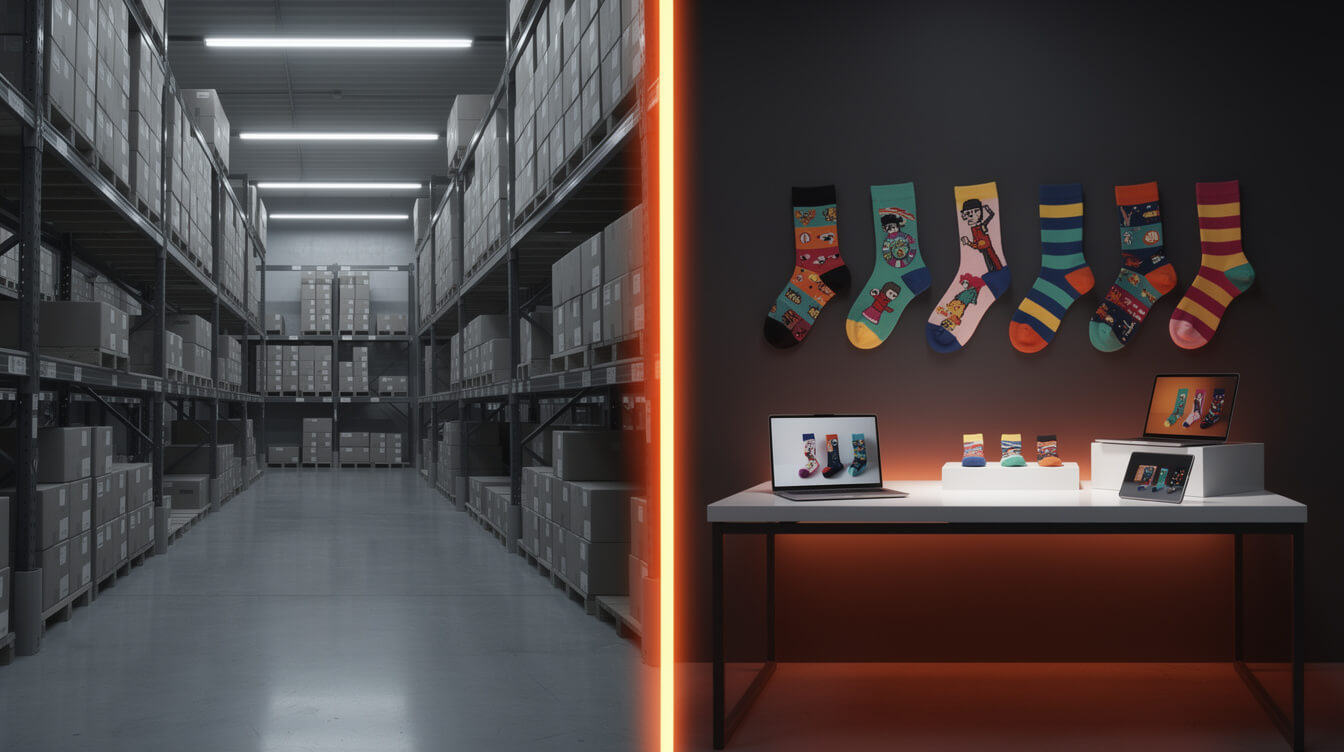
Search “custom socks with logo” and the first page returns DecoSlides, DivvyUp, VividPins, and CustomSockShop. These are B2B consumer personalization services. They serve the HR manager ordering 200 pairs for a corporate retreat or the youth sports league ordering 60 pairs for a tournament. Minimum orders of 24 to 100 pairs are standard. Setup time per design only makes sense when the cost amortizes across a sufficient run.
That is not what POD sellers are building.
The POD version of custom socks with logo is a retail product listing: socks as a discoverable item in a WooCommerce store, fulfilled one pair at a time on demand, with no stock held. The buyer is a pet owner who wants their dog’s face printed on a sock, a sports fan who wants their team’s colors in an all-over sublimated crew sock, or someone buying a novelty gift for a person who is notoriously difficult to shop for.
Both markets use the same keyword. The business models behind them are completely different.
If you are reading this as a POD seller, your question is: can I build a sock product line at zero minimum order, drop-ship to individual customers, and keep 35 to 45% gross margin per pair? That is the question this guide answers.
The secondary question is whether the editorial vacuum around POD sock stores represents an opportunity. It does. The SERP for this keyword is almost entirely B2B bulk order vendors. There is very little content written for the seller building a sock product line via Printful or Printify. That gap is why this guide exists.
Which POD providers carry custom socks with logo in 2026
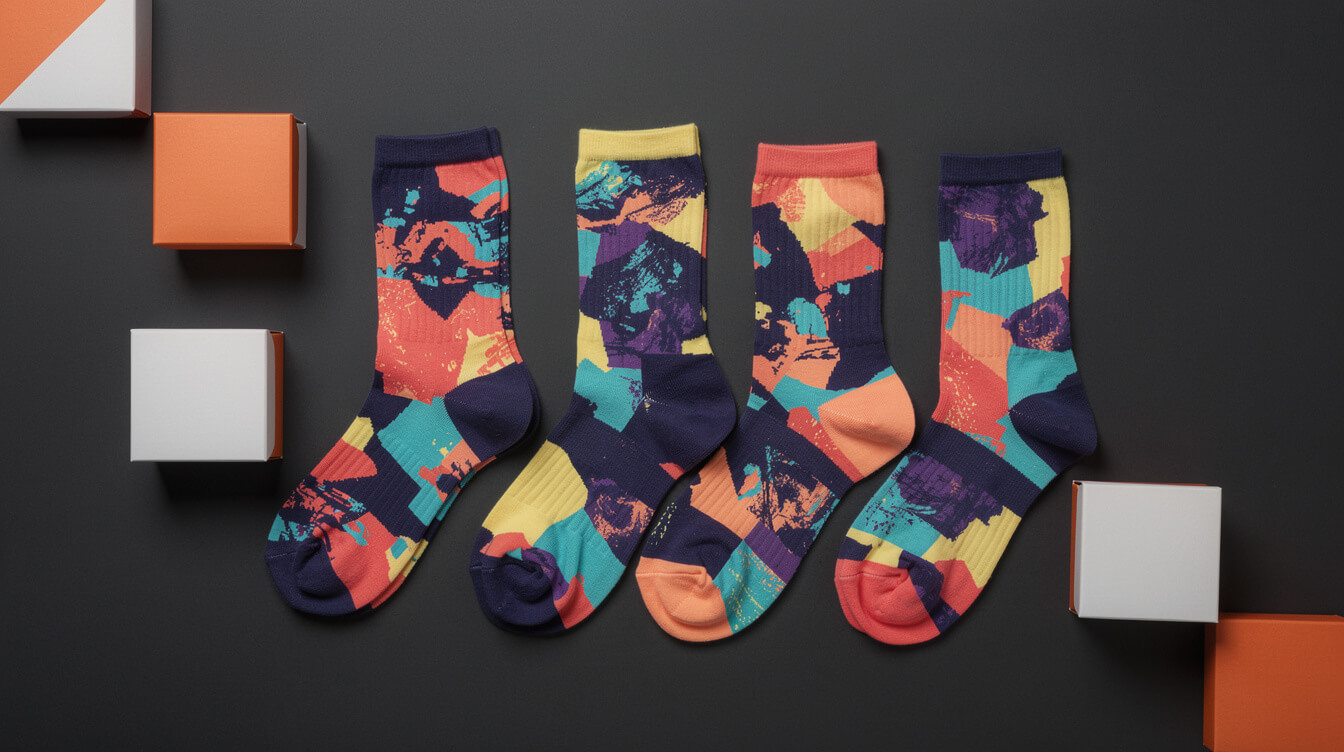
Printful carries sublimated all-over-print crew socks. The current listing includes a poly-cotton blend crew sock with full sublimation coverage, no MOQ, drop-ship to customer. Check the current Printful catalog directly before building listings — product availability updates periodically and stock can vary by fulfillment region (US, EU, AU).
Printify’s vendor network includes sock suppliers depending on region. Sublimator and AOP+ are names that come up in the network, but availability varies. Log into Printify’s product creator and filter for socks to see what is live for your shipping destination. Vendor availability on Printify changes more frequently than Printful because Printify is a network rather than a vertically integrated fulfiller — a vendor can enter or exit without notice.
Gooten and CustomCat have carried printed sock options in past catalog versions. Check their current product pages before building a listing. The sock product tends to appear and disappear on these platforms depending on supplier contracts.
Three rules apply across all providers:
- Verify current availability in your fulfillment region before investing in design work. Printful’s sock catalog in the US and EU can differ by SKU.
- Check the fabric content on the specific sock SKU. Sublimation quality is directly tied to polyester percentage. Higher polyester equals more vibrant print.
- Test a sample before listing at scale. Socks are wearable and tactile. Fit, elasticity, and print durability matter more than they do for a canvas print or a mug.
What all these providers share: sublimated socks print at no minimum order quantity. One pair ordered by one customer ships directly. You hold no inventory and make no minimum commitments. The POD model works for socks in a way it does not work for categories requiring bulk decoration runs.
The print method behind sublimated socks
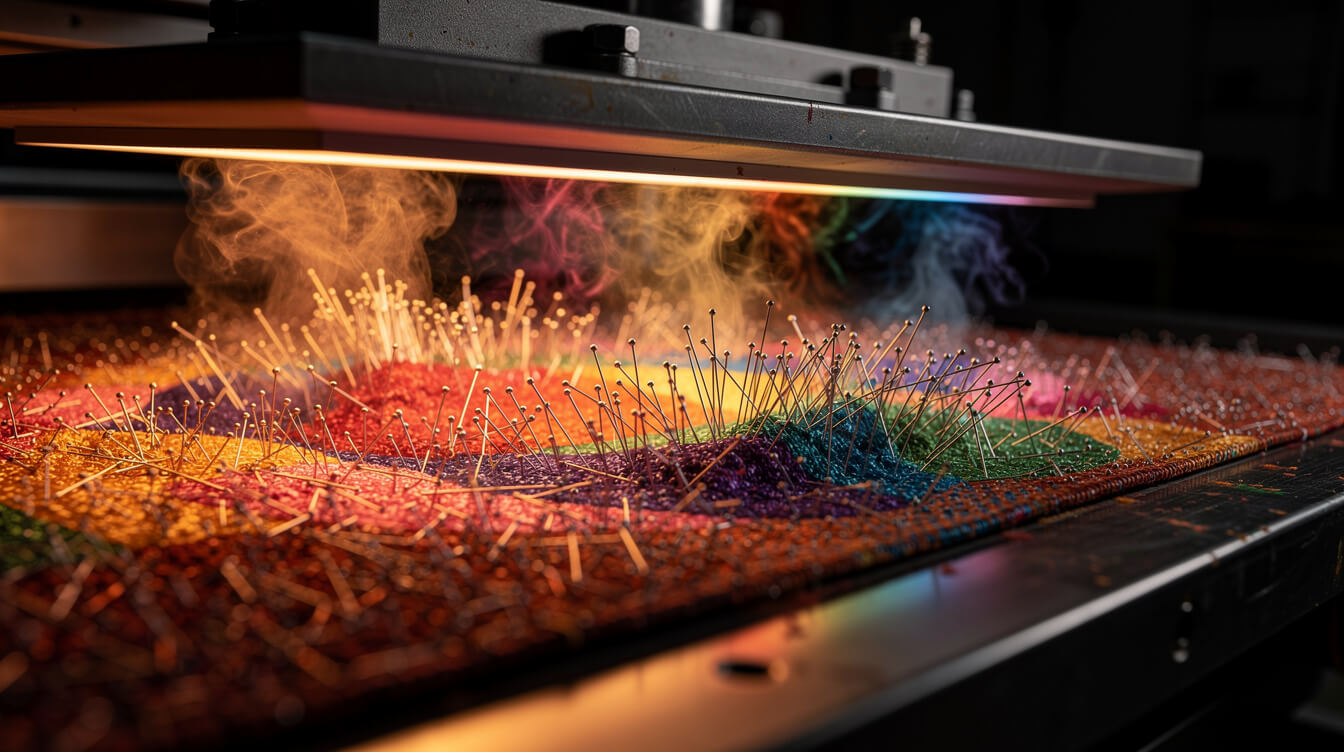
Sublimation is a chemical process, not a surface coating. The ink converts from solid to gas under heat and pressure, then bonds directly with the polymer chains in the fabric. The result is permanent color that does not sit on the surface, does not crack over time, and does not fade with washing.
The critical constraint: sublimation requires a fabric with at least 80% polyester content. The dye bonds with polyester at the molecular level. On cotton, the bonds do not form. The ink either beads off or produces a washed-out result that degrades further after the first wash cycle.
Most POD sock substrates are poly-cotton blends in the 70% to 90% polyester range. The higher the polyester content, the more vibrant and durable the sublimation result. A sock at 95% polyester sublimates significantly more vividly than one at 65%.
Pure cotton socks cannot sublimate. If you want decoration on cotton socks, the options are screen print (requires minimum quantities, typically 25 to 50 pairs per design) or embroidery (logos only, no photographic imagery). Neither method works for POD individual-order fulfillment in the way sublimation does on poly-cotton blends.
This matters for product copy and customer expectations. Some customers searching “custom socks with logo” have cotton dress socks in mind. If a buyer expects cotton and receives a poly-cotton blend, the gap can produce a return and a review that damages conversion. Naming the fabric content explicitly in your product description is worth two extra sentences.
Design file specifications for sublimated socks vary by provider. Printful’s spec is documented on their product page. Full-wrap sock design files generally need high resolution to cover the full knit surface without pixelation. The design wraps around a three-dimensional curved form, and the file needs to account for that distortion in the artwork.
Logo socks vs all-over-print socks: which earns more per unit and why

Smash print-on-demand. Join the engine room.
One short email a week. Real numbers, real teardowns, the unfiltered economics behind every move.
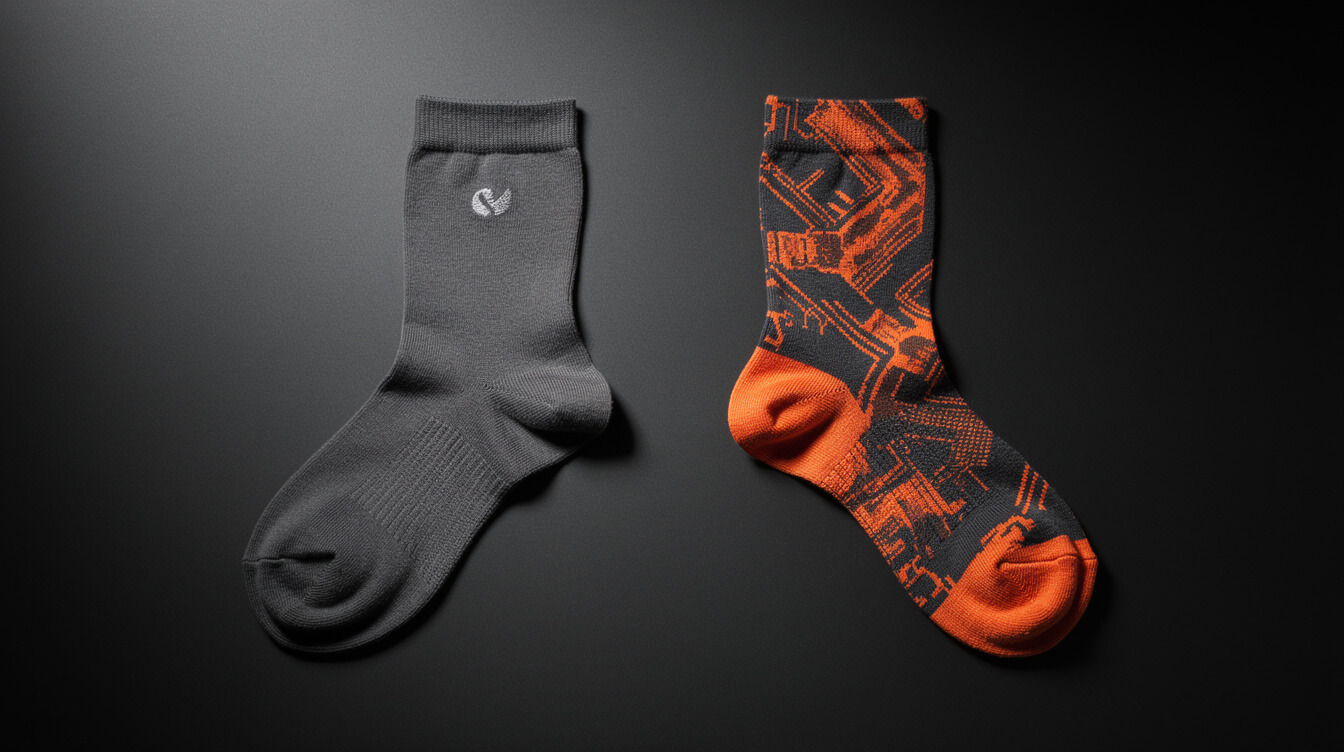
A logo sock has a small design element on the ankle or cuff — a mark, monogram, or team icon comparable to a chest-print on a t-shirt in terms of design coverage. This approach works for corporate branded merch where the brand wants subtle recognition rather than visual impact.
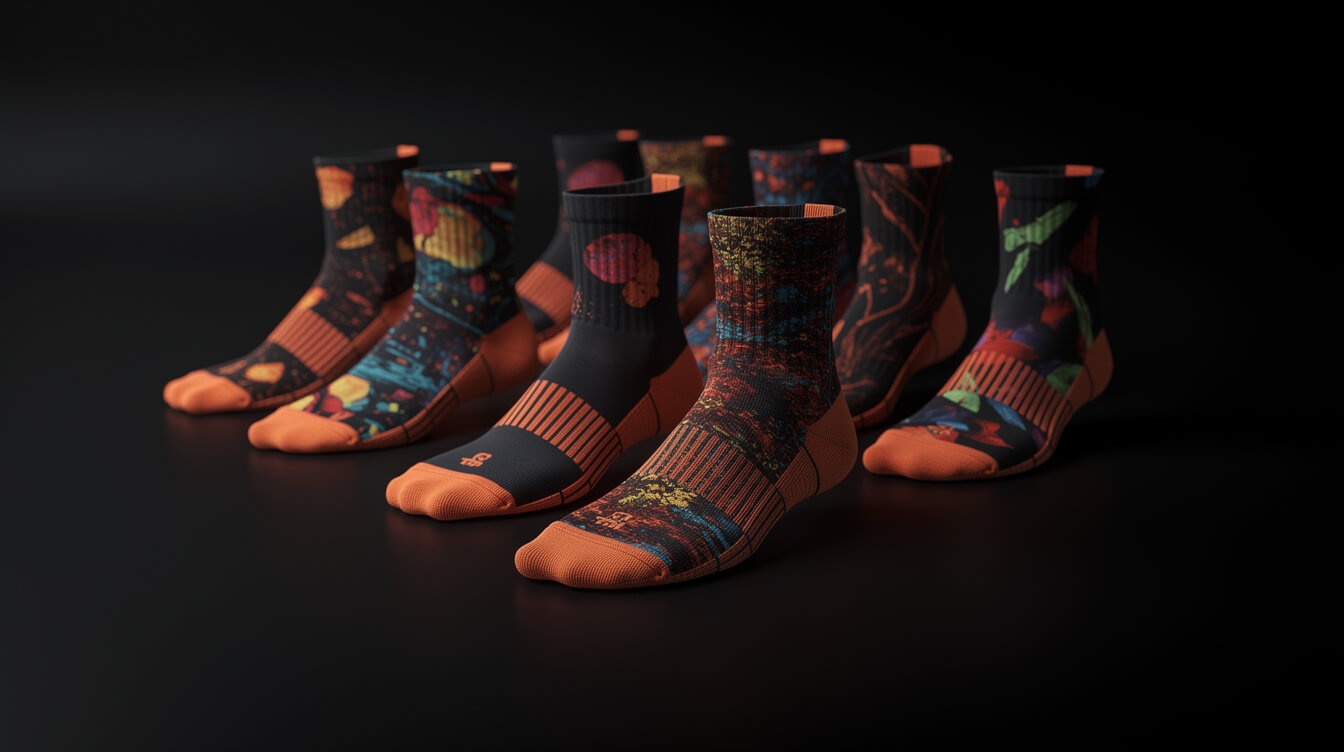
An all-over-print sock uses the full sock surface as a canvas. The design wraps around the foot, up the ankle, across the cuff. The result is visually distinctive and retail-ready. It does not look like office swag.
For POD retail, all-over-print wins on both conversion and margin. Here is why.
AOP socks retail at $18 to $24 per pair. A pet portrait sock, a sports fan sock, or a novelty holiday gift sock is visually compelling enough to justify a $20 to $22 retail price. Buyers comparing options in a WooCommerce store will pay for something that looks genuinely custom-made, and AOP delivers that quality where a logo-only design does not.
A logo-only sock in the same distribution channel is harder to differentiate at that price point. The design constraint limits visual impact. Unless the logo carries strong existing brand recognition — unlikely for most new POD stores — the all-over-print product will convert better at the same retail price.
The unit cost difference between logo and AOP is minimal. Both go through the same sublimation process. The design investment is comparable. The margin math strongly favors AOP for retail-facing POD stores.
For sellers who want to serve corporate clients asking specifically for logo socks, the B2B angle is viable. It typically requires minimum-order commitments with a local embroiderer, or a Printful embroidery setup on crew socks — which is a different product category with different economics, worth exploring once you have proven retail demand for the standard sublimated product.
Unit cost math for custom socks with logo at POD pricing
Here is the baseline unit economics for sublimated crew socks via Printful as of mid-2026. Prices shift — verify current figures in your Printful dashboard before setting retail prices.
Single pair, no bundle:
- Base cost at Printful: $8 to $12 depending on sock style and size
- Shipping (US domestic): $4 to $5
- Landed cost: $12 to $17 per pair
- Retail price: $18 to $24
- Gross margin per pair: $6 to $12 = 35 to 50% gross
The gross margin on a single pair is respectable. The dollar margin per order is modest — $6 to $12 per transaction before platform fees, payment processing, and any advertising spend. At 200 orders per month, single-pair listings generate $1,200 to $2,400 in gross margin dollars before those deductions.
The math changes with a bundle. This is where sock stores build sustainable unit economics.
4-pair bundle:
- Base cost: $32 to $48 (4 pairs at the same per-unit cost structure)
- Shipping: $6 to $8 (marginal increase on a heavier package)
- Landed cost: $38 to $56
- Retail price: $55 to $68
- Gross margin per bundle: $17 to $30 = 30 to 45% gross
The dollar margin at $17 to $30 per order is meaningfully better than the single-pair transaction at $6 to $12. Customer acquisition cost amortizes across a larger purchase. Shipping cost averages down per unit in the bundle.
POD sellers who build their sock store around bundles — family sets, seasonal gift sets, sports fan 4-packs — consistently outperform per-unit listings on dollar margin per order. The bundle also reduces the Shopify fee problem covered later in this post.
MEGA handles the product listing pipeline on your WooCommerce store — generating unique sock designs at scale, sizing files to Printful’s spec, and populating listings without the manual Canva workflow. At 30x the throughput of manual design-and-list, the sock niche becomes viable as a scalable product line rather than a one-off listing experiment.
Six niche verticals that convert for custom sock stores
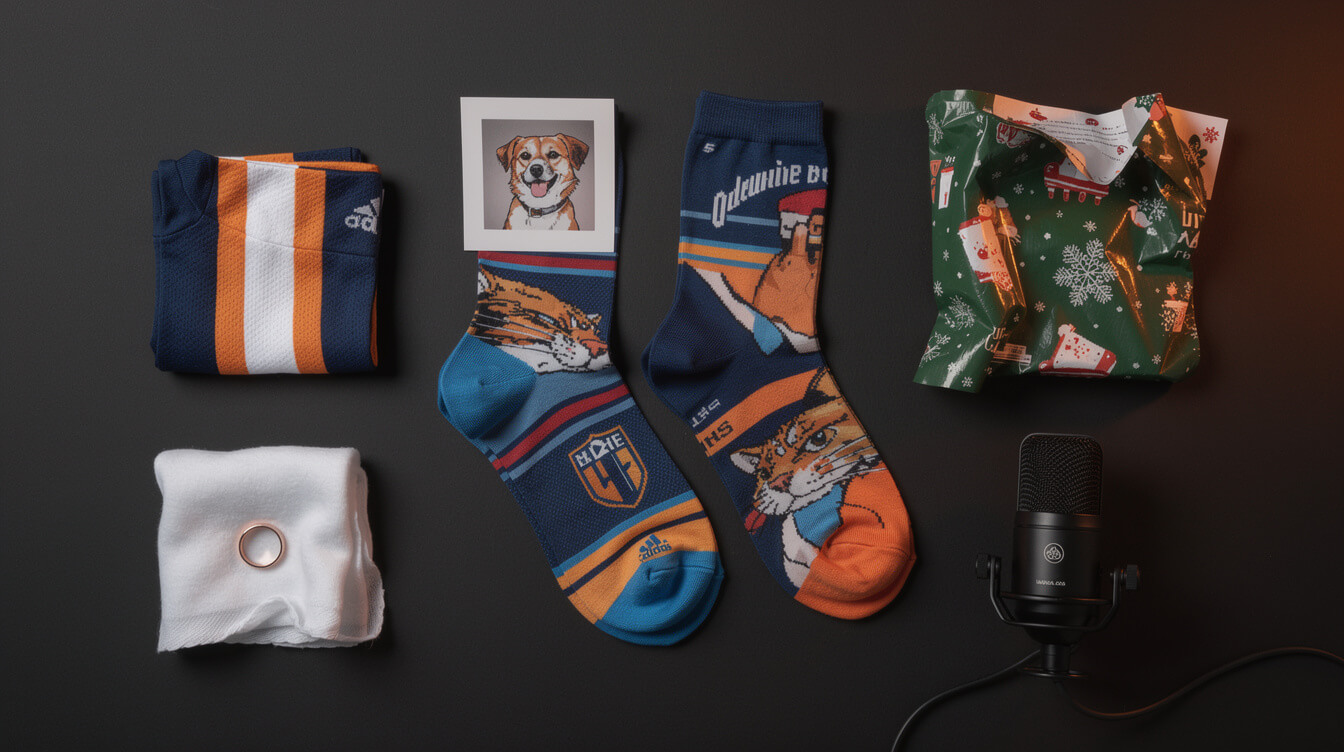
Not all sock niches perform equally. The highest-converting niches share a common trait: the sock is a gift purchase rather than a self-purchase, which means the buyer has lower price sensitivity and higher motivation to buy for the custom element.
1. Pet portrait socks. Dog or cat faces printed on the sock body. Buyers are overwhelmingly gift purchasers — a sock with someone’s pet on it is low-risk, moderately priced, and high in novelty value. The repeat-purchase rate is driven by gift-giving cycles: birthdays, Christmas, Valentine’s Day. A buyer who purchased a dog portrait sock for a partner’s birthday often returns for a different occasion throughout the year.
2. Sports team fan socks. Sublimated socks in team colors, with jersey-style patterns or team-adjacent visual motifs. This niche benefits from seasonal demand spikes aligned with sports seasons. Football in August and September, basketball in October, baseball in April. The team-specific angle also reduces price comparison pressure — a Packers fan will pay $22 for a Packers-adjacent sock that does not exist on Amazon.
3. Novelty gift socks. Photo socks with a face or image printed on the foot area. This is one of the highest-conversion novelty gifting products in POD. The category requires the buyer to upload a photo, which is a strong commitment signal — people who upload a photo convert at higher rates than people still browsing without intent.
4. Wedding favor socks. Bride and groom sock sets, wedding party gifts, bridesmaid socks, groomsmen socks. This niche has a defined buying window, typically 3 to 9 months before the wedding date. Conversions tend toward higher AOV because buyers are purchasing multiple pairs at once for the full wedding party.
5. Holiday seasonal drops. Christmas socks, Halloween socks, Thanksgiving family sets. These are high-velocity spike products for 6 to 8 weeks per year, with near-zero sales outside the seasonal window. Sellers who build holiday sock listings need designs indexed at least 6 to 8 weeks before the holiday for SEO to do meaningful work.
6. Music artist and creator merch socks. Independent musicians, podcasters, and content creators who want a low-barrier merch product. Socks are lightweight to ship, inexpensive to produce, and offer full creative coverage. The repeat-purchase dynamic is fan-driven — fans buying socks as a low-cost way to support creators they follow.
The pet niche guide for dog bandanas covers the repeat-purchase mechanics of pet owner buyers in depth. The buyer behavior in that category and in pet portrait socks is closely related.
Generate custom sock designs at scale. 30x the throughput of manual Canva workflows.
MEGA is the research-to-product pipeline for POD sellers. Connect WooCommerce and Printful, feed a niche idea, and MEGA generates designs, sizes files, and populates listings end to end.
The Shopify 1% override math at custom sock store AOV levels

The Shopify 1% platform override on third-party payment processors does not look dramatic in isolation. At a $20 AOV, it is $0.20 per order. At 200 orders per month, it is $40 per month, or $480 per year.
But that $480 does not exist in isolation. It stacks on top of the Shopify plan cost ($29 to $79 per month), payment processor fees (2.9% plus $0.30 on Stripe), and — if you are running photo upload socks where the buyer submits their pet’s face — you need a personalization app because Shopify does not include custom file upload fields natively. Personalization apps run $19 to $49 per month.
Here is what the full platform overhead looks like at 200 orders per month on a sock store with a $20 average order value:
- Shopify plan: $29 to $79 per month
- 1% platform override (200 x $20): $40 per month
- Personalization app (photo upload field): $19 to $49 per month
- Total Shopify overhead: $88 to $168 per month / $1,056 to $2,016 per year
- WooCommerce hosting: $15 to $30 per month
- 1% platform override: $0 (WooCommerce charges no platform fee on sales)
- Personalization app: $0 (WooCommerce native custom product fields handle file uploads)
- Total WooCommerce overhead: $15 to $30 per month / $180 to $360 per year
The annual difference is $700 to $1,600. For a sock store at $20 AOV and 200 orders per month ($4,000 GMV), that overhead difference represents 18 to 40% of total gross margin before any marketing spend. It compounds every month you operate on the more expensive platform.
The Shopify argument is ease of setup. That argument holds at zero orders per month when you are experimenting. At 200 monthly orders on a low-AOV product, WooCommerce’s fixed overhead structure wins in a way that compounds over time.
The WooCommerce vs Shopify comparison for POD sellers runs the full math at multiple GMV levels from $1,000 to $10,000 per month. The sock store case is one of the starkest illustrations because the AOV is low enough that the percentage fee impact is unusually high.
The custom sticker sheet post covers the same low-AOV economics from a different product angle. Stickers and socks share a pricing structure ($8 to $20 per unit) that makes the 1% override more damaging as a percentage of gross margin than it is on higher-AOV products like framed prints or premium drinkware.
Where to start with custom socks in your POD store
Custom socks with logo is an underserved editorial space because the content that exists was written for bulk buyers, not POD sellers. That gap represents an opportunity for sellers willing to build a sock product line with the right foundation.
For POD sellers entering this category, the starting point is straightforward. Confirm that your preferred provider carries a sublimated sock style in your fulfillment region. Build your first product around all-over-print rather than logo-only. Choose a starting niche — pet portrait or sports fan socks will give you the fastest feedback loop on conversion rate and repeat purchase behavior.
The bundle math matters more than the per-unit margin. A 4-pack promotion at $55 to $65 AOV transforms the economics of this category compared to $20 single-pair listings. Build toward bundles once you have one sock design converting consistently.
On WooCommerce, native custom product fields handle photo uploads and personalization without an app. That is $19 to $49 per month back in margin, compounding monthly against the Shopify alternative.
The custom sportswear guide covers sublimation on performance fabric in more detail if you are building a sports-adjacent product line. The technical requirements overlap substantially with what you will encounter building a sock product line in that niche.
Implement AI. 30x your throughput. Get a 30-min call with the founder.
Drop your details and book a free 30-minute discovery call. Personalized advice on your POD stack, your margin, and where AI fits. No pitch, no fluff.