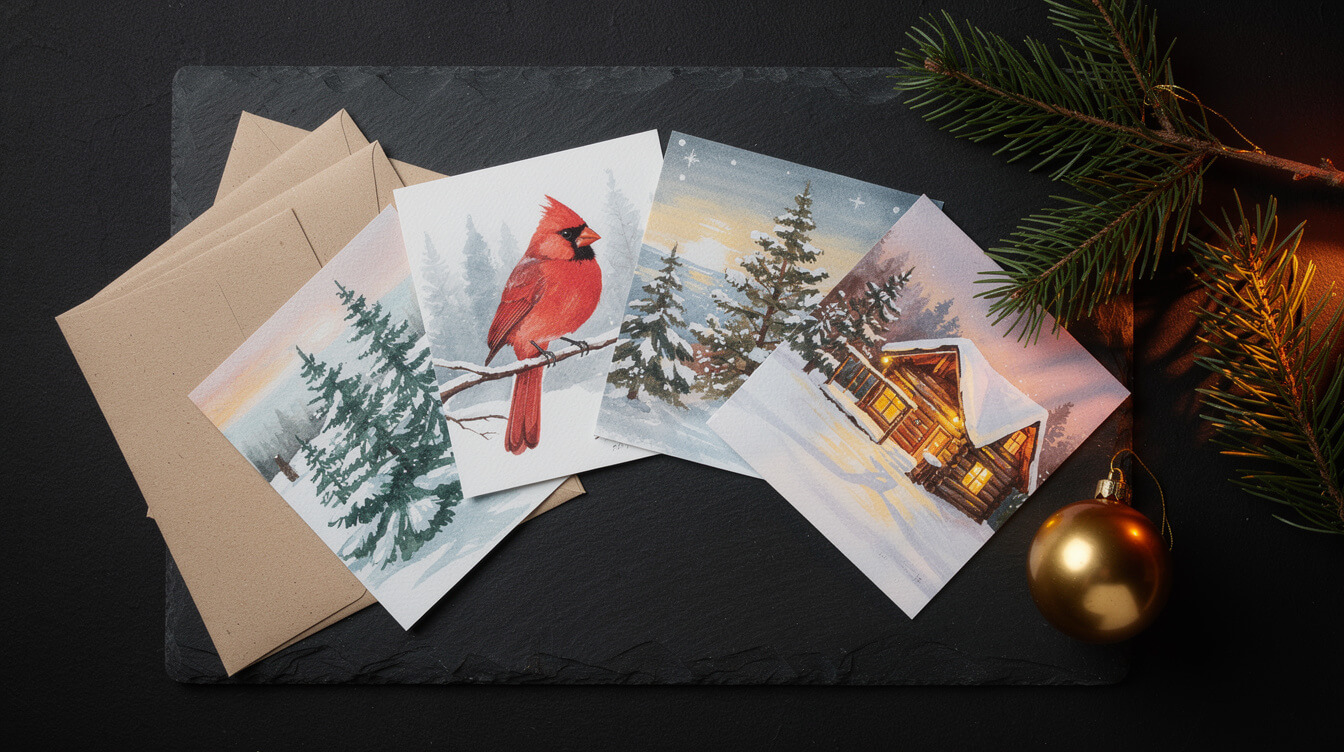
Custom christmas cards for POD sellers: why the per-card math breaks at one card, and the three models that sell
Search for custom christmas cards and every result on page one sells to the buyer. 123print, PhotoAffections, JukeboxPrint, Paperless Post, Walmart Photo. Template grids, 50-card photo packs, foil upgrades, and promo banners. The one editorial result is a Wirecutter review written for people mailing family photos, and its benchmark is blunt: about $2.50 per card, shipping included, is the most a consumer should pay.
Now look at that number from the seller side. Printful’s 4×6 greeting card costs $2.50 before shipping. Shipping to a US address starts at $4.49. One print-on-demand card lands at $6.99 before you have earned a cent. That gap is why most POD sellers either skip the category or list a $5 card and quietly lose money on it. This guide does the math with live Printful and Printify pricing pulled on October 13, 2026, then shows the three models that actually make money on custom christmas cards: premium art sets, gift-bundle add-ons, and digital printables. It ends with the Q4 calendar, because search demand for this keyword climbs from about 8,100 searches a month to roughly 49,500 in November.
Custom christmas cards: why the SERP is a price war POD sellers should not enter
The page-one players for custom christmas cards are not print-on-demand stores. They are bulk photo printers with their own presses, paper contracts, and mailing operations. They print 50 or 100 copies of one design for one household, ship them in one box, and spread the shipping cost across the whole order. That is why PhotoAffections can advertise cards “as low as” $0.55 to $0.73 each at volume, and why its sitewide promotions stack 35% off with free shipping.
POD works the other way around. The product is made one unit at a time, packed one unit at a time, and shipped to one customer at a time. That model is brilliant for a $35 hoodie, where a $4.49 shipping line is 13% of the price. It is brutal for a $2.50 card, where the same shipping line is 180% of the product cost.
The benchmark buyers carry in their heads
Here is how the two models compare on a typical 25-card photo order, the kind a family mails every December.
- Bulk photo service: 25 cards at $0.55 to $2.50 each = $13.75 to $62.50, usually with a free or flat shipping promo.
- POD, shipped one per order: 25 cards at $6.99 landed = $174.75 in cost alone.
- POD, shipped as one 25-card order: Printful’s own bulk calculator shows $1.78 per card at 25 units (30% off), but that discount is for you ordering stock, not for a single customer’s design.
The verdict is simple. Do not compete on cheap custom christmas cards aimed at the “family photo card, 50 copies, cheapest wins” buyer. That buyer is shopping on price per card, and a POD stack will lose that fight every time. The good news is that this buyer is only part of the 49,500 November searches. The rest want something the bulk printers do not sell well: original art, a card that comes with a gift, or a file they can print tonight.
Which providers print custom christmas cards one at a time
Two networks matter for US sellers who want to sell custom christmas cards right now. We checked both live on October 13, 2026.
Printful Greeting Card (catalog ID 568)
- Stock: 350 gsm paperboard (14.77 oz/yd²), toner-based digital printing, complimentary envelope included.
- Sizes: 4×6 in, 5×7 in, and 5.83×8.27 in.
- Price: 4×6 is $2.50 in the catalog API ($2.55 on the product page). 5×7 is $2.95. The large size is $3.75.
- The catch: only the 4×6 is available in the US region. The 5×7 and large sizes are listed for Europe only. A US seller effectively has one size to work with.
- Shipping: starts at $4.49 to the US. An order placed today shows estimated US delivery of Oct 26 to 29.
- Minimum: none. One card per order is fine.
Printify: two very different card products
- Greeting Cards, 1 or 10 pcs (ID 785): 4×6 closed, 8×6 open, semi-glossy print on matte paper, envelopes included. From $2.97 ($2.20 with Printify Premium). The problem: there is no local provider for the US, and shipping starts at $16.79. Skip it for US buyers.
- Multi-Design Greeting Cards, 5-pack (ID 1232): 4.25×5.5 in, 271 gsm uncoated paper, printing on outside and inside, a different design on each card, matching white envelopes, assembled in the USA. From $16.01 per pack ($11.88 with Premium), shipping from $8.99, average production 1.8 days. This is the most useful card SKU in POD right now for sellers who want to sell sets.
The postcard alternative
Printful’s Standard Postcard (ID 433) is $1.75 for a 4×6 coated card and ships to the US. It is flat, not folded, and there is no envelope. It works for minimalist art cards and “mail it as-is” holiday greetings, and it is the cheapest physical option on either network. It does not feel like a christmas card to most buyers, so price and position it as an art postcard, not a card.
One honest note: provider catalogs change fast in Q4. A size that is EU-only today can open to the US in November, and stock can disappear. Check the product page the day you list, not the day you read a guide.
The per-card landed cost math: 1 card vs 5-pack vs 10-pack vs bundle add-on
This is where most guides on custom christmas cards get vague. Here are the numbers. Payment processing is calculated at 2.9% + $0.30 per order, a typical card processor rate on an owned WooCommerce store. Prices include shipping, because buyers compare card prices with shipping baked in.
Scenario A: one Printful 4×6 card, sold at $12
- Base $2.50 + shipping $4.49 = $6.99 landed
- Processing on $12: $0.65
- Net: $4.36 per order (36%)
That works on paper, but $12 for one card is almost five times the Wirecutter ceiling. It only sells when the buyer is paying for the art, not the paper.
Scenario B: Printify 5-pack multi-design set, sold at $38
- Pack $16.01 + shipping $8.99 = $25.00 landed ($20.87 with Premium)
- Processing on $38: $1.40
- Net: $11.60 (31%), or $15.73 (41%) on Printify Premium
At $34 the same set nets $7.71 (23%) without Premium. Below $34, the set is not worth listing. Premium pays for itself at roughly 7 sets a month in Q4.
Scenario C: ten Printful 4×6 cards in one order, sold at $48
- Base 10 x $2.50 = $25.00 + first-item shipping $4.49 = $29.49 before additional-card shipping
- Processing on $48: $1.69
- Net: up to $16.82, minus whatever Printful charges per additional card
Printful’s additional-item rates live in its shipping calculator, not on the product page. Run a test order to your own address before you price a 10-pack. If additional cards add $0.50 each, you lose $4.50 and still net about $12.
Scenario D: a card added to a gift order
- Base $2.50, shipping at the additional-item rate instead of a fresh $4.49
- Sold as a $6 add-on, or folded into a gift bundle priced $5 higher
- Net: roughly $3.00 per add-on after processing, before the additional-item rate
Scenario D looks small. It is not, because it rides on traffic you already paid for. More on that in the next section.
Three models that sell custom christmas cards at a profit

Smash print-on-demand. Join the engine room.
One short email a week. Real numbers, real teardowns, the unfiltered economics behind every move.
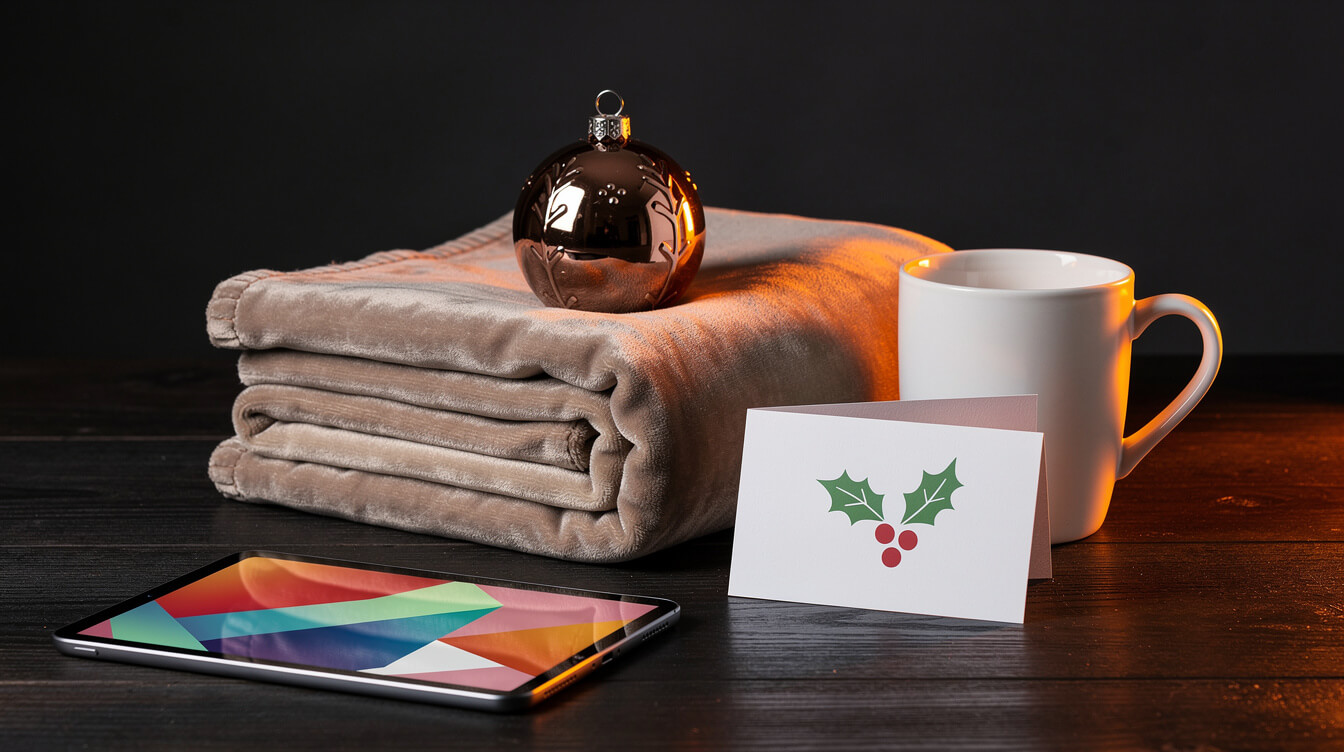
Each model sidesteps the per-card price war on custom christmas cards in a different way. Most stores should run two of the three.
Model 1: premium art sets (5 to 10 cards, $34 to $48)
Stop selling “a card.” Sell a collection. Five illustrated winter scenes by one artist, a set of ten cards featuring one dog breed, a nativity series in a consistent style. The Printify 5-pack is built for this, because each card in the pack can carry a different design.
The buyer here is not a family mailing 60 photo cards. It is someone who writes 8 to 15 cards by hand every year and wants them to look intentional. They compare your set to boutique stationery at a gift shop, not to PhotoAffections. That shifts your price anchor from $0.55 per card to $5 to $8 per card.
Model 2: the gift-bundle add-on
This is the quiet winner. Anyone buying a custom ornament, a pet portrait blanket, or a christmas mug for someone else needs a card to go with it. Offer a matching card on the product page as a checkbox add-on, printed with the same art as the gift.
The economics change completely. The card no longer carries its own first-item shipping, it costs nothing extra to acquire, and it lifts average order value by $5 to $6. If 25% of 400 Q4 ornament orders add a $6 card, that is 100 cards and about $300 in extra profit from traffic you already had. Pair it with our custom ornament guide and our custom wrapping paper breakdown, and you have a three-SKU gift bundle where the card and wrap are pure margin lift.
One warning: Printful only ships items together when they come from the same fulfillment facility. If the ornament and the card are produced in different locations, the card ships separately at the full first-item rate. Place a test order with both SKUs before you promote the bundle.
Model 3: digital printables (instant download)
The dominant model on Etsy for custom christmas cards is not physical at all. It is a PDF or an editable template the buyer prints at home or at a local print shop. No fulfillment, no shipping, no deadline.
- $6 printable on WooCommerce: processing $0.47, net $5.53 (92%)
- $6 printable on Etsy: $0.20 listing fee + 6.5% transaction fee ($0.39) + about 3% + $0.25 payment processing ($0.43), net about $4.98 (83%)
Digital also owns the late-buyer window. After the physical shipping cutoff, the only card you can still sell on December 22 is one the buyer prints themselves.
Which two to run
- You already sell gifts (mugs, ornaments, blankets): Model 2 first, Model 3 second.
- You are an illustrator or run an art-led store: Model 1 first, Model 3 second.
- You sell apparel only: Model 3 alone. A $6 printable that matches your best-selling holiday tee is the lowest-risk test in this guide.
Design specs for print-ready christmas cards

Custom christmas cards are small, held close, and read in good light. Every flaw shows. Five rules cover most of the problems we see.
1. Build at 300 DPI at final size
A 4×6 front panel at 300 DPI is 1,200 x 1,800 px. The open 8×6 spread is 2,400 x 1,800 px. The Printify 5-pack at 4.25×5.5 needs 1,275 x 1,650 px per panel. Start from the provider’s template so the fold and panel order are correct.
2. Respect bleed and safe zones
Extend background art past the trim line using the template’s bleed area, and keep faces, stars, and key details at least 0.125 in inside the trim. Cutting tolerance on small cards is visible. A dog’s ear clipped by 2 mm ruins a pet card.
3. Plan the inside panel
The Printify 5-pack prints inside and out. Printful’s 568 listing does not mention inside printing, so confirm it in the designer before you promise it. If you print inside, keep the message panel quiet: a short line and lots of white space so the buyer can write. Busy insides are the most common complaint on handwritten card sets.
4. Know what toner and uncoated paper do to color
Printful prints cards with toner on paperboard. Toner handles crisp illustration and flat color well. Very large areas of deep, solid dark color can look slightly less rich than on screen. Printify’s 5-pack uses uncoated paper, which absorbs ink and softens colors. Design for it: favor clean shapes, strong contrast, and a slightly brighter palette than you would use on a glossy photo card. Order one physical sample of each design family before Q4 traffic arrives.
5. Keep text minimal and vector
If the front carries a greeting, set it as vector type in a clean holiday serif or script, not as part of a raster image. Small type rasterized at the wrong resolution prints fuzzy. Better still, let the art carry the front and put the greeting inside.
Repeating all of this across a 20-design Q4 line is where most sellers run out of evenings. MEGA automates this step entirely: MEGA handles niche research, generates the art, crops it to each product, builds mockups, and writes titles, SEO, and the full WooCommerce listing in under seven minutes per product. That is a full holiday card collection in one afternoon instead of one Canva card per night.

A 20-design Q4 card set in one afternoon
MEGA generates the art, mockups, titles, SEO, and WooCommerce listings for a full holiday card collection end-to-end. Under seven minutes per product, 30x faster than the manual Canva workflow.
Shopify 1% override vs WooCommerce on low-AOV seasonal cards

Custom christmas cards are a low-AOV product, and that changes how platform costs bite. Percentage fees matter less. Fixed monthly fees matter more.
The percentage side
Say a store sells 400 card orders in Q4 at a $14 average order value. That is $5,600 in card revenue. Shopify’s 1% override on third-party payment processing takes $56 of it. Not a disaster on its own. But on a $12 card that nets $4.36, the $0.12 override is nearly 3% of your profit on every order, and it stacks on top of processing.
The fixed side is the real cost
Personalized custom christmas cards need a text field: the family name on the front, a custom message inside. On Shopify, that usually means a product personalization app at $15 to $29 a month. Run it for October through December and you spend $45 to $87 before you sell a card. For a card line that nets $1,500 in Q4, app fees plus the override can eat 7% to 10% of profit.
On an owned WooCommerce store, a product add-on text field is a one-time setup, and the field data flows straight into the order. You pay hosting you were already paying. There is no override on the transaction. We broke down the full comparison in WooCommerce vs Shopify for POD sellers.
Personalization fields that sell cards
- Family name line on the front (“The Alvarez Family”), limited to 24 characters so it fits the safe zone.
- Inside message, limited to 120 characters, with a default message pre-filled so buyers who skip it still get a finished card.
- Pet name on pet cards. This one field lifts conversion more than any other on pet products.
- Year as a dropdown, not free text, to avoid typos like “2062.”
Keep character limits tight. Every extra character is a chance for a buyer to break your layout, and every broken layout is a refund in December.
Q4 timeline and the niches that sell custom christmas cards
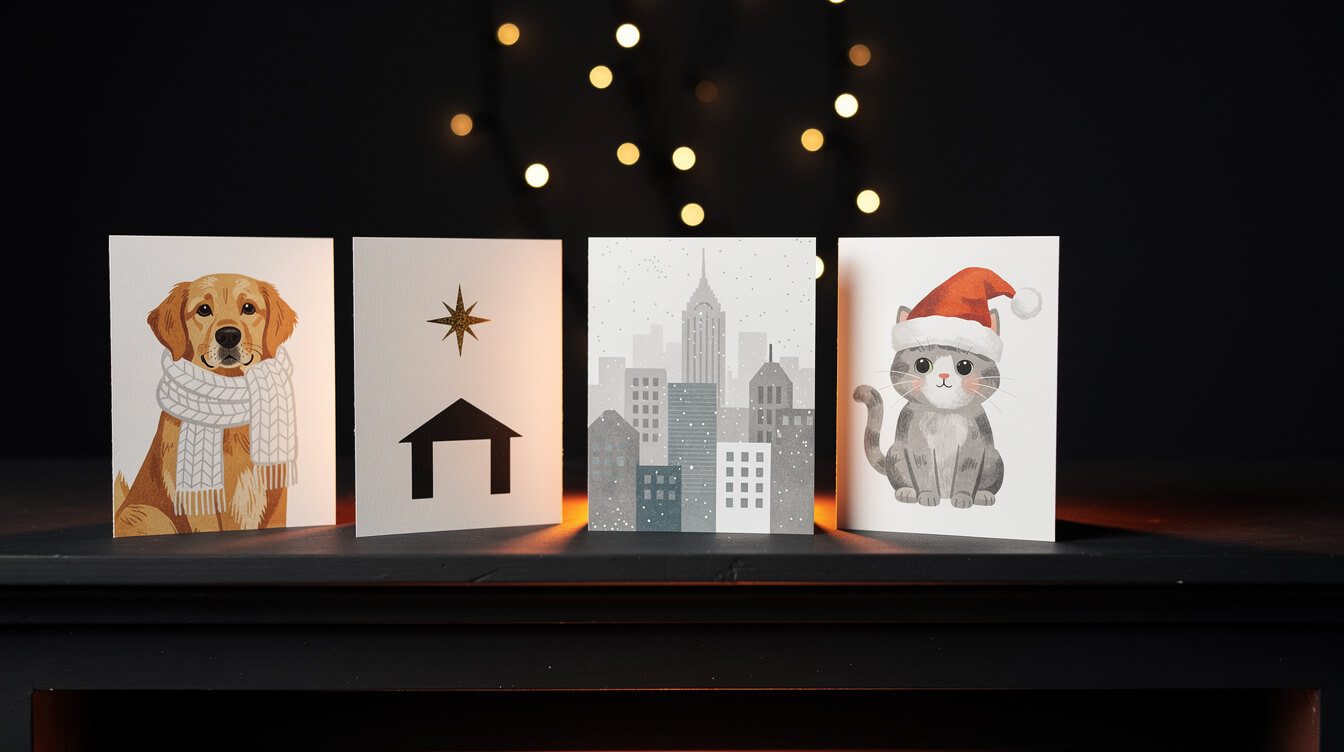
Demand for custom christmas cards is the most deadline-driven in Q4. Buyers need cards to arrive, be written, and be mailed again before December 25. Work backwards.
The 2026 calendar
- Now to Nov 1: list. Google needs weeks to index and rank new product pages, and search demand peaks in November.
- Nov 1 to Dec 1: peak physical sales. Lead with sets and bundles.
- Dec 1: put a “last day to order” banner on every card product. Card buyers need time to write and re-mail.
- Dec 11: Printful’s 2026 standard-shipping order deadline for US-fulfilled home and living products shipping to the US. Dec 16 for express.
- Dec 17: USPS’s recommended 2026 send-by date for First-Class Mail to arrive by Christmas in the lower 48. That is the deadline your buyer faces when they mail the card onward.
- Dec 12 to 24: digital only. Swap your homepage hero to printables and promote “print tonight” sets.
A practical rule: set your own physical card cutoff around December 10. A card that arrives December 18 is a card the buyer cannot mail in time, and that buyer asks for a refund.
Five niches worth a collection
- Pet-family cards. Breed-specific illustrated sets, “from the dog” cards, and pet name personalization. Breed communities share aggressively, and pet buyers are the least price-sensitive card buyers.
- Small-business client cards. Contractors, realtors, salons, and agencies send 20 to 100 client cards each December. A 10-pack with a logo-free, on-brand illustration and a custom inside line is an easy B2B upsell.
- “From the dog” and “from the cat” humor. A distinct sub-niche with strong gift intent. Keep jokes inside, art outside.
- Faith and nativity. A large, loyal audience that bulk photo services serve poorly. Quiet, reverent illustration outsells clip art.
- Illustrated city and hometown cards. A snowy skyline of a specific city sells to locals and to people who moved away. Each city is its own small niche with low competition.
If you already sell holiday decor, cross-sell these against our custom christmas stockings guide. Stockings, ornaments, cards, and wrap are one buyer making one set of decisions in one week. The same buyer is usually ordering matching family christmas shirts for the photo on the card.
Conclusion: custom christmas cards are a margin product, not a volume product
The bulk photo printers have the volume game locked. At $0.55 to $2.50 per card, no print-on-demand setup can match them, and you should not try. What POD does well is everything they do badly: original art, one-of-one sets, a card that arrives with the gift, and a file that is ready in seconds on December 22.
Run the numbers before you list. One Printful card lands at $6.99. A Printify 5-pack lands at $25.00, or $20.87 on Premium. A $6 add-on card rides on traffic you already paid for. A $6 printable keeps 92% on your own store. Pick two models, build your custom christmas cards collection by early November, and set your physical cutoff around December 10.
This post was researched and assembled with help from the MEGA stack, the same pipeline our users run on their own catalogs. The other stationery pieces in this series are worth a read before Q4: custom calendars, custom notepads, and custom playing cards.
Frequently asked questions
Can you sell custom christmas cards on print on demand?
Yes. Printful prints a 4×6 greeting card with an envelope at no minimum for $2.50, and Printify’s network offers a US-made multi-design 5-pack from $16.01. The challenge is not availability. It is that per-card shipping makes single cheap cards unprofitable, so sell sets, bundles, or printables instead.
How much does it cost to print one christmas card with POD?
About $6.99 delivered in the US with Printful: $2.50 for the card and $4.49 for first-item shipping, as of October 2026. That is why single cards need to sell at $12 or more as premium art, or ride along with another product.
Are digital christmas cards worth selling?
For most stores, yes. A $6 printable keeps about $5.53 on WooCommerce and about $4.98 on Etsy, with no fulfillment and no shipping deadline. Digital cards also own the last two weeks before Christmas, when physical orders can no longer arrive in time.
What size should a POD christmas card be?
For US buyers, 4×6 on Printful or 4.25×5.5 on Printify’s 5-pack. Printful’s 5×7 and larger sizes are currently EU-only. Build files at 300 DPI using the provider template.
If you want that throughput on your own holiday catalog, MEGA handles research, imagery, titles, SEO, and the WooCommerce product end-to-end.

Implement AI. 30x your throughput. Get a 30-min call with the founder.
Drop your details and book a free 30-minute discovery call. Personalized advice on your POD stack, your margin, and where AI fits. No pitch, no fluff.