Custom playing cards for POD stores: which providers carry them, card stock specs, and the niche market breakdown
Custom playing cards attract 18,100 monthly searches, and almost every result points to a B2B card manufacturer or a consumer photo-gift service. There is no editorial content for POD sellers who want to stock playing cards as a drop-ship product in their own store. That gap is exactly what this guide covers. You will find out which providers actually carry custom playing cards, what card stock specs matter at the point of listing, how the unit economics play out at $25-35 retail, and which niche verticals drive the most consistent demand.
Playing cards as a POD product: what the 18,100 monthly searches are actually looking for
The search intent behind “custom playing cards” splits into three distinct groups, and understanding the split determines how you position your store.
The first group is game creators. Kickstarter backers, TTRPG publishers, and independent card game designers searching for card manufacturers. They need short-run physical production at 100-500 unit minimums, not a drop-ship fulfillment partner. Providers like MakePlayingCards.com built their business serving this segment.
The second group is consumers. Wedding couples who want personalized photo decks for favor bags. Parents ordering novelty decks with family photos. Fans of a sports team wanting a custom deck as a gift. These buyers land on Walmart Photo or Bicycle Custom and order 1-3 decks at a time.
The third group is the one no competitor serves with editorial content: POD sellers. Store operators who want to list custom playing cards as a permanent product in their WooCommerce or Shopify store, fulfilled via drop-ship, with no minimum order and no inventory risk. This guide is written for them.
The business case is straightforward. Playing cards have a high perceived value relative to their production weight. A deck that costs $10-14 to produce via POD sells for $25-35 retail, clearing 40-55% gross margin. They ship in a flat box or padded mailer, so fulfillment is simple. And unlike apparel, there are no size variants to manage. One SKU, one listing, one design file.
Which POD providers carry custom playing cards: Printify partners, Printful, and direct alternatives compared

The critical fact every seller needs to know upfront: Printful does not carry custom playing cards in its standard catalog as of 2026. This eliminates the most common starting point for new POD sellers and pushes the search toward Printify’s partner network and direct alternatives.
Printify network
Printify lists custom playing cards through its fulfillment partner network. MakePlayingCards.com (MPC) is the most recognized name in the space and operates within the Printify ecosystem for some configurations. Card quality from Printify partners is generally strong, using standard poker-sized stock with linen or plastic-coated finishes. Production time typically runs 7-10 business days before shipping, so total fulfillment to a US buyer runs 10-18 days depending on the shipping tier selected.
Printify’s free tier imposes a 20% markup on base costs. If the base cost for a 54-card deck is $11.50, a free-tier Printify seller sees that as $13.80 before setting their retail price. Printify Premium ($29/month) removes the markup, which matters on a sub-$15 base cost product because the savings compound quickly at volume.
Direct via MakePlayingCards.com
MPC also operates a white-label drop-ship program directly, outside the Printify layer. Going direct eliminates the Printify markup but requires managing a separate supplier relationship, separate order routing, and separate customer service escalation path. For high-volume sellers who already know MPC’s quality and process, this can be the right move. For sellers building out a catalog alongside other product categories, staying within a single platform like Printify keeps operations cleaner.
Gooten
Gooten is a third fulfillment platform that integrates directly with WooCommerce. Its catalog depth and pricing structures differ from Printify, and playing card availability varies by region. If you are already researching Gooten for other product types, it is worth checking the current catalog. For a full breakdown of how Gooten’s integration and pricing compare to Printful, see our Gooten print-on-demand overview.
Printify vs. direct: the practical answer
For most POD sellers starting out with playing cards, Printify Premium is the cleaner path. One platform, one order dashboard, and access to a broader catalog of other products alongside the card decks. The $29/month cost for Printify Premium pays for itself in markup savings within 3-4 deck orders per month.
Card stock, finish, and print specs that matter for sellable decks
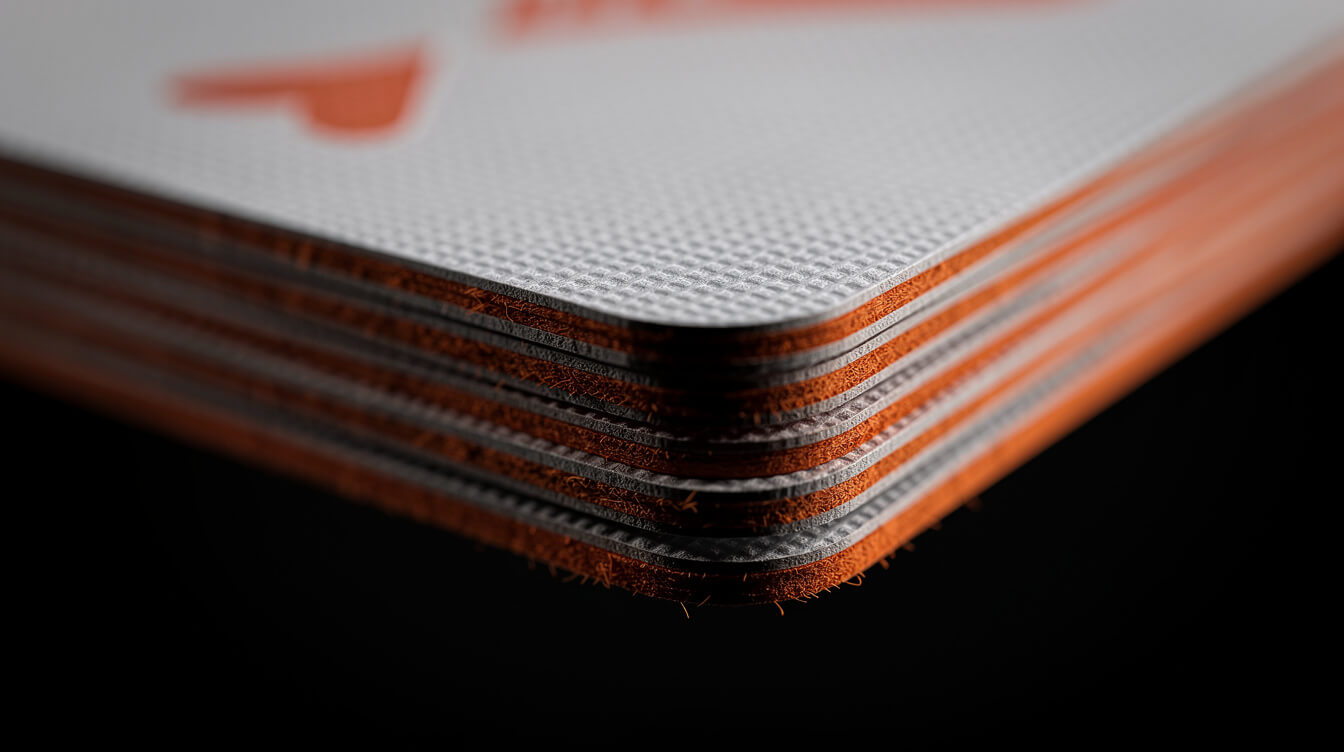
Not all custom playing card specs are equal. The choices you make at the product setup stage directly affect how your deck handles during use, and buyers in the gift and gaming categories notice the difference.
Size: poker vs. bridge
Standard poker size is 2.5 x 3.5 inches. Bridge size is narrower at 2.25 x 3.5 inches. Poker size is the default for custom decks in the US gift market and most gaming contexts. Bridge size is primarily used for actual bridge card games. List poker size unless your niche is specifically bridge-adjacent.
Card stock weight
Most POD playing card suppliers print on 300-330 GSM card stock. This sits in the range that feels substantial without being stiff. Thinner stock (below 280 GSM) feels cheap to buyers. The stock weight is usually fixed by the supplier, so this is not a choice you make, but it is a spec worth including in your product description to justify the price point.
Finish options
The two most common finishes for drop-ship playing cards are linen finish and smooth plastic-coated finish.
Linen finish uses a textured air-cushion embossing that improves handling, reduces slipping, and gives the deck a premium tactile feel. It is the standard finish on casino-quality decks and handles better than smooth stock for card games.
Smooth plastic-coated finish is a wipe-clean coating applied over the print. It protects against light moisture and finger oils. It is more durable than raw paper stock but does not have the air-cushion performance of linen.
If your supplier offers a choice, linen finish is the better default for gift and gaming buyers. It photographs better and justifies a $3-5 higher retail price.
Deck configuration
Standard deck: 54 cards (52 playing cards plus 2 jokers). Some suppliers allow 56-card decks that include 2 additional custom cards, which is useful for adding a branding card or a rules card. The tuck box that the deck ships in is also fully custom-printed and is included in the product cost.
Print method
Playing cards are printed via offset lithography or digital sheet printing, not DTG, sublimation, or screen printing. The substrate is a laminated paper or plastic-paper composite, not fabric. This matters because the design rules are entirely different from apparel: full bleed is standard, color accuracy is high, and there are no polyester-content restrictions or color-mode limitations beyond standard CMYK print specs.
Unit cost math at 1, 10, and 50 units with margin analysis at $25-35 retail

Smash print-on-demand. Join the engine room.
One short email a week. Real numbers, real teardowns, the unfiltered economics behind every move.

Here is how the numbers look across order volumes. All figures are approximations based on Printify partner catalog pricing; your exact costs will vary by supplier and region.
At 1 unit (individual order, fully drop-shipped)
- Base production cost: $11.50-13.50 per deck
- Standard shipping to US buyer: $4.50-6.00
- Printify free-tier markup (20%): adds $2.30-2.70 to base if not on Premium
- Total fulfillment cost (Premium, no markup): $16.00-19.50
- Retail price at $28: gross margin $8.50-12.00 (30-43%)
- Retail price at $32: gross margin $12.50-16.00 (39-50%)
At 10 units (small batch, still drop-shipped one at a time)
POD fulfillment is per-order, so the unit cost at 10 orders is the same as at 1 order. The difference is operational: at 10 units per month you are covering Printify Premium ($29/month) within the markup savings alone.
At 50 units per month
- Total fulfillment cost per deck (Premium): $16.00-19.50 (unchanged)
- Revenue at $30 average selling price: $1,500
- Total fulfillment cost: $800-975
- Gross profit: $525-700 (35-47%)
- Printify Premium cost: $29
- Net gross after platform: $496-671
Playing cards sit in a similar margin profile to custom sticker sheets and custom koozies: low AOV products where the percentage margin is solid but the dollar margin per order is thinner than apparel. The business case depends on volume and niche specificity.
MEGA handles the research-to-listing pipeline in under seven minutes, including niche discovery, SEO titles, and product descriptions so you can build out a full playing card catalog without the manual setup overhead. Try MEGA at mega.management.
30x your product throughput. Research-to-listing in under 7 minutes.
MEGA automates the niche research, design generation, SEO, and WooCommerce listing for every product in your POD catalog. No Canva. No 6-hour workflows.
Shopify 1% at $20-35 AOV: the low-ticket platform fee problem playing cards share with stickers and koozies

Shopify charges a 1% platform override on all sales processed through non-Shopify payment gateways. On high-AOV products like a $65 hoodie, this fee is $0.65 and barely registers. On a $28 playing card deck, it is $0.28 per order.
That sounds small. Here is where it compounds.
At 50 deck orders per month, the Shopify 1% fee costs $14. At 200 orders per month, it is $56. At 500 orders per month, it is $140. None of those numbers will break your business, but they are pure extraction with zero value returned. The fee goes to Shopify for processing transactions through payment gateways they do not control and did not build.
On a $28 product with $10-12 gross margin, the 1% fee represents 2.3-2.8% of your gross profit per order. Stack that against Shopify’s base plan at $39/month, the Printify Premium fee, and the Shopify Payments rate, and the platform stack starts to look expensive for a product in this price range.
WooCommerce eliminates the platform override entirely. You pay hosting (typically $15-30/month), the WooCommerce plugin (free), and payment processing at standard card rates (Stripe or PayPal, comparable to Shopify Payments). There is no percentage extracted on top of the transaction. At 500 playing card orders per month at $28, that is $140/month in margin you keep instead of sending to Shopify.
This is the same math we cover for custom puzzles and other gift-category products: the lower the AOV, the more proportionally damaging the Shopify 1% becomes over time. The argument for WooCommerce gets stronger, not weaker, at lower price points.
Niche verticals: wedding favors, tabletop gaming, corporate gifts, artist decks, and the magic market
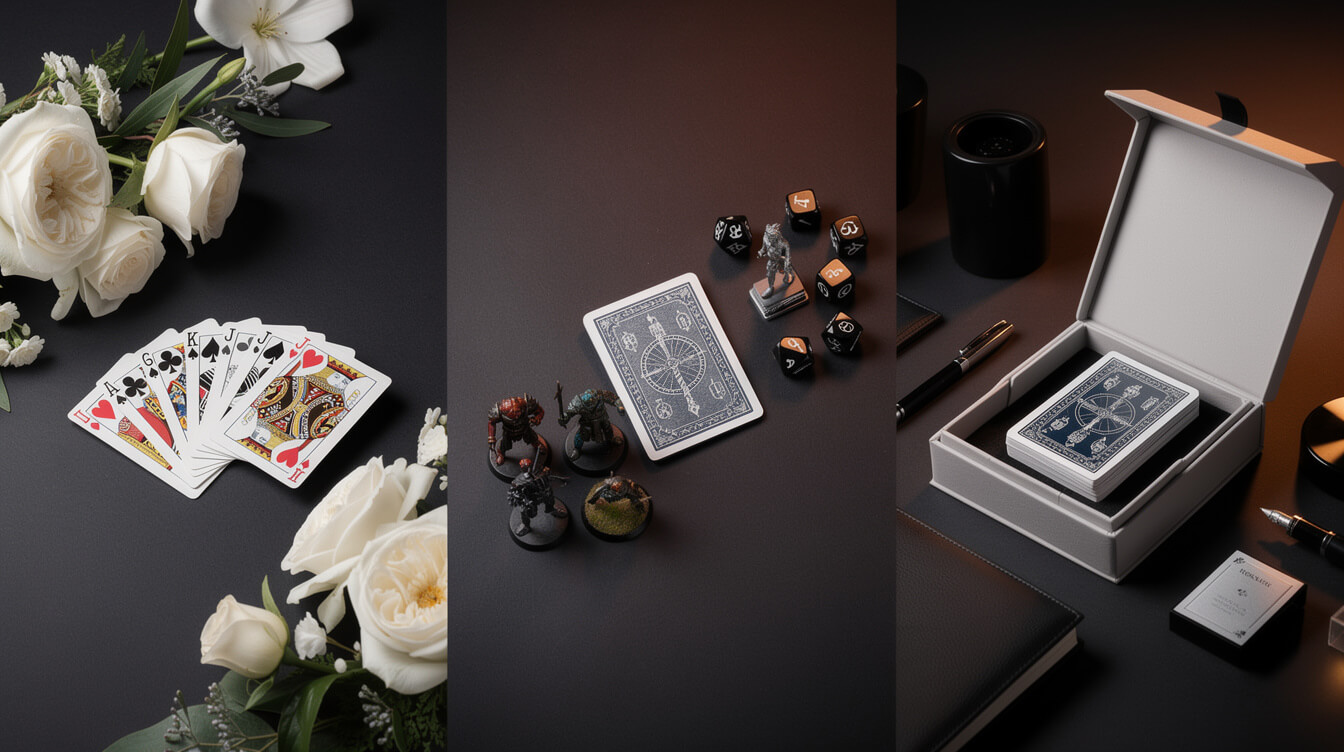
Playing cards are a product with multiple distinct buyer segments, and each segment responds to different design angles and marketing messages. Identifying your primary niche before building out your catalog lets you focus your SEO and design work instead of trying to serve everyone at once.
Wedding favors
Wedding-favor playing cards are a well-established category. Couples order custom decks printed with their names, wedding date, and a photo or illustration. The economics favor POD: the couple typically orders 30-80 decks for table settings, which in a drop-ship model means 30-80 individual orders processed sequentially. At $28-32 per deck, the total order value is $840-2,560 for a single wedding client. The conversion window is 3-6 months before the wedding date, and repeat purchase rates are zero (one wedding per couple). Acquisition happens via wedding forums, Pinterest, and Etsy-adjacent search.
Tabletop gaming (TTRPG and card games)
The tabletop roleplaying game and custom card game market is one of the largest and most consistent buying segments for custom playing cards. Players want initiative trackers, status effect cards, item decks, and lore cards printed as proper card decks rather than paper printouts. The buyer is willing to pay $30-45 for a high-quality printed deck because it replaces hours of DIY lamination or low-quality print-at-home alternatives. Design files in this niche are often created by the buyer and submitted for printing, meaning your job is sourcing and listing, not design.
Corporate gifts and branded decks
Companies order custom branded playing card decks for conference swag, client gifts, and internal events. The decision-maker in this segment has a budget and a deadline, cares more about delivery reliability than price, and will order 50-200 decks for a single event. If your product listing communicates a clear lead time and your Printify partner’s production time is under 10 business days, you can compete for this business. The AOV on a corporate order of 100 decks at $30 each is $3,000 from a single transaction.
Artist portfolio decks
Illustrators, designers, and digital artists use custom playing card decks as a physical portfolio product. Each card in the deck features one piece of original artwork, and the deck becomes a collectible showcase of the artist’s body of work. Limited-edition artist decks sell on Kickstarter, at conventions, and via direct-to-fan stores. The buyer profile is a collector, and the price ceiling is higher than functional decks, sometimes $40-65 for a premium linen-finish deck with custom box.
The magic and mentalist market
Professional magicians and mentalists buy custom decks for performance use. Gimmick decks, training decks, and aesthetically distinctive performance decks are a persistent demand. The buyer is a professional or serious hobbyist who replaces decks regularly (professional card handlers wear through decks in days of practice). Repeat purchase rates are significantly higher than the gift market. If you can reach this audience through magic forums or YouTube, the LTV per customer is substantially above the gift-buyer average.
Design file specs and getting your first custom playing card listing live
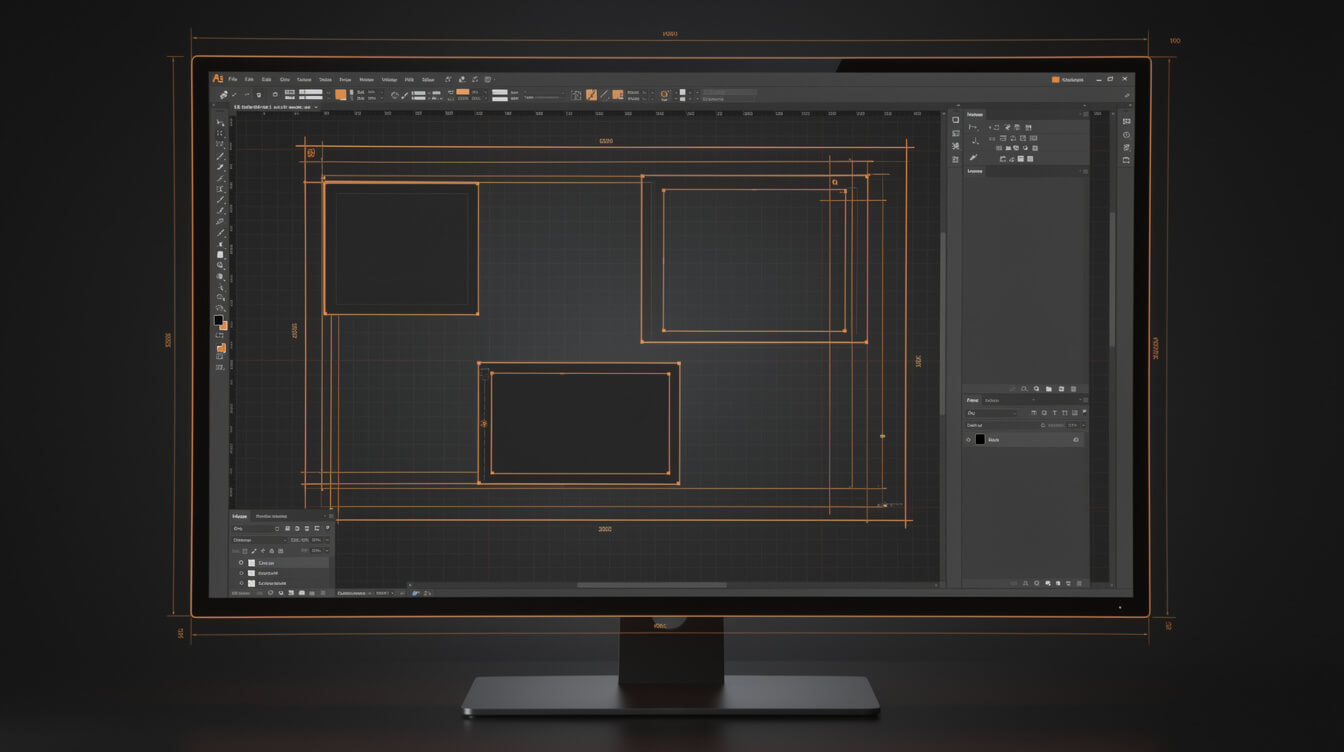
The design submission process for custom playing cards is more complex than a t-shirt listing, but it is manageable once you understand what the supplier needs.
File format and resolution
Most playing card suppliers require individual card face files submitted as a multi-page PDF or a structured ZIP of individual images. Minimum resolution is typically 300 DPI at print size. For a poker-size card (2.5 x 3.5 inches), that means a source image of at least 750 x 1050 pixels, though 1500 x 2100 pixels (600 DPI) gives the supplier more room to handle any final adjustments.
Bleed and safe zone
Card printing requires a bleed area of 1/8 inch (3mm) on all sides. Elements you want to keep away from the cut line should sit at least 1/8 inch inside the trim boundary. Most suppliers provide downloadable templates with bleed, trim, and safe-zone guides marked.
Card back design
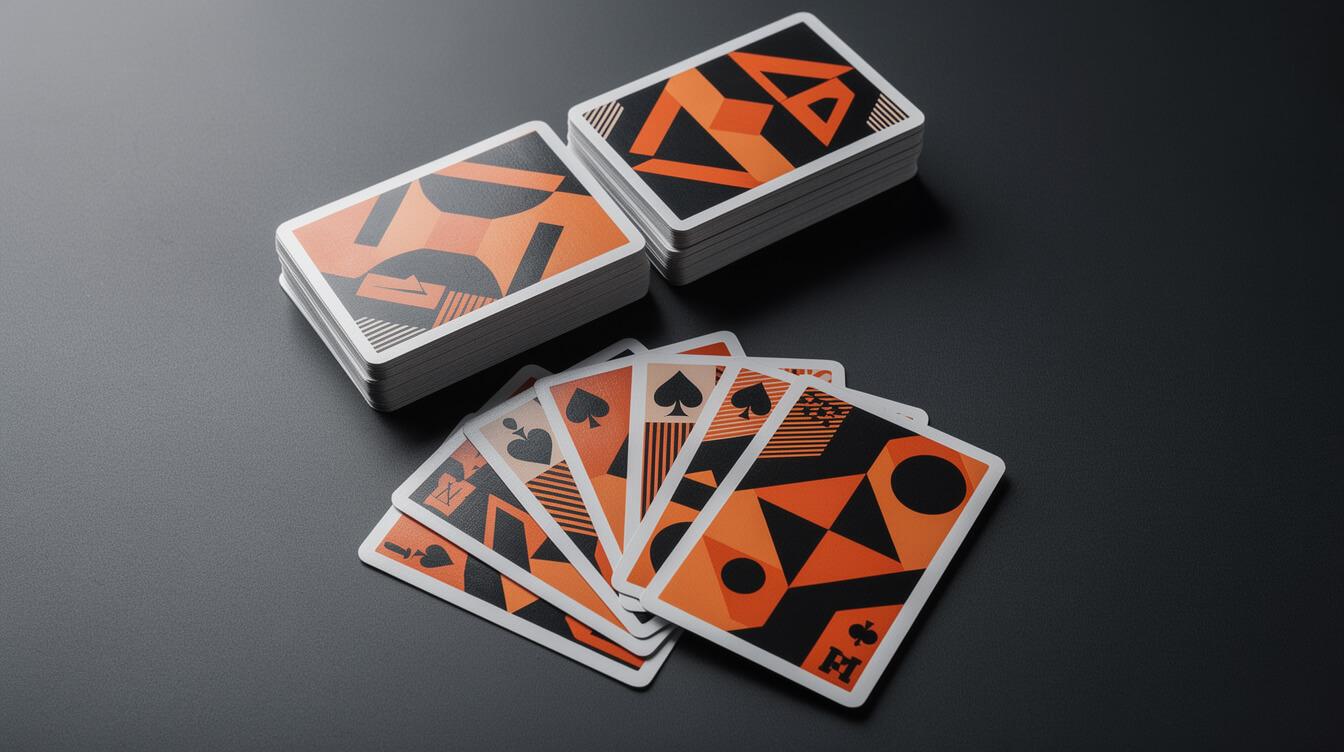
The card back is a single design applied to all 52-56 cards in the deck. This is the most visually prominent element when the deck is fanned or displayed in product photos. A strong back design is what makes a custom deck photogenic and shareable on social. Invest design time here first before fine-tuning the face cards.
Tuck box
The tuck box (the outer packaging the deck slides into) is also fully custom-printed and included in the product cost. The box template is separate from the card files and typically wraps around a die-line that varies slightly by supplier. Download the supplier’s specific tuck box template before designing, not after.
Mockups and listing photos
Playing card decks are challenging to photograph because the product is inherently flat and small. Strong product listings use layered mockups: a fanned deck showing the card back design, a tuck box alongside the deck, and a detail shot of 2-3 face cards fanned with visible artwork. Free mockup templates for playing cards are available from MakePlayingCards.com and through design resource sites.
Your first listing should cover the core poker-size deck with linen finish as the primary SKU. Once that listing is live and traffic is flowing, add variants for bridge size or smooth finish if demand signals support it. Keeping the first listing simple reduces your time to market and your design file complexity.
Building a playing card catalog that works long-term
Custom playing cards occupy a reliable niche in the POD landscape: low barrier to listing, solid margin at $28-35 retail, and multiple distinct buyer segments to serve without competing on the same keywords. The absence of editorial content for POD sellers means early movers will capture search real estate that is currently unoccupied.
The provider path is clear: Printify Premium with a playing card-capable partner is the cleanest starting point. The card stock specs (poker size, linen finish, 300+ GSM) give you a product worth the retail price. The niche selection work determines whether your traffic converts or bounces.
Running a multi-product POD store means constantly researching new niches, testing new listings, and managing the operational overhead of multiple suppliers. That is where a research-to-product pipeline like MEGA earns its keep. Every category you want to add, from custom puzzles to playing cards, goes through the same research, design, and listing steps. Automating that stack lets you build catalog depth without the six-hour manual workflow that most Canva-first operators are still running.

Implement AI. 30x your throughput. Get a 30-min call with the founder.
Drop your details and book a free 30-minute discovery call. Personalized advice on your POD stack, your margin, and where AI fits. No pitch, no fluff.