Custom keychains for POD sellers: which providers carry them, what acrylic printing costs, and the low-AOV margin math
Custom keychains are a $15 product that can close at the register while your customer is already thinking about something else. For a print-on-demand seller running a niche store, that impulse-buy dynamic matters. The challenge is that most guides on custom keychains are written for event planners ordering 500 units from a bulk vendor. This guide is for you, the POD seller who wants to add custom keychains to a WooCommerce or Shopify catalog without holding inventory, signing contracts, or paying for minimum order quantities.
We cover which providers actually carry keychains in their print-on-demand catalog, what the three main print methods cost at different volumes, and why the low average order value of a keychain product makes your platform fee structure matter more than it does for any other product category.
Why custom keychains belong in a POD store
The economics of a POD accessories line are different from apparel. A custom keychain retails at $15 to $28 and fits in a padded envelope. Shipping is cheap. Returns are almost nonexistent. And unlike a hoodie, a keychain is not a sizing decision, so the customer buys it in the moment without the friction of measuring themselves against a size chart.
That impulse-buy price point is exactly where a well-run niche store can generate volume. A convention merch table, an Etsy-adjacent WooCommerce store for a fandom community, a sports team fan shop. In every one of those contexts, a $20 custom keychain is an easy add-on that a $50 t-shirt is not.
The bundle opportunity matters too. A customer who buys a custom hoodie and a custom keychain from the same store in one order pushes your AOV above $60. At that level, the Printful or Printify fulfillment cost per shipment spreads across two items, improving margin on both. The keychain is the upsell that does not require a hard sell.
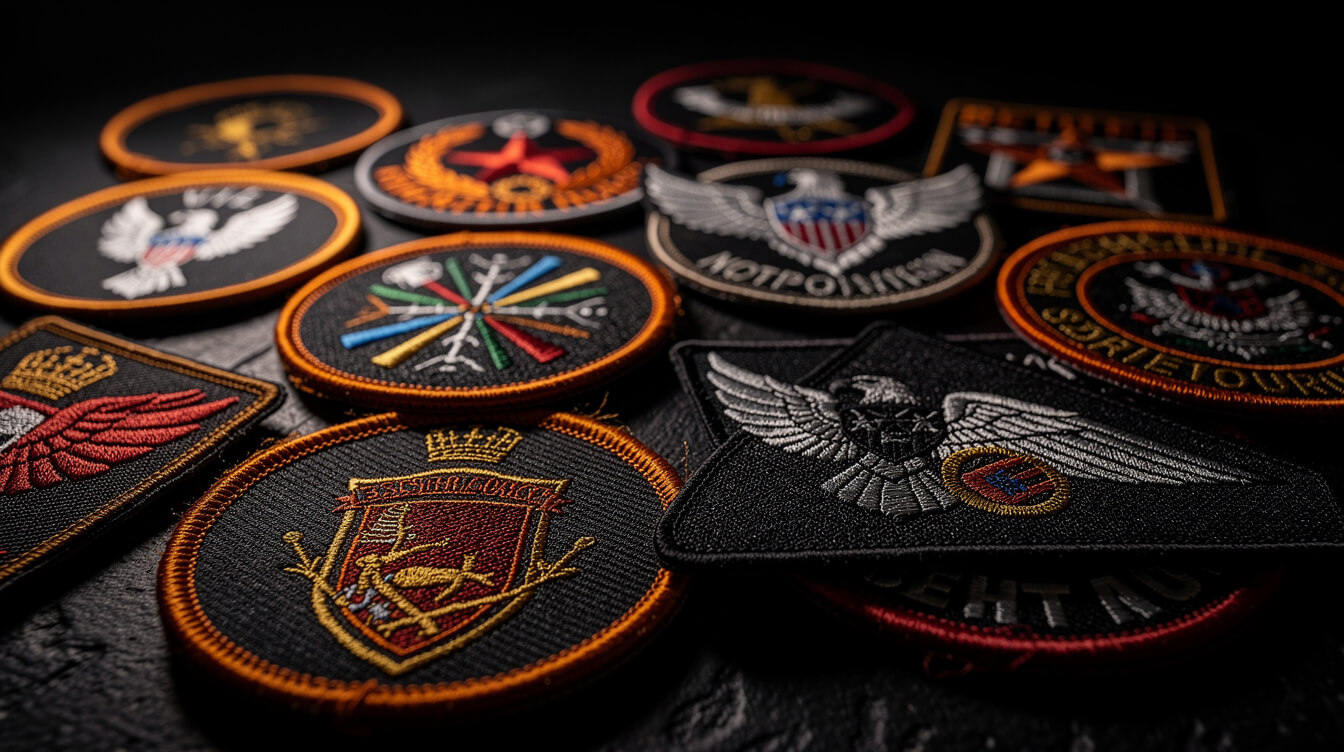
Custom keychains also function as low-risk niche validators. Before commissioning 20 t-shirt designs for a sub-niche, launch five keychain designs and see what sells. The print cost is low, the listing investment is minimal, and the data you get from actual sales is worth more than any competitor keyword analysis. Accessories like keychains pair naturally with other POD items: if you already carry custom patches, keychains fit the same impulse-buy, accessories-cluster shopping behavior.
How custom keychains are made: acrylic UV printing, PVC casting, and laser engraving compared

There are three production methods relevant to POD sellers, and they produce different products at different price points.
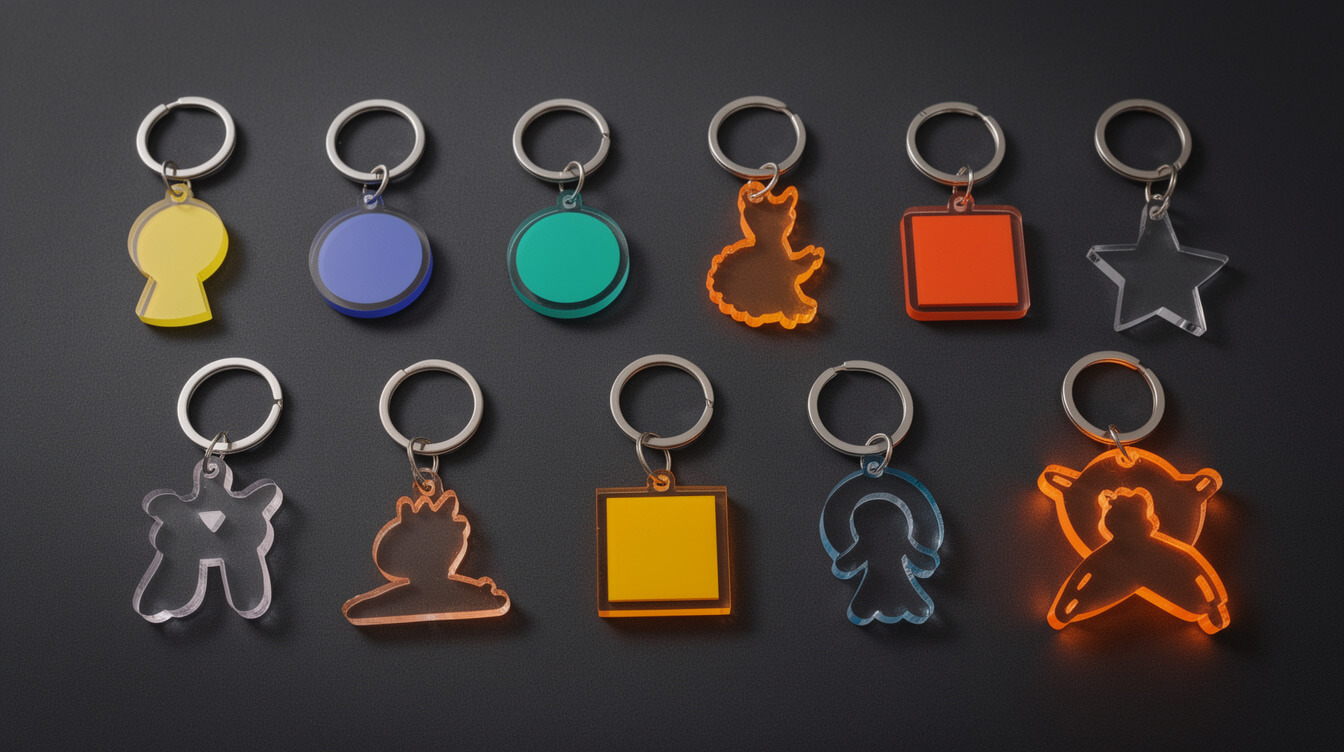
Acrylic UV printing is what most POD-adjacent keychain suppliers use. A flat sheet of clear or white acrylic is cut to shape, then a UV-cured ink layer is applied directly to the surface. The result is a rigid, glossy keychain with vibrant full-color artwork. This method works for any design that can be reproduced as a flat print. It is the most common method in the Printify partner network and through suppliers like Vograce and Zugmonster.
PVC mold casting produces soft, flexible keychains with a slightly raised design surface. It requires a mold, which adds a one-time tooling cost of $20 to $80 depending on complexity. For a POD seller ordering one unit at a time, PVC casting is not economical. It becomes relevant only at volumes above 100 units and is the territory of bulk promotional merchandise vendors, not print-on-demand.
Laser engraving burns a design into wood, leather, metal, or acrylic without ink. The result is a permanent, monochrome mark on the material surface. Laser-engraved keychains from artisan shops like Thoughtful Impressions sell at $20 to $40 and feel premium. Printful does not currently offer laser-engraved keychains in its standard catalog, but some Printify network partners do.
For most POD sellers, acrylic UV printing is the right choice. It is available without MOQ, ships fast from POD suppliers, and supports full-color artwork that can be swapped per design listing without retooling costs.
Which POD providers carry custom keychains
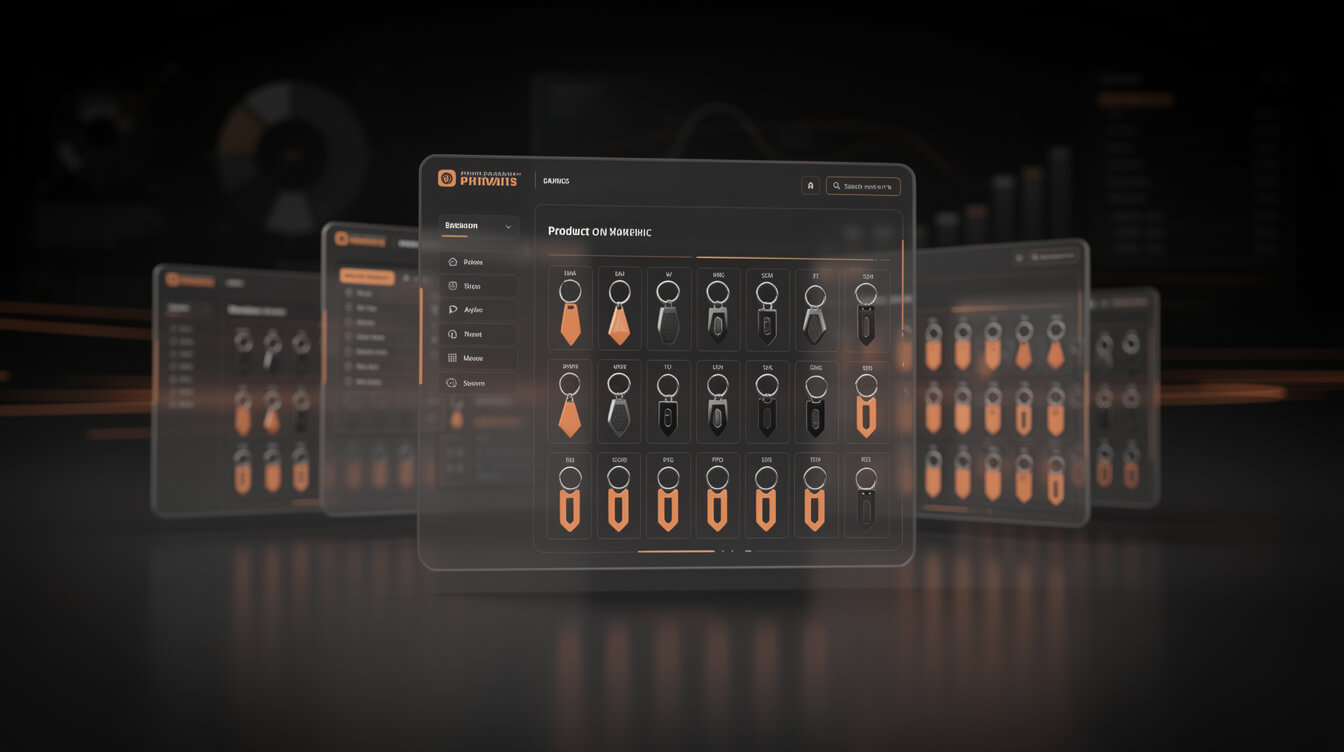
This is where many POD guides go wrong by assuming that what Printful offers equals what the full POD landscape offers. For keychains specifically, the reality is more nuanced.
Printful does not list acrylic keychains in its core product catalog as of mid-2026. Their accessories line covers phone cases, jewelry, home decor, and stationery, but standard acrylic keychains are absent from the fulfillable catalog. This is worth verifying before you build a collection around Printful as your sole provider. If your store runs on Printful WooCommerce integration and you want to add keychains, you are looking at a hybrid model or a second fulfillment source.
Printify has a broader network model and does carry keychains through partner suppliers. The specific products depend on which print provider you select in the Printify catalog. Providers like AOP+, Printify’s own network partners based in Europe and the US, and third-party suppliers connected through the Printify marketplace all list acrylic keychain options. Product specs vary by supplier: check minimum size, shape options, material thickness (typically 3mm acrylic), and keyring hardware included.
Gooten is another Printify-adjacent network that some POD sellers use as a secondary fulfillment layer for accessories that major platforms do not carry. Gooten’s keychain availability fluctuates, so confirm before building SKUs.
Supplier-direct on white-label terms is the path most established POD accessory sellers eventually reach. Vograce (acrylic keychains from $1.91/unit), GS-JJ (bulk from $0.94/unit), and similar manufacturers operate on white-label fulfillment for US and European addresses. At 50-plus units per design, these suppliers undercut POD platform pricing significantly. The trade-off is inventory hold and up-front payment rather than per-order fulfillment.
If you already have a custom phone case catalog running on Printify, adding keychains from a Printify partner supplier keeps your fulfillment stack simple. One dashboard, one shipment origin per order where possible.
Unit cost math at 1 unit, 10 units, and 50 units

Smash print-on-demand. Join the engine room.
One short email a week. Real numbers, real teardowns, the unfiltered economics behind every move.
Here is what the numbers look like across fulfillment models. All figures are estimates based on publicly available pricing as of mid-2026 and exclude shipping.
Printify network partner (acrylic keychain, single unit)
Base cost: approximately $4.50 to $7.00 per unit depending on the provider and size selected. Printify Premium members receive a 20% discount, bringing this to $3.60 to $5.60. Add $3.50 to $5.50 for US domestic shipping on a standalone keychain order.
Total landed cost for a single unit shipped to a US customer: approximately $8 to $12. At a $19 retail price, your margin before transaction fees is $7 to $11.
Supplier-direct at 10 units
Vograce at 10 units: approximately $3 to $4 per keychain, plus shipping from China (typically $12 to $18 for a small parcel). Per-unit landed cost drops to $4 to $6 at 10 units when you factor in the shared shipping cost.
At this quantity, you are holding inventory and self-fulfilling, which adds your own labor and packaging costs. The margin improvement over Printify is real but the operational cost is also real.
Supplier-direct at 50 units
GS-JJ at 50 units: as low as $0.94 per keychain for simple acrylic designs. Add $25 to $40 for international shipping and the per-unit landed cost lands around $1.50 to $1.80 before your own packaging and fulfillment labor.
At $19 retail and $1.80 unit cost, your gross margin per unit is over $17. That is the economics of a successful accessories brand at volume, not a POD starter. The catch is you need to predict demand accurately enough to justify the 50-unit commitment and manage inventory across designs.
For most POD sellers starting with keychains, Printify at single-unit fulfillment is the right starting point. Validate with 10 to 20 sales, then consider a small bulk order for your top two or three designs once you have purchase history. MEGA automates the product generation pipeline from brief to live listing, which makes testing more designs in less time the smarter path to finding your top performers before committing to bulk inventory.
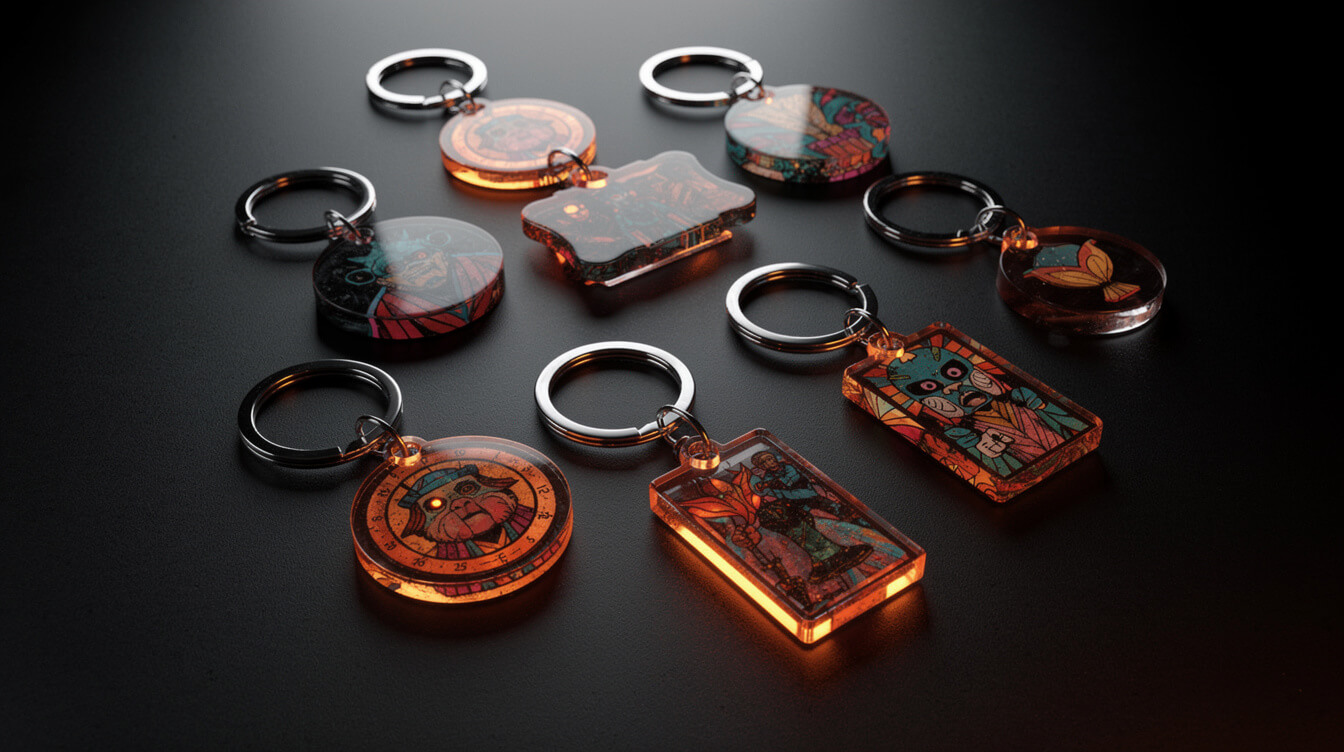
Generate keychain listings end-to-end with MEGA
MEGA handles the full pipeline: brief, image generation, sizing, and live product listing. Add 30 keychain designs to your catalog in the time it takes to manually list one.
Retail pricing and the margin reality at $15 to $28 AOV
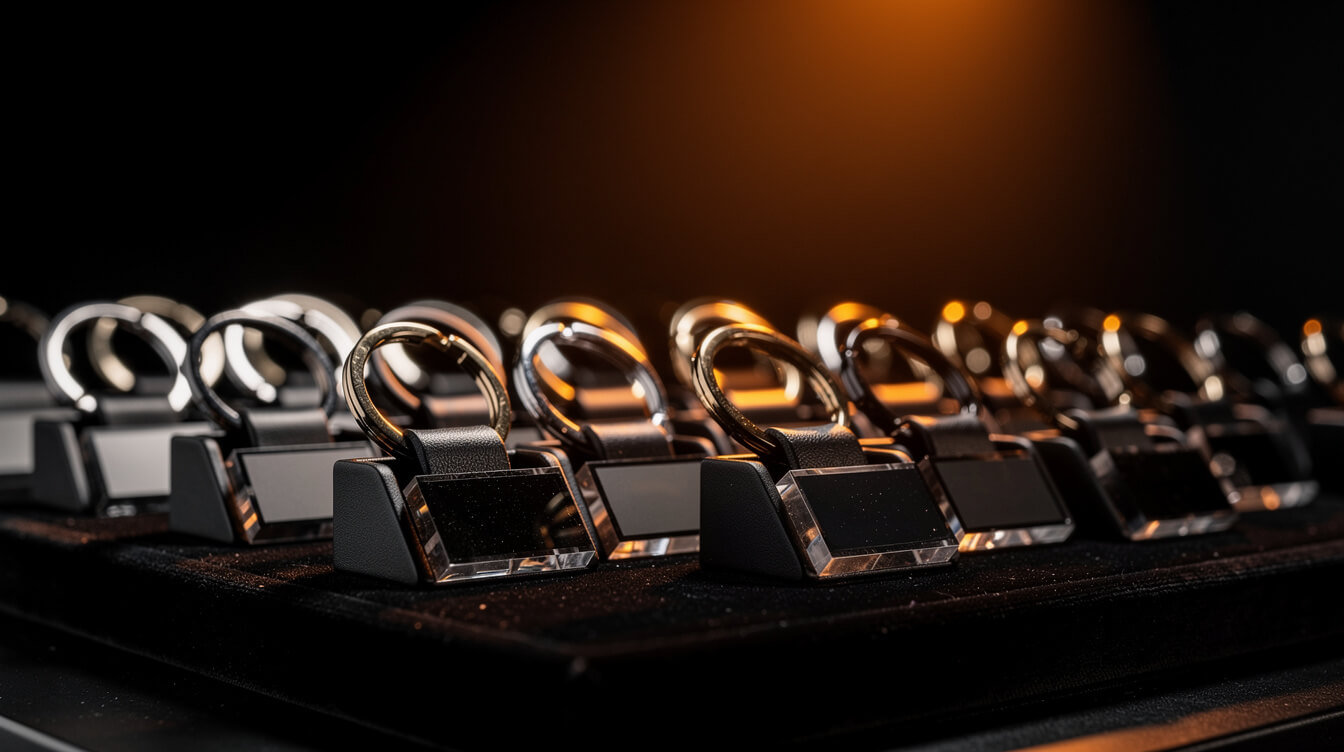
Keychains are a product category where pricing psychology runs into math constraints. Customers expect to pay $10 to $25 for a custom keychain at retail. You can push toward the high end of that range with quality positioning, a niche-specific design, or a bundle offer, but you cannot price a $3 keychain at $45 and expect conversion.
At a $19 retail price and $6 unit cost on Printify, your gross margin before platform fees and transaction costs is $13. That sounds healthy. Here is where it gets complicated.
Add a 2.9% plus $0.30 Stripe transaction fee on a $19 sale: $0.85. Add your Shopify or WooCommerce monthly cost prorated per order at your volume. If you are on Shopify Basic at $39/month and you move 100 keychain orders per month, that is $0.39 per order in platform overhead. Nothing here is catastrophic, but the numbers compress quickly when you factor in the Shopify 1% platform override that applies to all sales on Shopify when using Printful or Printify as your fulfillment provider.
At $19 per sale, that 1% override is $0.19. On a $13 gross margin, you give up 1.5% of margin in override fees alone. That percentage climbs as AOV falls. And for a keychain seller running 50 orders per week, that $0.19 per order adds up to $9.50 per week or roughly $494 per year in override fees on keychain sales alone. Low-AOV products like keychains are where platform fee structures show their true cost fastest, a dynamic similar to what we analyzed in our custom ornament guide for seasonal low-ticket items.
Why the Shopify 1% platform override hits hardest on low-AOV products

The Shopify platform override is 1% of all sales when you use a third-party payment gateway, or 0.5% on Advanced, or 0.2% on Plus. For most POD sellers on Shopify Basic using Printful or Printify, the relevant number is 1%.
On a $50 t-shirt sale, the 1% override is $0.50. That hurts, but the gross margin on a $50 t-shirt is wide enough to absorb it. On an $18 keychain sale, the 1% override is $0.18. That sounds smaller in absolute terms. The problem is proportionality.
A $50 t-shirt might have a $14 gross margin (28%). The $0.50 override represents 3.6% of that margin. An $18 keychain at $6 unit cost has a $12 gross margin. The $0.18 override represents 1.5% of the margin. So far, keychains look better on this metric alone.
But now factor in transaction fees, shipping subsidies on thin-margin orders, and the monthly platform cost prorated per order at low volumes. A store moving 20 keychain orders per week generates $360 per week in keychain revenue. The 1% override on $360 is $3.60 per week, or $187 per year. That same store on WooCommerce with Stripe direct pays $0 in platform override fees. The $187 annual difference is not life-changing. But across all low-AOV accessories, sticker sheets, pins, koozies, the aggregate fees add up.
The override fee also scales with revenue, not with profitability. A store generating $5,000 per month in keychain revenue pays $50/month in Shopify override fees. At $10,000 per month, it is $100/month. That is $1,200 per year on a high-performing keychain catalog, paid to Shopify for the privilege of using Printful or Printify for fulfillment. This is exactly the math our custom phone case analysis showed for another accessories category: the fee is regressive at scale.
The WooCommerce advantage at keychain scale
WooCommerce charges no platform override fee on sales. Zero. You pay for hosting, a domain, and the WooCommerce plugin itself (which is free), plus any premium extensions you choose. The Printful and Printify WooCommerce integrations are available and functional. Your payment processor fee is the only percentage-of-sale cost beyond unit production.
For a store running 200 keychain orders per month at $19 average, here is the annual comparison.
Shopify Basic: $468/year in platform fees ($39/month) plus approximately $456/year in 1% override fees on $3,800/month in keychain revenue. Total platform cost: approximately $924/year.
WooCommerce on managed hosting: $180 to $360/year in hosting costs. Zero override fees. Total platform cost: $180 to $360/year.
The difference at 200 keychain orders per month is $564 to $744 per year. At 500 orders per month, the override fees alone reach $1,140/year on Shopify. WooCommerce hosting at higher traffic levels costs perhaps $600/year. You save over $500 per year just on the platform math.
The ownership argument matters beyond fees. Your customer email list, your order history, your analytics, your product catalog, all live on infrastructure you control. When Shopify changes a policy or Printify adjusts how its Shopify integration routes orders, you are downstream of decisions you had no input on. On WooCommerce, you make those decisions. This is the same platform economics argument that applies to custom patches and accessories stores more broadly, not just keychains.
Niche verticals that drive custom keychain sales
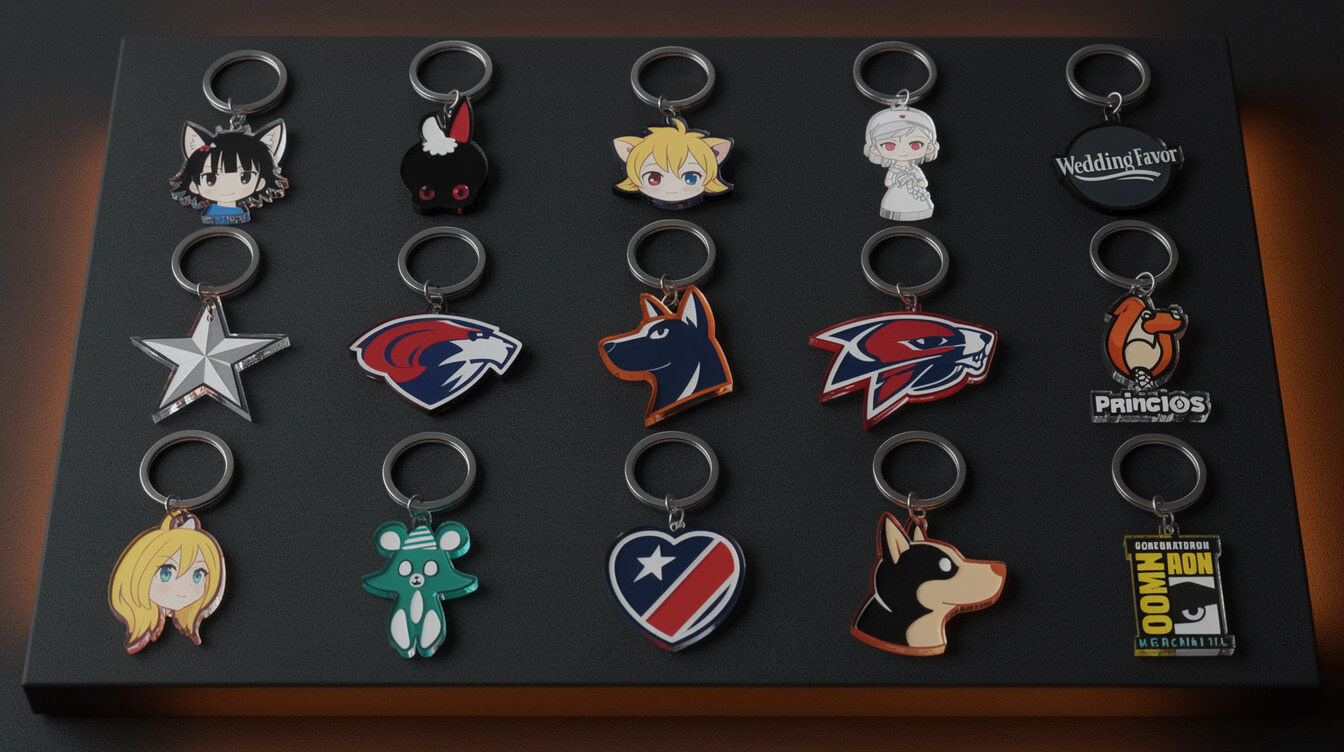
Keychains are a niche product in the best sense: they sell better with a specific story than they do as generic custom merchandise. Here are the verticals where POD keychain sellers consistently find traction.
Anime and fandom merch. Acrylic keychains are the standard accessory format in the anime convention circuit. Chibi character designs, logo keychains for popular series, and fan art of beloved characters all sell at convention tables and online stores serving the same audience. Convention merch demand peaks in summer and fall convention season but sustains year-round through online stores.
Fan art and creator economy. YouTubers, streamers, and independent artists use keychains as a low-cost merch item that fans can buy multiple of. A streamer running a merchandise store with channel-branded keychains at $18 to $22 retail is selling an impulse item to an audience that already has brand loyalty built in.
Sports teams and league merch. Youth sports leagues, recreational adult leagues, and semi-pro local teams all create demand for custom keychains. A $15 keychain with a team logo is affordable for every player and their family members. This is repeat-customer territory: new season, new keychain design.
Wedding favors and event gifting. A custom keychain with the couple’s initials and wedding date is a perennial wedding favor. At $8 to $12 per unit from a supplier-direct source at 50 units, a wedding favor keychain order is profitable even when the couple negotiates a bulk discount. On a POD model via Printify at single-unit pricing, the margin is tighter but the no-minimum-order feature means you can quote a custom design without committing to 100 units upfront.
Pet portrait keychains. Pet portraits on phone cases sell well. The same dynamic applies to keychains. A customer who has already purchased a custom dog portrait mug or canvas print is a natural buyer for a matching keychain. If your store carries other pet portrait products, keychains are a complementary add-on that requires no additional audience development.
Convention merch tables. Artists tabling at fan conventions and craft markets generate a meaningful share of keychain sales in person. These sellers need a print source that can produce small batches of a new design fast. POD at Printify pricing fits that use case better than bulk-order suppliers with 2-to-4 week lead times on new designs.
Conclusion
Custom keychains are a product category with strong impulse-buy economics, no sizing friction, and a wide variety of niche verticals with proven purchase intent. The main friction for POD sellers is that Printful does not carry standard acrylic keychains. That routes you toward Printify’s partner network or supplier-direct sourcing at volume.
The margin math works at POD pricing when you stay above $17 to $19 retail and keep your platform fee structure clean. That is the argument for WooCommerce over Shopify for any accessories-heavy catalog. The 1% Shopify platform override is regressive at low AOV, and keychains are the product category where that fee shows up most clearly in your margin stack.
Start with five designs, validate, and scale the winners. The custom keychain niche is genuinely undercovered in POD editorial. The sellers who build catalog depth here before the market gets crowded will have a meaningful head start.
Implement AI. 30x your throughput. Get a 30-min call with the founder.
Drop your details and book a free 30-minute discovery call. Personalized advice on your POD stack, your margin, and where AI fits. No pitch, no fluff.