Custom bucket hats for POD sellers: AOP sublimation vs embroidery, which providers carry them, and the streetwear niche math
Custom bucket hats sit at an unusual intersection in the print-on-demand catalog. The keyword pulls 2,900 searches per month, and virtually every result is either a corporate embroidery shop with 50-unit minimums or a consumer personalization service charging $59 per hat. Neither is speaking to the POD store owner who wants a no-minimum custom bucket hat in their Printful or Printify product lineup. This guide covers the real path: which providers carry them, what all-over-print sublimation can achieve that embroidery cannot, what you keep per unit at $28-40 retail, and which streetwear and festival niches are actually buying.
What makes a custom bucket hat different in a POD context
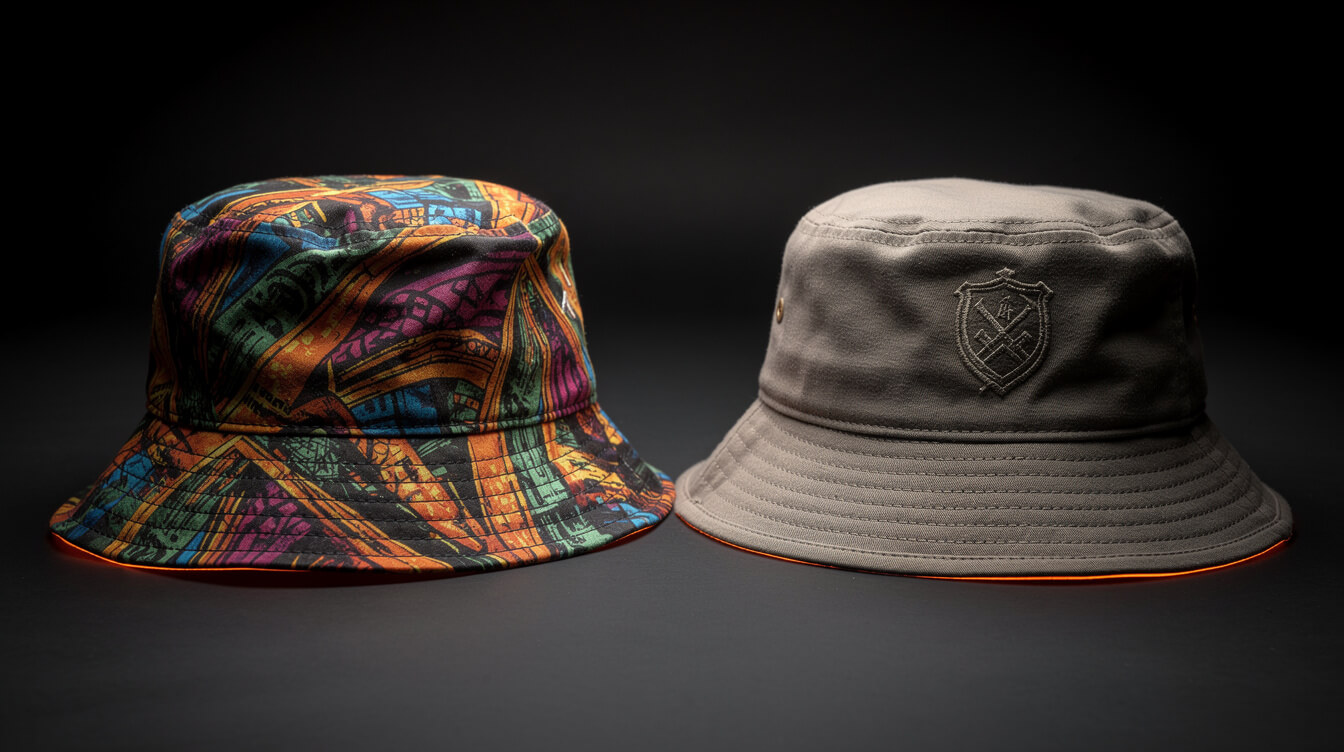
Bucket hats occupy a specific product position in POD: they attract buyers who want the full canvas. A t-shirt buyer typically wants a chest print or a back graphic. A custom bucket hat buyer in the streetwear and festival markets wants the entire surface covered. That distinction drives the product decision before you touch a design file.
Most custom hat vendors default to embroidery. Embroidery reads well on caps with flat front panels, specifically snapbacks and structured 5-panels. On a bucket hat, the brim curves away from the embroidery head, brim panels are angled, and the full-coverage print area that makes bucket hats visually distinctive cannot be achieved with stitching. A logo on the front panel is possible. A continuous wrap-around design covering crown, panels, and brim is not.
All-over-print (AOP) sublimation changes the product entirely. Instead of stitching a design onto the surface, sublimation dyes bond at a molecular level with the polyester fibers of the hat during a heat press at 375-400 degrees Fahrenheit. The result is that every panel, every seam transition, and every millimeter of brim can carry continuous color without cracking, peeling, or washing off. That is what the streetwear and festival buyer is looking for, and why custom bucket hats as an AOP sublimation product sit in a completely different market than the corporate embroidered hat vendors dominating the search results.
For a POD seller, the decision tree is straightforward: embroidered bucket hat for corporate or team markets (requires vendors with embroidery capability), or AOP sublimated bucket hat for streetwear, fan art, and lifestyle markets (requires Printful’s AOP hat or equivalent Printify partner vendors). They are different products for different buyers, and conflating them leads to the wrong sourcing decision.
Which POD providers carry custom bucket hats in 2026
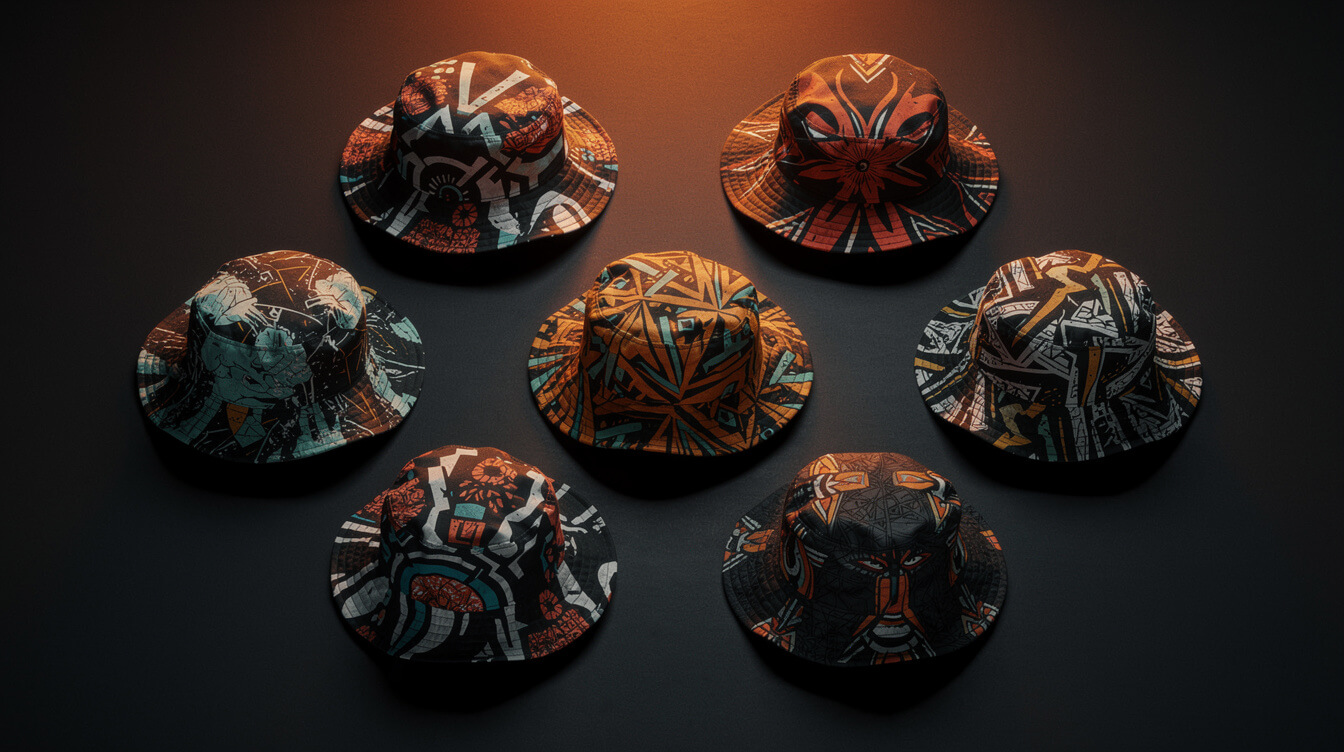
Printful carries all-over-print bucket hats in their catalog as of mid-2026. The product uses 100% polyester construction, a requirement for dye sublimation, with a structured crown, adjustable chin cord, and sizes ranging from S/M to L/XL. Print coverage extends across all panels including the brim, which is the key differentiator from embroidered styles. Printful’s no-MOQ policy applies: one hat prints and ships the same as a thousand.
Printify’s partner network also includes sublimated bucket hat vendors, though availability varies by vendor and region. Check the Printify product creator directly for current stock, as the vendor roster changes and specific products come in and out of the catalog as partners update their offerings. When evaluating a Printify vendor for bucket hats, confirm polyester construction (not a cotton blend), all-panel print coverage, and brim print capability. A vendor that only prints the crown panels is not the same product.
Other platforms worth checking:
- Gooten: select sublimated apparel and accessories; hat availability is intermittent
- SPOD: primarily focused on standard apparel (t-shirts, hoodies); hat options are limited
- Contrado: carries AOP bucket hats at premium price points ($30-40 base cost); their direct-to-consumer positioning at $59+ retail places them in a different pricing tier than most POD stores
The practical starting point for most POD sellers is Printful for no-MOQ guaranteed reliability, with Printify as a secondary option for price comparison once the product proves itself in your catalog.
One critical note on materials: AOP sublimation requires 80%+ polyester substrate. A hat labeled as a poly-cotton blend at 60/40 will show washed-out colors and compromised print coverage on the cotton fibers, which do not bond with sublimation dye. If a vendor lists a cotton or cotton-blend bucket hat, that product requires screen printing or DTG, which typically carries minimum order requirements. For the no-MOQ AOP bucket hat, polyester is non-negotiable.
AOP sublimation vs embroidery: print method decision framework

Most buyers encounter bucket hats first through embroidery, as it is the default method for corporate, team, and promotional vendors. Understanding why sublimation is the better choice for most POD stores requires knowing what embroidery actually is and where it stops.
Embroidery stitches thread directly into the hat fabric using a digitized design file converted to stitch patterns. The output is tactile, durable, and reads as premium in the corporate and team market. What it cannot do:
- Full-bleed designs that wrap across panels
- Photorealistic imagery, gradients, or complex color fields
- Coverage on curved surfaces like bucket hat brims, as the embroidery head requires a flat surface
- More than 12-15 thread colors without significant cost increase
For a POD seller, embroidery also typically requires a digitization fee ($15-50 per design, one-time but vendor-specific) and suits simple logos and text best.
AOP sublimation has no thread count limit, no stitch density limit, and no constraint on design complexity. A photograph, a gradient, or a continuous wraparound landscape: sublimation handles all of it on polyester. What it cannot do:
- Work on cotton or natural fiber fabrics, as the dye needs synthetic fiber to bond with
- Produce white ink on its own, since sublimation dye requires a white or light base to show true colors, which means dark-base bucket hats are not achievable with sublimation
- Produce tactile texture, as the design becomes part of the fabric rather than sitting on top of it
For the streetwear, fan art, and lifestyle niche that custom bucket hat buyers inhabit, sublimation wins on every dimension that matters to the buyer: design complexity, visual coverage, color range, and wash durability.
The practical decision rule: if a buyer wants a logo on a hat, recommend a structured snapback or 5-panel with embroidery. If a buyer wants a full-surface graphic, an all-over pattern, or any photorealistic design, the AOP sublimation bucket hat is the correct product.
Unit cost math: base cost, retail pricing, and gross margin
Smash print-on-demand. Join the engine room.
One short email a week. Real numbers, real teardowns, the unfiltered economics behind every move.

Running the numbers before building a product listing is not optional. Here is the unit economics for a Printful AOP bucket hat as of mid-2026.
Base production cost (Printful AOP bucket hat):
- Base price: approximately $17-21 depending on size
- Shipping (standard, US domestic): $4.50-5.50
- Landed cost per unit: $21.50-26.50
Suggested retail pricing:
- Entry retail at $28-32: slim margin, volume-driven
- Standard retail at $34-38: 35-43% gross
- Premium retail at $40-45: 38-49% gross
At a $35 retail price: landed cost is roughly $24, leaving approximately $11 gross per unit, or 31% gross margin.
At a $40 retail price: landed cost is still roughly $24, leaving approximately $16 gross per unit, or 40% gross margin.
Bundle math: Pairing the custom bucket hat with a matching tote bag or face covering pushes AOV higher without increasing per-unit production complexity. A bucket hat at $38 plus a matching tote at $22 creates a $60 AOV order that generates roughly $24-28 gross, enough to absorb a modest ad spend if you are running any paid traffic.
Design complexity does not affect cost. A simple logo and a full-panel photorealistic design both print at the same base price from Printful. This is the sublimation advantage over embroidery at scale: your most visually complex designs cost the same to produce as your simplest.
At 200 orders per month at a $35 retail price, you generate $7,000 in revenue and roughly $2,200 in gross profit before platform fees and marketing. The platform fee math in the next section changes that take-home number significantly depending on whether you run on Shopify or WooCommerce.
The streetwear, festival, and outdoor niche: who buys and when
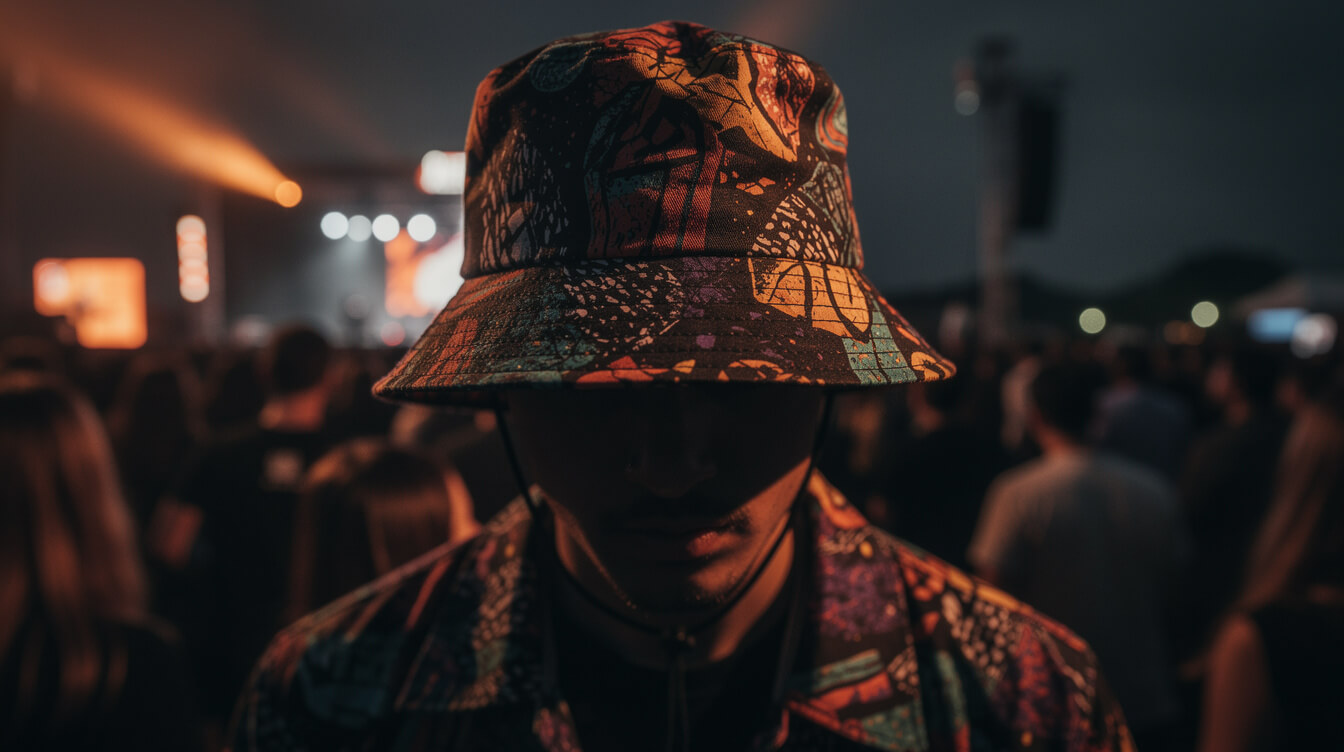
Custom bucket hats have clear buyer profiles. Understanding which one you are serving determines your design strategy, your pricing floor, and your content marketing approach.
Music festival and streetwear buyers are the highest-intent segment. These buyers treat the bucket hat as a fashion statement rather than a sun-protection product. They want bold, full-coverage graphics: abstract patterns, artist collaborations, psychedelic color fields, and retro prints. Price sensitivity is lower in this segment, and $38-45 retail is normal. Demand peaks April through August (outdoor festival season), with a secondary window in September and October for fall events.
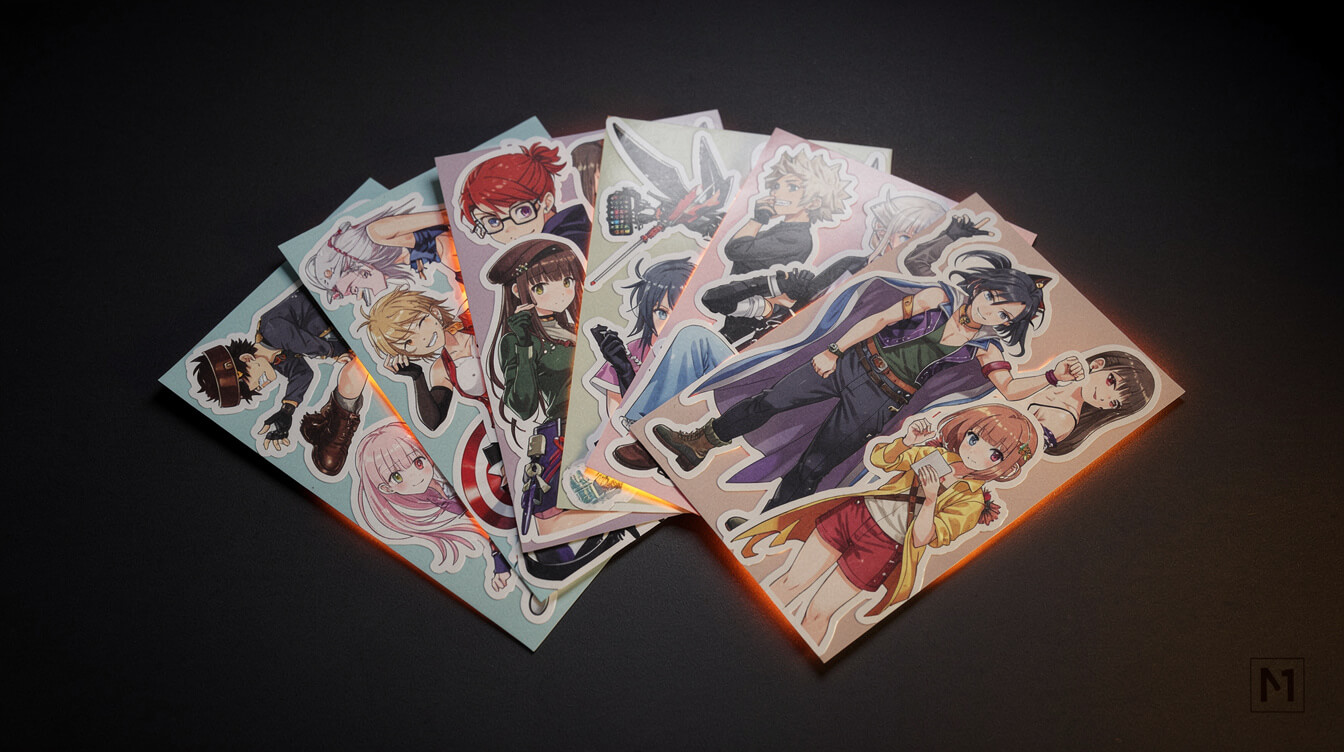
Anime and gaming fan art buyers represent a large online-native cohort. Bucket hats with original fan-inspired artwork perform well in anime convention-adjacent social media. These buyers discover products through Instagram Reels and TikTok, making short-form video showing the hat design in motion particularly effective. This is also a buyer segment where a batch design pipeline pays off, since generating unique variant designs for different fandoms at volume reduces per-product time from hours to minutes. MEGA automates this step entirely, turning a niche idea into a live listing in under seven minutes.
Outdoor, camping, and hiking brands use custom bucket hats as functional accessories with lifestyle branding. Earth tones, nature-pattern sublimation, and topographic designs do well here. This segment is less price sensitive than you might expect: a well-designed outdoor bucket hat at $40 is a reasonable purchase for a buyer who just spent $200 on a daypack.
Sports fan non-licensed stores can use custom bucket hats as an alternative to licensed team caps. City-name designs, regional color palettes, and sport-specific abstract patterns sell consistently to fans who want to show allegiance without licensed IP risk. See the custom baseball jersey POD seller guide for more on navigating the licensing boundary in fan apparel.
Seasonality: Bucket hats skew spring and summer in search volume. If you are building your catalog in fall or winter, list your designs now to capture the indexing window before spring demand peaks. A listing that has been live for 90 days ranks better in product search than one uploaded in March.
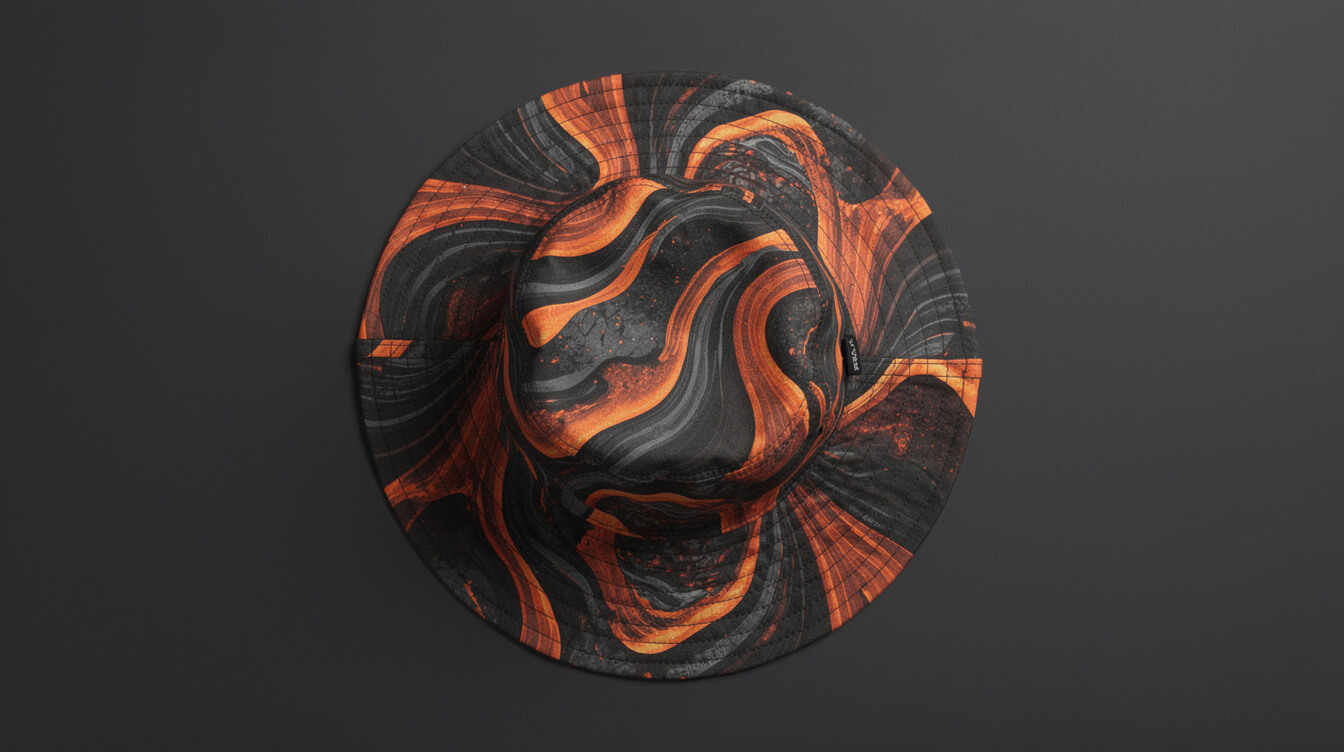
Generate your first bucket hat listing in under 7 minutes
MEGA is the research-to-product pipeline for POD sellers. Feed it a niche, and it handles design generation, sizing, mockups, titles, and live listings on Printful and WooCommerce, end to end.
Shopify 1% override fee at $28-40 AOV versus WooCommerce

Platform fee math is not the most exciting topic in a POD seller guide, but it is the one that changes your actual take-home the most at scale.
Shopify’s 1% transaction override fee (on top of payment processor fees) is charged on every order. At the AOV range for custom bucket hats:
| Monthly orders | AOV | Shopify 1% annual cost |
|---|---|---|
| 100 | $35 | $420/year |
| 200 | $35 | $840/year |
| 200 | $40 | $960/year |
| 500 | $38 | $2,280/year |
At 200 orders per month and a $40 AOV, the Shopify transaction fee costs $960 per year. That is on top of the Shopify plan fee ($39/month or higher, totaling $468/year minimum) and any app fees for personalization tools. WooCommerce handles name and text customization via native custom fields; Shopify requires a $19-49/month personalization app for the same functionality.
Total Shopify platform overhead at 200 orders per month for a custom bucket hat store:
- Transaction override: $960/year
- Plan fee: $468/year
- Personalization app: $228-588/year
- Total: $1,656-2,016/year
WooCommerce at the same volume:
- Hosting and WordPress: $180-360/year depending on host
- WooCommerce extensions: $0-200/year, as most customization is native
- Transaction fees: 0% (payment processor fees are separate and identical to Shopify’s)
- Total: $180-560/year
The annual difference: $1,100-1,800 in favor of WooCommerce at 200 orders per month. For a seasonal product line like custom bucket hats where spring and summer peaks may drive 300-400 orders in a three-month window, that gap compounds. The WooCommerce vs. Shopify breakdown for POD sellers walks through this math at five revenue milestones if you want to run your own numbers.
Top niche verticals for custom bucket hats in 2026
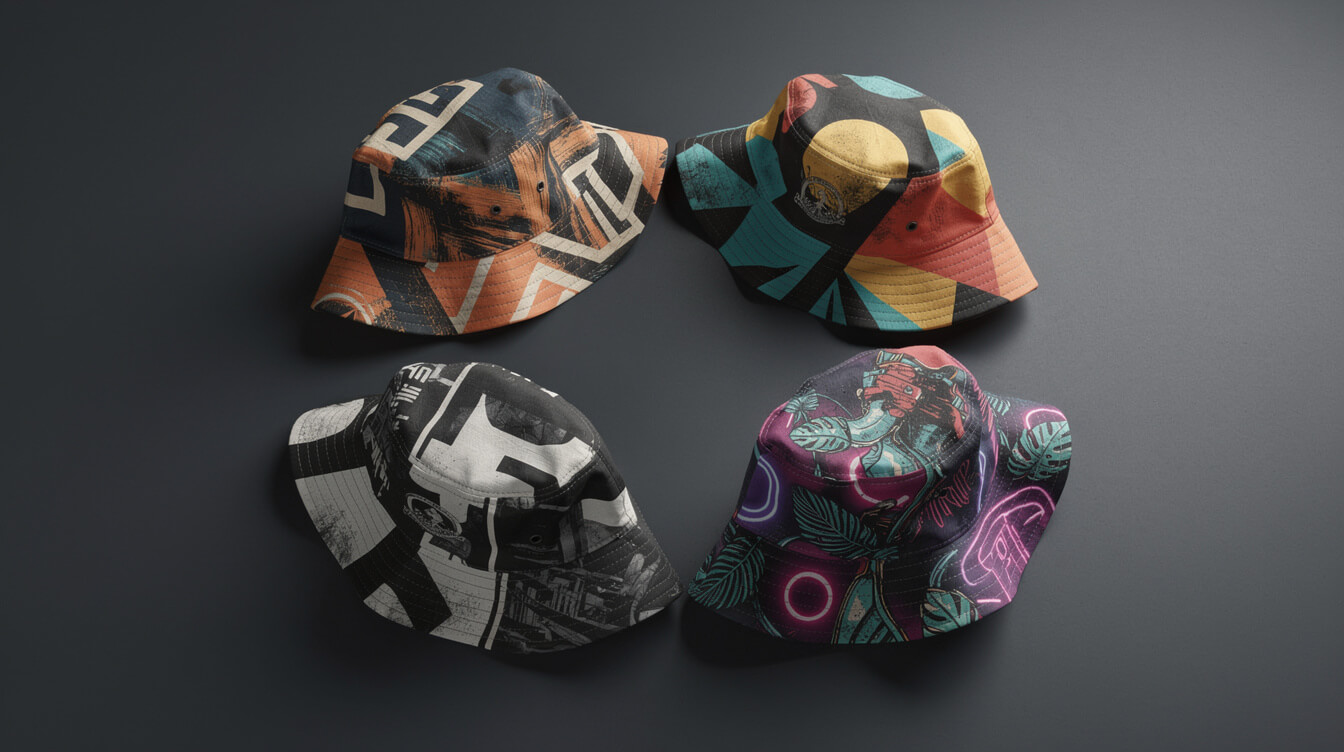
Six verticals show consistent demand for custom bucket hat designs, ordered by buyer intent signal strength.
1. Music festival merch. Festival organizers, local event brands, and artist merch tables all need no-minimum hat options. A local music festival with 2,000 attendees that wants 50 hats at wholesale pricing is the kind of B2B-adjacent order that turns a test listing into a recurring revenue relationship. No-MOQ via Printful means you can fulfill the first order of any size without inventory risk.
2. Anime and fan art conventions. Bucket hats are a staple of the convention floor aesthetic. Original fan-inspired artwork (not licensed IP, but original designs inspired by aesthetics rather than trademarked characters) sells well through both Etsy and standalone WooCommerce stores. Convention season peaks May through August, with a second window in October and November for the fall convention circuit.
3. Outdoor and adventure brands. Bucket hats are standard gear in hiking, camping, fishing, and paddleboarding communities. Sublimation is ideal here because the design holds through wet conditions, repeated washing, and extended outdoor exposure. Earth-tone topographic prints and nature-inspired patterns perform consistently. The custom golf polo shirt POD guide covers how the outdoor sports apparel niche positions these products if you want positioning reference for adjacent products.
4. Sports fan non-licensed stores. City-based stores selling region-specific designs without licensed IP are a growing segment. Abstract designs in regional color palettes serve the buyer who wants to show local pride without paying licensed merchandise prices. See how custom socks for POD sellers approaches building a cohesive fan-adjacent catalog across multiple product formats.
5. Beach and surf lifestyle. This vertical runs year-round in warmer markets and seasonally everywhere else. Abstract wave patterns, tropical color palettes, and lifestyle-adjacent designs perform consistently. Buyers in this segment are repeat purchasers: buy one hat for spring, buy another print for summer.
6. Pet portrait merchandise. Custom pet portrait bucket hats are an underserved format. Most pet portrait POD sellers focus on phone cases, mugs, and t-shirts, making the bucket hat an unusual offering that stands out in the catalog. Photo-realistic sublimation handles pet portraits as well as any other design. The buyer motivation is typically gift-giving: dog owner to dog owner, or self-gifting.
For seasonal timing: list new designs by February to capture the spring indexing window. Q4 has a secondary custom bucket hat window in October for fall outdoor and Halloween-adjacent designs. The core spring and summer buying season rewards early listing more than any other product in the hat category.
The product decision that unlocks the streetwear catalog
Custom bucket hats in POD are not a hat story. They are an AOP sublimation story. The product only works at no-minimum quantities because all-over-print on 100% polyester makes full-coverage designs viable without inventory commitment. That distinction separates the custom bucket hat from the corporate embroidery market entirely.
Printful’s AOP bucket hat is the most reliable no-MOQ path. Printify’s partner network offers secondary options worth checking in the product creator before building your first listing. The unit economics are workable at $34-40 retail, and the streetwear, festival, and fan art niches that drive demand for this product are consistently underserved by editorial content, meaning a store with strong listing copy and design quality has meaningful organic visibility opportunity.
Run the platform fee math before you pick your storefront. At 200 or more orders per month, the WooCommerce ownership model saves $1,100-1,800 per year over Shopify for exactly this product type. And if generating unique design variants for every niche vertical sounds like a full-time job, that is the problem MEGA is built to solve.
Implement AI. 30x your throughput. Get a 30-min call with the founder.
Drop your details and book a free 30-minute discovery call. Personalized advice on your POD stack, your margin, and where AI fits. No pitch, no fluff.