Custom embroidered sweatshirts for POD sellers: digitization fees, unit cost math, and the WooCommerce vs Shopify calculation
Search for “custom embroidered sweatshirt” and every result sends you to a bulk screen printer with a minimum order of 50 units. That is not a print-on-demand seller’s world. A POD seller needs one custom embroidered sweatshirt sold, one fulfilled, no inventory, no upfront digitization fee spread across a small run. The SERP has not caught up to that reality. This post covers everything a POD seller needs to know about adding custom embroidered sweatshirts to a WooCommerce or Shopify store: how the technique works, what Printful and Printify actually offer, the real unit cost math, and why the platform you choose matters more at a $65 average order value than it does on a $19 t-shirt.
What the custom embroidered sweatshirt SERP is not telling you
Search “custom embroidered sweatshirt” and Google returns Stitch America, Corporate Casuals, Carhartt Company Gear, and Thread Logic. These are B2B embroidery vendors. Their business model requires minimums of 12 to 50 units, setup fees per design, and turnaround times measured in weeks. They are serving corporate buyers placing annual uniform orders.
The problem is that no result on the first page speaks to a POD seller. No one explains how a solo operator adds embroidered sweatshirts to a WooCommerce store, lists them with no inventory, and lets Printful or Printify handle fulfillment on demand.
This matters because embroidered sweatshirts are a premium product category. Average selling prices run $55 to $85 on Etsy and independent storefronts. Margins behave differently than on a $19 DTG t-shirt. The mechanics of embroidery differ from direct-to-garment printing. And the platform fee math changes at higher average order values.
Reddit threads in r/Printful and r/streetwearstartup show buyers asking where to find quality custom embroidered sweatshirts. Every reply points to local embroidery shops or Etsy sellers who outsource to specialists. Zero replies mention that both Printful and Printify offer embroidered sweatshirts on demand, no minimum, shipped from their own fulfillment centers.
That is the gap this post fills. If you have been thinking about adding embroidered sweatshirts to your product catalog but assumed you needed a bulk order to make it work, you do not. You need the right fulfillment partner and the right platform economics.
How embroidery on sweatshirts works: digitization, stitch count, and what that means for your designs
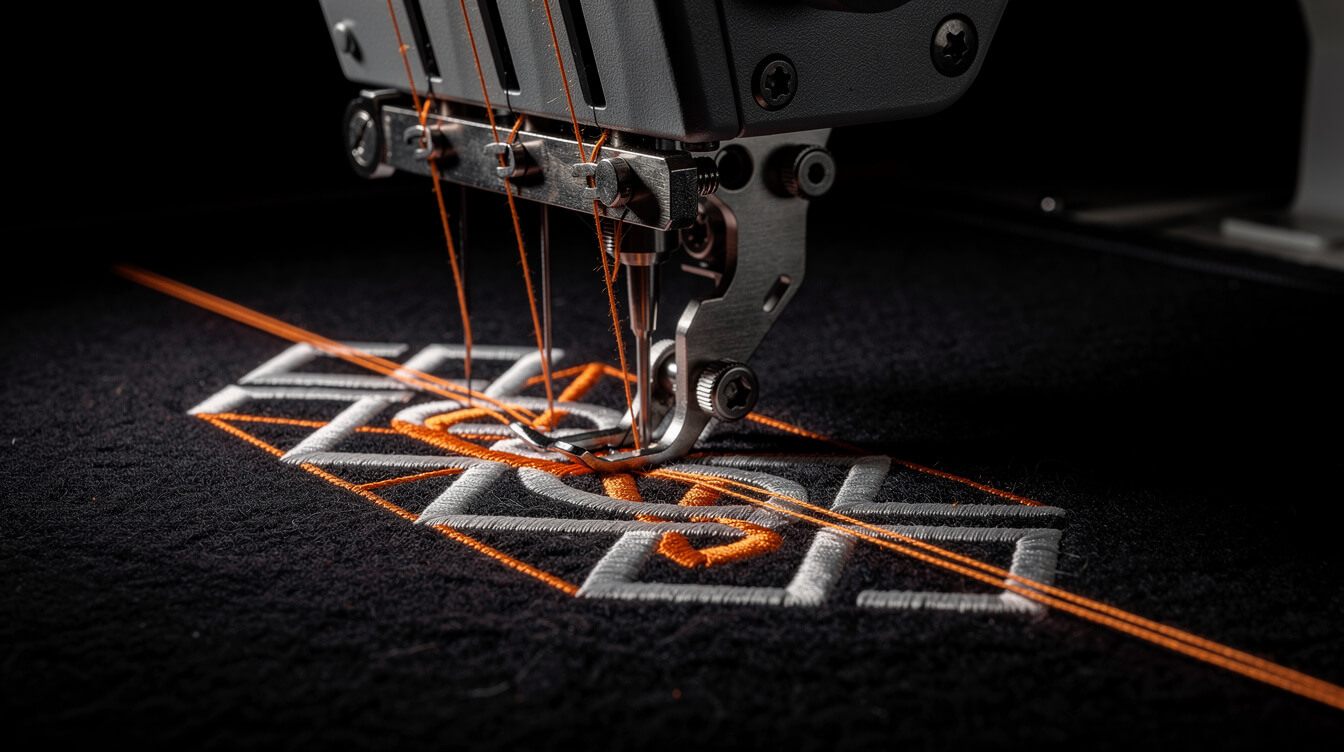
Embroidery and printing are fundamentally different processes. Printing lays ink on fabric. Embroidery stitches thread through fabric. That distinction changes your design requirements, your cost structure, and what sells at what price point.
Digitization
Digitization is the process of converting your artwork file into a format that an embroidery machine can execute. A specialist called a digitizer traces your design and assigns stitch types, stitch directions, and stitch densities to each element. The output is a machine file format (typically .DST or .EMB, depending on the equipment manufacturer). This step happens once per design, not once per garment. That one-time cost structure is important: after the first sale, the per-unit digitization cost drops to zero.
Stitch count
Stitch count is the total number of individual stitches in your design. It directly determines how long the embroidery machine runs per garment, which determines your per-unit service charge. A simple left-chest logo at 5,000 stitches costs less to embroider than a full-back design at 50,000 stitches.
For sweatshirts specifically, common placements and typical stitch ranges:
- Left-chest placement (most common): 5,000 to 10,000 stitches
- Sleeve placement: 3,000 to 7,000 stitches
- Center-chest placement: 8,000 to 15,000 stitches
- Full-back embroidery: 30,000 to 80,000 stitches (expensive on POD, rarely offered)
What this means for your designs
Embroidery rewards simple artwork with clean lines and solid fills. A three-color corporate logo, a small monogram, a clean wordmark, a sports team graphic: these digitize cleanly and look sharp at any size. Photorealistic artwork, gradients, and fine detail do not translate well. Embroidery is not the right technique for a photographic print. It is the right technique for structured, brand-first, text-and-icon designs.
Most POD providers accept PNG or vector artwork (AI, SVG) and digitize internally. You do not need to supply the machine file yourself. Submit your clean artwork and let Printful or Printify handle the conversion.
Printful vs Printify embroidered sweatshirts: catalog comparison and unit costs
Both Printful and Printify offer embroidered sweatshirts. Their catalogs and cost structures differ in ways that matter for POD sellers.
Printful
Printful runs centralized fulfillment from its own facilities. Its embroidery offering covers crew necks and hoodies from Gildan, American Apparel, and its own branded blanks. Key details for POD sellers:
- Placement options: Left-chest, right-chest, center-chest, sleeve, back
- Stitch count pricing: Flat fee for designs under a base stitch threshold, with incremental charges above it. Check current Printful pricing directly, as rates update periodically.
- Digitization fee: Printful charges a one-time fee per design, typically in the $1.95 to $6.95 range depending on complexity. This is charged once, not per order.
- Base garment cost: A standard sweatshirt blank runs approximately $17 to $22 depending on the specific model and size.
- Embroidery service charge: Approximately $6 to $15 for a typical left-chest logo, depending on stitch count.
- All-in fulfillment cost for a simple left-chest logo sweatshirt: Typically $25 to $35 before shipping.
Printify
Printify connects sellers to a network of independent fulfillment providers, some of which offer embroidery. Provider availability varies by region, and not every provider in the Printify network supports the technique.
- Use the “Embroidery” technique filter in the Printify catalog to find eligible products
- Costs vary by print provider — some are lower than Printful, some are comparable
- Quality consistency varies more than with Printful’s centralized model
- Digitization fee policies differ by provider — check each one individually
Which to choose for embroidery
For embroidery specifically, Printful’s centralized fulfillment is often the more predictable choice. You know the blank, the embroidery fee structure, and the quality floor. Printify’s network can be cheaper, but introduces provider-dependent variability in both stitch quality and policy. For sellers building a consistent embroidered sweatshirt product line, that consistency is worth paying for.
Our post on custom hoodie embroidery at Printful covers the same fulfillment logic for hoodies. The sweatshirt catalog follows identical economics.
The real cost of a custom embroidered sweatshirt: base blank, digitization, shipping, and platform fee
Smash print-on-demand. Join the engine room.
One short email a week. Real numbers, real teardowns, the unfiltered economics behind every move.
Every unit-cost breakdown for embroidered sweatshirts that POD sellers see online is incomplete. Here is the full picture, component by component.
Component 1: Base garment
A Gildan 18000 or comparable sweatshirt blank runs $14 to $22 at fulfillment, depending on size, color, and provider. Premium blanks (Champion, Bella+Canvas fleece) run $25 to $35. Use $19 as a working baseline for standard Gildan stock.
Component 2: Embroidery service charge
A standard left-chest logo at 8,000 stitches on Printful costs roughly $6 to $10. A more complex 15,000-stitch design runs $10 to $15. Use $8 as a working estimate for a typical simple logo placement.
Component 3: Digitization fee (amortized)
Printful charges a one-time fee per design of roughly $1.95 to $6.95. On a 50-unit run, that adds $0.04 to $0.14 per unit. On a 10-unit run, it adds $0.20 to $0.70. For POD with no guaranteed volume, treat this as a one-time cost that reduces effective margin on your first few sales and then effectively disappears.
Component 4: Shipping
Standard US shipping for a sweatshirt through Printful is approximately $3.99 to $5.99 for the first item, with $1.50 to $2.50 for each additional item in the same order. If you offer free shipping to customers, this comes out of your margin.
Component 5: Platform fee
If you are on Shopify Basic, you pay a 1% transaction fee on every sale as an “additional fee” on top of payment processing. On a $65 sweatshirt, that is $0.65 on every single order. On WooCommerce, that fee is $0.00. See our breakdown of Shopify transaction fees for POD sellers to model what this costs at your volume.
Full unit cost comparison: Shopify vs WooCommerce at $65 retail
| Cost component | Shopify Basic | WooCommerce |
|---|---|---|
| Blank sweatshirt | $19.00 | $19.00 |
| Embroidery (8,000 stitches) | $8.00 | $8.00 |
| Shipping (passed to cost) | $4.99 | $4.99 |
| Platform transaction fee | $0.65 | $0.00 |
| Total cost | $32.64 | $31.99 |
| Gross margin on $65 sale | $32.36 (49.8%) | $33.01 (50.8%) |
That $0.65 difference seems small per order. At 200 orders per month, it is $130. At 500 orders per month, it is $325. At 1,000 orders per month, it is $650. The Shopify tax compounds with volume, and embroidered sweatshirts have exactly the high AOV that makes the compounding hurt.
MEGA automates the embroidered product setup on WooCommerce end-to-end: from niche selection to live listing, so you spend zero time on the workflow overhead that kills POD margins at scale.
Embroidery vs DTG on fleece: which print method wins at which price point
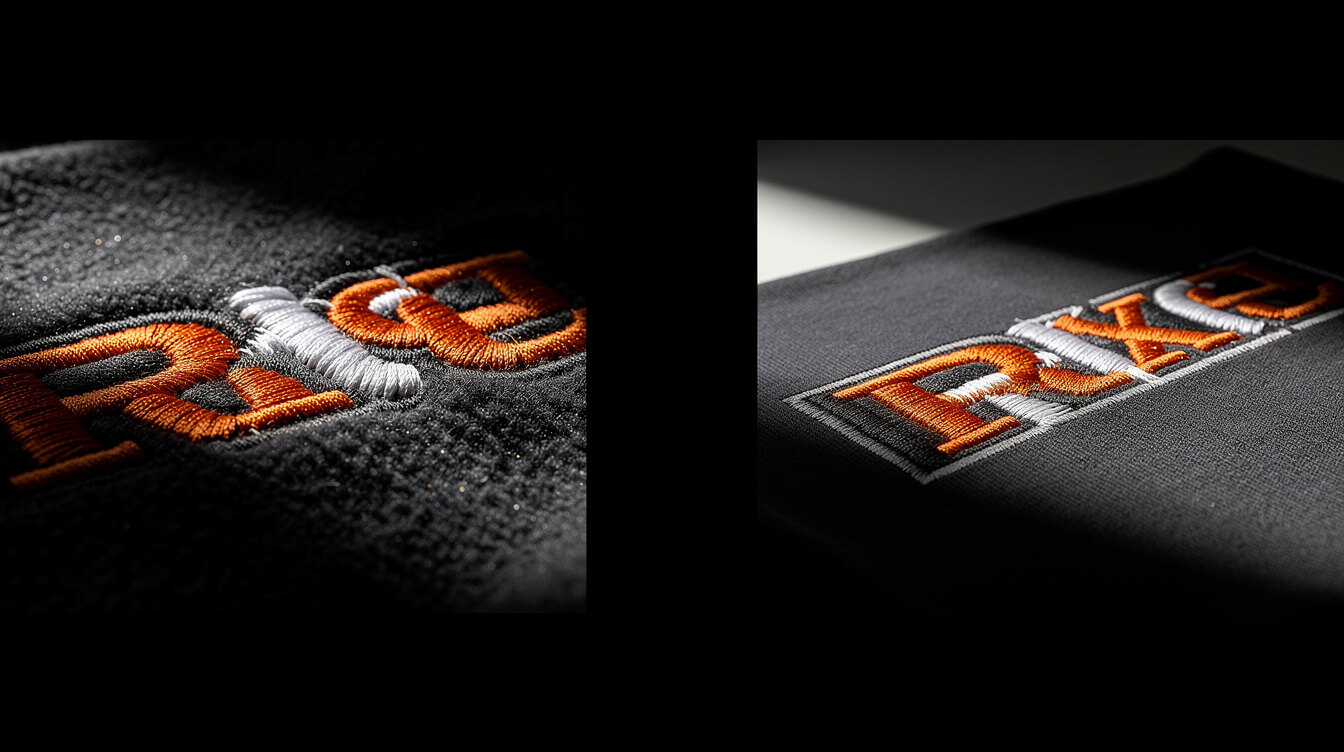
This is the design decision POD sellers avoid until a customer asks about it directly. Here is the cleaner framework for choosing between the two methods.
DTG (direct-to-garment) on sweatshirts
DTG applies ink to fabric using a printer head, similar to how an inkjet printer works on paper. Sweatshirt fabric (typically a cotton-polyester blend) can accept DTG, but with caveats:
- DTG results are best on 100% cotton. Most sweatshirts are 50% cotton/50% polyester. Ink saturation is lower on poly content.
- Printing on dark sweatshirts requires a white underbase layer, which adds cost and affects the hand feel of the garment.
- DTG pricing on a sweatshirt is typically lower than embroidery for complex or photorealistic artwork, because you pay for the print area, not the stitch count.
- Wash durability on DTG prints is generally lower than embroidery. Printed ink can crack and fade; embroidered thread does not.
Embroidery on sweatshirts
- Premium perceived value. Customers who buy embroidered garments pay more and return them less.
- Best for logo-driven, text-forward, structured designs with clean lines.
- Not suitable for photorealism, fine detail, or gradients.
- Higher unit cost than DTG, but commands a higher average selling price.
- Better durability: thread lasts longer than printed ink on fleece.
The decision framework by artwork type
| Artwork type | Better method | Why |
|---|---|---|
| Photorealistic graphic | DTG | Embroidery cannot reproduce photorealism |
| Gradient or watercolor | DTG | Thread cannot replicate smooth color transitions |
| Bold logo or wordmark | Embroidery | Cleaner finish, longer-lasting, premium perception |
| Text-only design | Embroidery | Premium look with minimal stitch complexity |
| Multi-color complex print | DTG | Lower cost at higher complexity |
| Sports or organizational identity | Embroidery | Traditional execution that matches customer expectations |
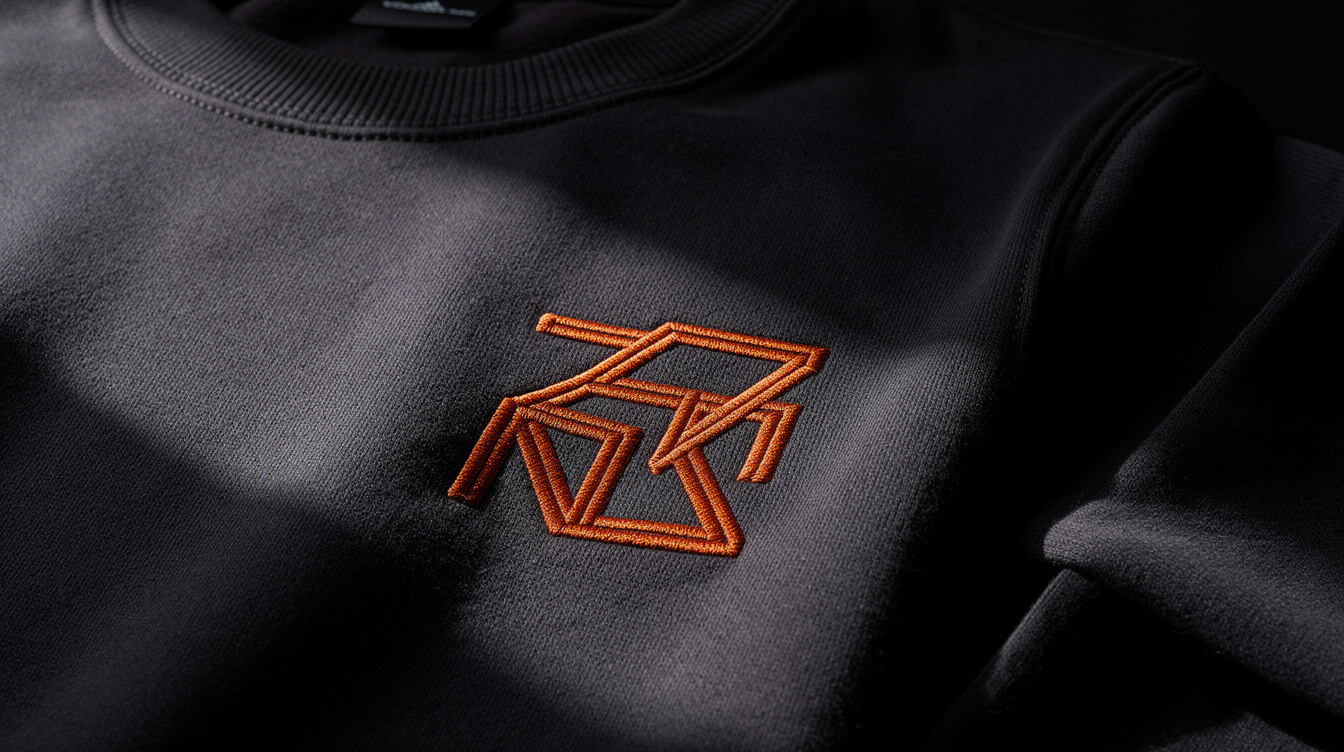
The sweet spot for an embroidered sweatshirt product line is structured, brand-oriented designs: school crests, sports team identities, occupational themes, organizational logos. That audience pays $55 to $85 without hesitation because the embroidery signals quality in a way that a DTG print on the same sweatshirt does not.
For sellers running custom sweatshirt printing via DTG, embroidered sweatshirts can be a natural premium tier in the same catalog. You offer both. DTG handles the complex artwork. Embroidery handles the logo and brand identity work.
30x your product throughput. Get MEGA.
MEGA automates the research-to-listing pipeline for POD sellers on WooCommerce. Add embroidered sweatshirts at scale without the manual workflow overhead. From niche keyword to live listing in under 7 minutes.
WooCommerce vs Shopify at a $65 sweatshirt AOV: the math that changes your margin

A $65 average order value changes the Shopify fee calculus significantly compared to a $19 t-shirt. The math is the same percentage, but the absolute dollar impact per order is more than three times larger.
The Shopify fee at different AOVs
| Product | Retail price | Shopify Basic fee (1%) | At 500 orders/month |
|---|---|---|---|
| DTG t-shirt | $19 | $0.19 | $95/month |
| Custom hoodie | $45 | $0.45 | $225/month |
| Embroidered sweatshirt | $65 | $0.65 | $325/month |
| Premium embroidered crewneck | $85 | $0.85 | $425/month |
The argument that “Shopify fees are just 1% so it does not matter” falls apart the faster you scale and the higher your AOV climbs. Embroidered sweatshirts are a premium category. If your product mix shifts toward $55 to $85 items, the fee grows proportionally with every order.
Can you upgrade your Shopify plan to escape the fee?
Shopify Advanced ($299 per month) reduces the transaction fee to 0.5%. Shopify Plus ($2,000 per month) eliminates it. For a growing POD seller doing $15,000 to $40,000 per month in revenue, neither plan makes economic sense purely to offset the transaction fee. You would spend more on the plan upgrade than you save on the fee.
At $15,000 per month gross revenue, Shopify Basic transaction fees cost $150 per month. Upgrading to Advanced to save $75 per month costs $299 per month in plan fees. The math does not clear until you are at very high revenue levels. Most POD sellers are not there.
WooCommerce at the same volume
WooCommerce has no equivalent platform transaction fee. You pay your payment processor (Stripe at 2.9% plus $0.30 per transaction, or WooPayments at similar rates) and nothing to the platform itself. At 500 embroidered sweatshirt orders per month at $65 average:
- Shopify Basic: $325 per month in platform transaction fees
- WooCommerce: $0 per month in platform fees
- Difference: $325 per month, or $3,900 per year
For a POD seller who started on Shopify and has not done this math on their actual product mix and volume, it is worth doing now. The Shopify transaction fee breakdown walks through the full annual cost at different revenue levels.
Building an embroidered sweatshirt product line with MEGA: from niche to live listing
Adding a single embroidered sweatshirt SKU to your store manually takes two to four hours when you account for niche research, design brief preparation, Printful catalog navigation, digitization submission, product title and description writing, SEO tagging, and listing setup. Do that for ten SKUs and you have lost a full day. Most POD sellers know this friction. It is why embroidered sweatshirts remain an under-served category even though demand is clearly there.
The niche-targeting advantage in embroidery
Embroidered sweatshirts benefit from a depth strategy. If you sell custom embroidered sweatshirts for nurses, you want the registered nurse design, the ICU nurse design, the pediatric nurse design, the travel nurse design, and the nursing student design. Not one SKU but ten. At manual speed, building that catalog takes a week. At MEGA’s speed, it takes under an hour.
The same logic applies to any occupational or organizational niche:
- First responders: firefighter, EMT, paramedic, police, dispatcher
- Education: teacher, principal, school counselor, college major
- Sports teams: league names, team names, position names
- Corporate identity: department logos, company names, annual event themes
Each of these sub-niches is a separate SEO-targeted product page. Each page targets a specific buyer who is already searching for exactly that product. Embroidery’s premium nature means conversion rates are higher and return rates are lower than DTG equivalents.
Seasonal windows for embroidered sweatshirts
Embroidered sweatshirts are strongly seasonal. Three windows drive the majority of annual demand:
- Graduation season (April to June): Class of [year] designs, school crests, graduation themes
- Back-to-school (August to September): School spirit wear, team uniforms, organization identities
- Fall and winter gifting (October to December): Premium gifts, holiday company orders, year-end recognition
MEGA lets you pre-generate a product roster before each seasonal window opens, without hiring a design team or burning VA hours on listing setup. Build the catalog in October. Capture the November and December gifting demand. Repeat the following August for back-to-school.
The full pipeline recommendation
For sellers who are already running custom logo hats as a product line, embroidered sweatshirts follow the same fulfillment logic and benefit from the same niche-targeting approach. The hat buyer and the sweatshirt buyer often have the same underlying intent: a branded, premium, logo-forward garment. Cross-list both and your average order value increases when buyers add both to their cart.
To build an embroidered sweatshirt product line that works at POD economics:
- Use Printful for consistent quality and predictable fulfillment costs
- Target logo-driven, text-forward designs under 10,000 stitches for best unit economics
- Price at $55 to $85, which is competitive with B2B embroidery vendors and reflects the premium of the technique
- Run on WooCommerce to keep the Shopify transaction fee out of your margin
- Use MEGA to generate and list at scale, not one SKU at a time
Embroidered sweatshirts are a product category where the manual-Canva workflow genuinely cannot compete with automation. The research, the niche permutations, the listing volume required to capture seasonal demand: these are all pipeline problems that MEGA solves. The question is not whether to add embroidered sweatshirts. It is how fast you want to build the catalog.
Implement AI. 30x your throughput. Get a 30-min call with the founder.
Drop your details and book a free 30-minute discovery call. Personalized advice on your POD stack, your margin, and where AI fits. No pitch, no fluff.