Print on demand stickers: margin math, provider comparison, and when stickers are worth adding to your POD store
Print on demand stickers are one of the most-searched product categories among POD sellers. Low barrier to entry, no minimum orders, and a buyer base that treats sticker collecting as a hobby rather than a purchase. The appeal is obvious.
The margin math is less obvious. Most guides in this space come from print providers — Printful, Prodigi, Gooten, StickerApp — and they are selling you on their catalog, not on whether this product category will actually make you money. Nobody breaks down what you keep per unit at $5, $8, and $12 retail. Nobody shows what happens to your margin when Shopify takes its platform override on a low average order value.
This post does that math. It covers print on demand stickers by type, provider costs, platform fee impact, and volume thresholds. If you run a WooCommerce store or you are evaluating the switch, the numbers in section five are worth the read.
Why stickers are tempting for POD sellers (and what the math actually shows)
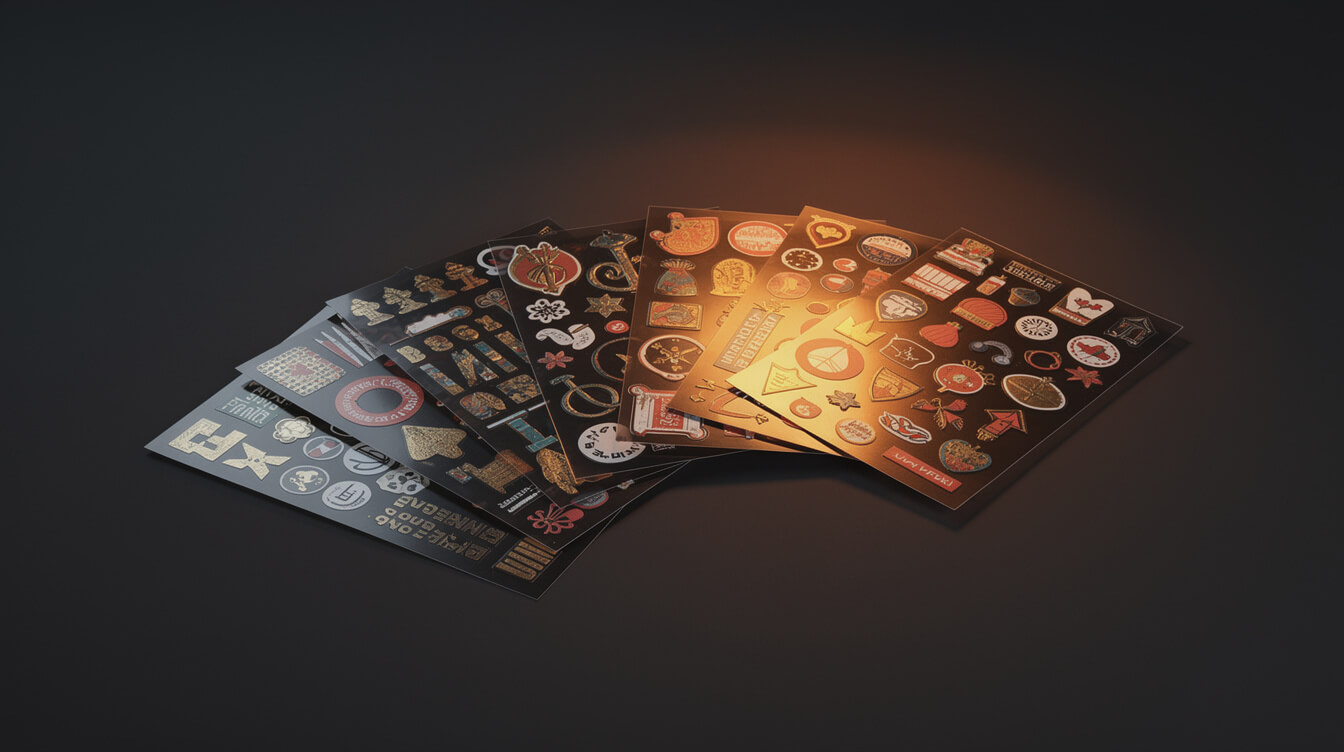
Stickers check every box a POD seller looks for in a new product category. They ship flat, so fulfillment is cheap. Buyers expect to pay $5 to $15 per unit, which creates comfortable-looking margins at first glance. Sticker collectors exist in almost every niche — anime, gaming, outdoor gear, vintage cars, sports teams, local pride. You can build a catalog of 50 SKUs without holding any inventory.
The temptation makes sense. A 3×3 kiss-cut sticker on Printful costs roughly $2.75 to produce. List it at $8 and you are looking at a $5.25 gross margin. That number feels healthy until you run the rest of the math.
The actual unit economics look like this on a standard Shopify setup. You sell a sticker for $8. Shopify’s payment processing takes approximately 2.9% plus $0.30, which equals $0.53 on an $8 order. Shopify’s platform override — the 1% that Shopify charges on top of payment processing on its Basic plan when you use a third-party payment processor — takes another $0.08. You net $4.64 on a sticker that feels like a $5.25 margin product. That is an 11.6% reduction in gross margin before you count shipping, returns, or the time it took to create the listing.
Compare that to a $28 t-shirt. Same Shopify setup. Payment processing takes $1.11. The 1% override takes $0.28. Combined deductions are $1.39, or about 7.5% of an $18.50 gross margin. The platform fees bite proportionally harder on low average order value products like stickers.
This is not a reason to skip stickers. It is a reason to know your math before you build the catalog.
Sticker types: kiss-cut, die-cut, sheet, and transparent
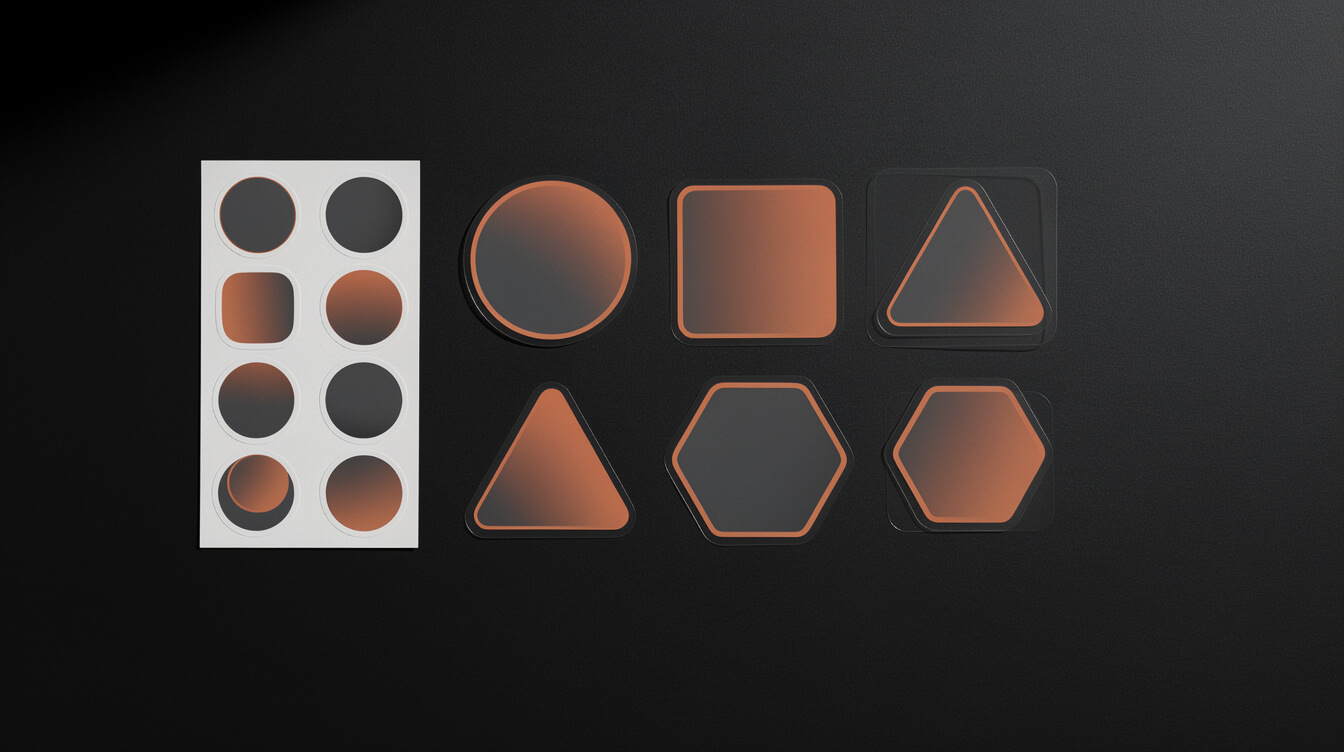
Not all print on demand stickers are the same product. The format you choose affects your unit cost, your retail price ceiling, and your buyer’s expectations.
Kiss-cut stickers are the most common format. The sticker is cut to shape but remains on a full rectangular backing sheet. They are easy to peel and feel familiar to buyers. Kiss-cut is the default format on Printful and most Printify suppliers, with unit costs typically running $2.50 to $2.90 for a 3×3 size. This format works across nearly every niche and carries the least production risk.
Die-cut stickers are cut precisely to the outline of the design. They look more premium and command a slightly higher retail price. The production cost is modestly higher — typically $0.25 to $0.50 more per unit than kiss-cut at the same size. Die-cut stickers perform well in niches where buyers are collectors and packaging presentation matters.
Sheet stickers group multiple smaller designs on a single backing sheet. The economics are different because you are selling one SKU that contains several images. Buyers pay $8 to $12 for a sheet, and the production cost per sheet at providers like Printful is typically $3.50 to $4.50. Your gross margin is similar to a single large sticker, but the perceived value is higher for the buyer. This format also has the practical benefit of letting you combine 4 to 8 smaller designs without creating separate listings for each.
Transparent stickers are a specialty format. The background of the design becomes see-through, which creates effects that opaque stickers cannot. Production costs run higher — typically $3.00 to $4.00 for a 3×3. Buyers who want transparent stickers are usually decorating laptops, water bottles, or car windows and they know exactly what they want. This is a narrower niche with correspondingly less competition.
For most POD stores starting a sticker catalog, kiss-cut is the right entry point. Low cost, familiar format, and every major provider supports it. You can add die-cut and sheets as your catalog matures and you learn which niches respond best.
Provider comparison: Printful vs Printify vs Gooten vs Prodigi for sticker margins
The provider you choose determines your unit cost, and unit cost determines your maximum gross margin at any given retail price. Here is how the four main providers compare.
Printful is the most integrated option for WooCommerce stores. Their sticker catalog covers kiss-cut and die-cut formats. A 3×3 kiss-cut sticker runs roughly $2.75 per unit. Printful’s production quality is consistent, and their WooCommerce integration is stable and well-documented. The trade-off is that they are not the cheapest option. You are paying for reliability and for fulfillment centers in the US, Europe, and Mexico, which keeps shipping times competitive. You can read more about their full catalog in our Printful products guide.
Printify connects you to a network of third-party suppliers, and StickerApp — one of their primary sticker suppliers — is a strong option for print on demand stickers. StickerApp’s unit costs run slightly lower than Printful for comparable sizes, typically $2.25 to $2.65 for a 3×3 kiss-cut. Printify also supports die-cut and holographic options through some suppliers. The caveat is that quality consistency varies across suppliers, so ordering samples before committing to a catalog is worth the time.
Gooten offers stickers through their catalog but with a narrower format selection than Printful or Printify. Their unit costs are competitive, often $2.00 to $2.50 for standard sizes, but the sticker catalog is not their strongest category. If you are already using Gooten for other products, adding stickers is straightforward. If stickers are your primary focus, Printful or Printify gives you more format options.
Prodigi is worth considering if your audience is primarily in the UK or Europe. Their per-unit costs are often the lowest in the comparison — sometimes under $2.00 for a basic kiss-cut sticker — but shipping from their UK facilities adds two to four business days for US customers. Prodigi works best as a secondary provider for a geographically specific product line, or if European fulfillment speed is your priority.
The provider decision is not permanent. One of the structural advantages of POD is that you can switch fulfillment partners without rebuilding your storefront. If your margins compress over time, you have options.
The Shopify 1% problem hits sticker sellers harder than anyone

Smash print-on-demand. Join the engine room.
One short email a week. Real numbers, real teardowns, the unfiltered economics behind every move.

Shopify’s platform override fee is not unique to sticker sellers. Every Shopify store pays it. But the proportional impact is larger on low average order values, and print on demand stickers are almost always a low-AOV product.
The math is straightforward. You can read the full breakdown in our Shopify transaction fees for POD sellers guide, but here is the sticker-specific version.
On Shopify’s Basic plan, if you use a third-party payment processor — which many international sellers must, since Shopify Payments is not available in every country — the platform override runs 2% per transaction. On an $8 sticker sale, that is $0.16. Add payment processing fees and you are down to $4.44 net from a $5.25 gross. That is a 15% reduction before counting fulfillment errors, return requests, or promotional discounts.
Run the same math on a $35 custom t-shirt with a $14 gross margin. The same 2% override takes $0.70. That is 5% of your gross margin. The fee is bigger in absolute dollar terms, but it is less destructive as a percentage of what you actually keep. This is why the Shopify tax matters more for sticker sellers than for almost any other POD product category.
MEGA automates the full sticker listing pipeline on WooCommerce, which carries no platform override. You pay flat hosting and plugin costs regardless of your sales volume. See how MEGA handles sticker listings end-to-end and what the WooCommerce setup actually costs at scale.
What you keep per sticker on WooCommerce at $5, $8, and $12 retail
WooCommerce eliminates the platform override entirely. Your store costs are flat — hosting, plugins, and payment processing. You still pay a payment processor (Stripe is common, at 2.9% plus $0.30 per transaction), but there is no Shopify override on top. For a full breakdown of what WooCommerce actually costs to run, see our WooCommerce pricing for POD stores guide.
Here is what the print on demand stickers margin looks like across three retail price points on WooCommerce.
At $5 retail, using a Prodigi-sourced sticker at approximately $1.70 unit cost, your gross margin is $3.30. After Stripe processing (roughly $0.45 on a $5 transaction), you keep approximately $2.85 per unit. This is a thin margin for a single-unit sale, but it is workable when selling in volume or in bundles. No platform override fee means you are not losing additional percentage points on top.
At $8 retail, using a Printify (StickerApp) sticker at approximately $2.45 unit cost, your gross margin is $5.55. After Stripe processing (approximately $0.53), you keep approximately $5.02 per unit. This is the sweet spot for most sticker catalogs — a price buyers accept without friction, and a margin that gives you room to run occasional promotions without going negative.
At $12 retail, using a Printful kiss-cut at approximately $2.75 unit cost, your gross margin is $9.25. After Stripe processing (approximately $0.65), you keep approximately $8.60 per unit. At this price point, you need a justification — a premium die-cut format, a multi-pack, or a niche with buyers accustomed to paying more for quality sticker art.
Compare these numbers to a Shopify setup at the same price points. Subtract an additional 1-2% per transaction depending on your plan and payment processor. At $8, that is $0.08 to $0.16 per unit more going to Shopify. Small numbers at low volume. At 500 sticker units per month, that is $40 to $80 per month in fees that WooCommerce sellers do not pay.
Volume math: how many stickers per month before this category pays off
Adding print on demand stickers to your store has one overhead cost most sellers underestimate: the time required to build a meaningful catalog. A sticker buyer is a browser. They scan listings, buy the designs that match their aesthetic, and move on. To generate consistent revenue from this category, you generally need variety — not two or three designs, but 30 to 100 or more.
The manual workflow looks like this. You open Canva or another design tool. You create a sticker design. You download the file, format it correctly for the print provider’s specifications, upload it, fill in the product title, description, dimensions, and pricing, and push it live. That process takes 45 to 90 minutes per SKU when done properly, including checking the preview mockup and verifying the cutting line placement.
At 50 SKUs, you are looking at 40 to 75 hours of setup work before you make a single sale. This is the wall that stops most sellers from building a sticker catalog worth building. The financial break-even is not the problem. If you sell 10 stickers per day at $8 retail and keep $5.02 per unit on WooCommerce, you are generating $50 per day in net margin from the sticker category alone. The economics work.
The constraint is throughput. How fast can you build and list 50 SKUs? If the answer is several weeks of evenings, most sellers deprioritize the category and never build past 8 to 10 designs. At that depth, a sticker catalog generates occasional revenue but not a consistent line item.
There is also the matter of design transferability. A sticker design built for a 3×3 format is not the same file as a t-shirt design or a mug wrap. You are building a parallel creative pipeline, not extending your existing one. The file formats, dimensions, and cutting specifications are different across providers and formats. This is not complicated, but it adds time to every SKU when done manually.
The break-even question is really: can you build the catalog fast enough that the revenue justifies the time? At 50 SKUs generating 300 units per month at $5 net per unit, you are adding $1,500 per month to your store. That math supports the investment. The challenge is getting to 50 SKUs without burning 75 hours doing it by hand.

Build a 50-SKU sticker catalog in 6 hours, not 75
MEGA automates sticker listings end-to-end on WooCommerce. Research, design, sizing, mockups, product descriptions, SEO titles — all done in under 7 minutes per SKU. Same pipeline as t-shirts. New product type.
How MEGA automates sticker listings: same 7-minute pipeline, new product type
MEGA’s research-to-product pipeline works on stickers the same way it works on t-shirts, hoodies, and mugs. You feed a niche. MEGA generates the design via AI image generation, sizes and formats it for the print provider, writes the product title, description, and SEO metadata, creates the WooCommerce listing, and pushes the mockup. From brief to live listing takes under seven minutes per SKU.
For sticker sellers, this changes the catalog math entirely. 50 SKUs at 7 minutes each is approximately 6 hours of pipeline time, compared to 40 to 75 hours of manual Canva work. You can build a full sticker catalog over a weekend rather than across three weeks of evenings.
The pipeline handles the decisions that slow most sellers down: which sticker size to use, how to format the die-cut outline, what dimensions each print provider requires for each format. MEGA has provider-specific constraints built in. You do not look them up each time.
WooCommerce compatibility is native. MEGA generates listings that push directly to your WooCommerce store. No manual copy-paste between your design tool and your storefront. No reformatting product data to match Printful’s upload requirements. The platform fee savings from WooCommerce versus Shopify — described in the previous sections — compound as your catalog grows.
The volume that becomes viable with MEGA is significantly higher than the manual approach allows. A sticker catalog of 200 or 300 SKUs — covering five or six niches in depth — is buildable in a week. At that scale, stickers become a consistent revenue category rather than a side experiment. For context on how print on demand platforms compare at that catalog scale, see our overview of the three types of POD sites and which model fits each seller stage.
The design methodology that makes automation possible for stickers also applies across every other POD product type. If you want to understand how the design generation pipeline works in more detail, our post on DTG vs DTF for POD sellers covers the print method differences and how they affect automated design pipelines.
Common questions about print on demand stickers
What is the minimum order quantity for print on demand stickers?
There is no minimum. All major POD providers — Printful, Printify, Gooten, and Prodigi — fulfill sticker orders starting from a single unit. This is what makes stickers practical for a POD store: you never hold inventory and you never pre-pay for stock that may not sell.
How does sticker print quality compare across providers?
Print quality for digital stickers is generally high across the major providers, since most use the same digital vinyl printing process. Differences show up in material quality, lamination options (gloss vs matte), and edge precision on die-cut formats. Printful and StickerApp (via Printify) are consistently rated well for edge precision on die-cut stickers. Order samples before committing your catalog to a single provider.
Do sticker designs need to be vector files?
Not necessarily. Most POD providers accept high-resolution PNG files with transparent backgrounds. At 300 DPI or higher, a PNG works well for kiss-cut and die-cut formats. Some providers prefer SVG for die-cut outlines to ensure clean cutting paths. Check your provider’s upload specifications before generating your design files at scale.
Can you sell print on demand stickers on Etsy?
Yes. Etsy has a large market for sticker designs, and you can connect Printify directly to an Etsy shop. Keep in mind that Etsy charges its own transaction fees on top of payment processing and fulfillment costs. The AOV math gets tighter on Etsy than on an owned WooCommerce store, where platform fees do not compound.
What are the best niches for sticker selling?
Sticker buyers tend to be in enthusiast communities. Gaming, anime, outdoor and adventure, pet breeds, local city pride, and fandom niches all have active sticker buyer communities. The same niche research principles that apply to t-shirts apply here. Find communities that spend money on merchandise and have strong visual identity — those are the niches worth building a sticker catalog for.
Conclusion: when print on demand stickers are worth adding
Print on demand stickers are a viable product category. The economics work on WooCommerce at $8 and above retail, especially with lower-cost providers like Prodigi or Printify’s StickerApp. The gross margin before fees is $3 to $6 per unit across common price points, and the business model requires no inventory.
The constraint is catalog depth. Sticker buyers do not convert on one or two designs. Building a catalog that generates consistent revenue requires 50 or more SKUs, which translates to 40 to 75 hours of manual work. That is the threshold that stops most sellers from taking the category seriously.
When you automate the listing pipeline, that threshold drops to 6 to 8 hours for 50 SKUs. The decision shifts from “is this worth the time” to “which niches should I build first.”
The platform fee difference between Shopify and WooCommerce is real but small at low volume. At 200 to 500 sticker transactions per month, it becomes a meaningful number. At that scale, the overhead cost of WooCommerce is more than recovered by the platform override you avoid paying.
Stickers are not a hero product for most POD stores. They are a catalog extension that adds revenue per visitor when built with depth. The math supports adding them. The practical question is whether your listing workflow can build the catalog fast enough to make the category pay.

Implement AI. 30x your throughput. Get a 30-min call with the founder.
Drop your details and book a free 30-minute discovery call. Personalized advice on your POD stack, your margin, and where AI fits. No pitch, no fluff.