T-shirt dropshipping in 2026: what the top results miss about margin and platform fees
If you search “t-shirt dropshipping” right now, you get pages from Printful, Contrado, Apliiq, and Teemill. Every one of them wants to sell you their fulfillment service. Then there is one Printify blog post listing the top eight companies. Nobody in that SERP explains what t-shirt dropshipping actually is, what it actually costs, or why so many stores doing it run thin margins even after they get sales coming in.
This post covers what they miss. T-shirt dropshipping and print-on-demand are the same model. The biggest cost is not the blank shirt. And the platform fee under your store is quietly taking a percentage of every sale you make.
T-shirt dropshipping is print-on-demand (not what most guides say it is)
Most search results for t-shirt dropshipping treat it like AliExpress-style dropshipping: find a supplier, import products, resell. That model means you are handling inventory someone else bought. That is not how t-shirt dropshipping works.
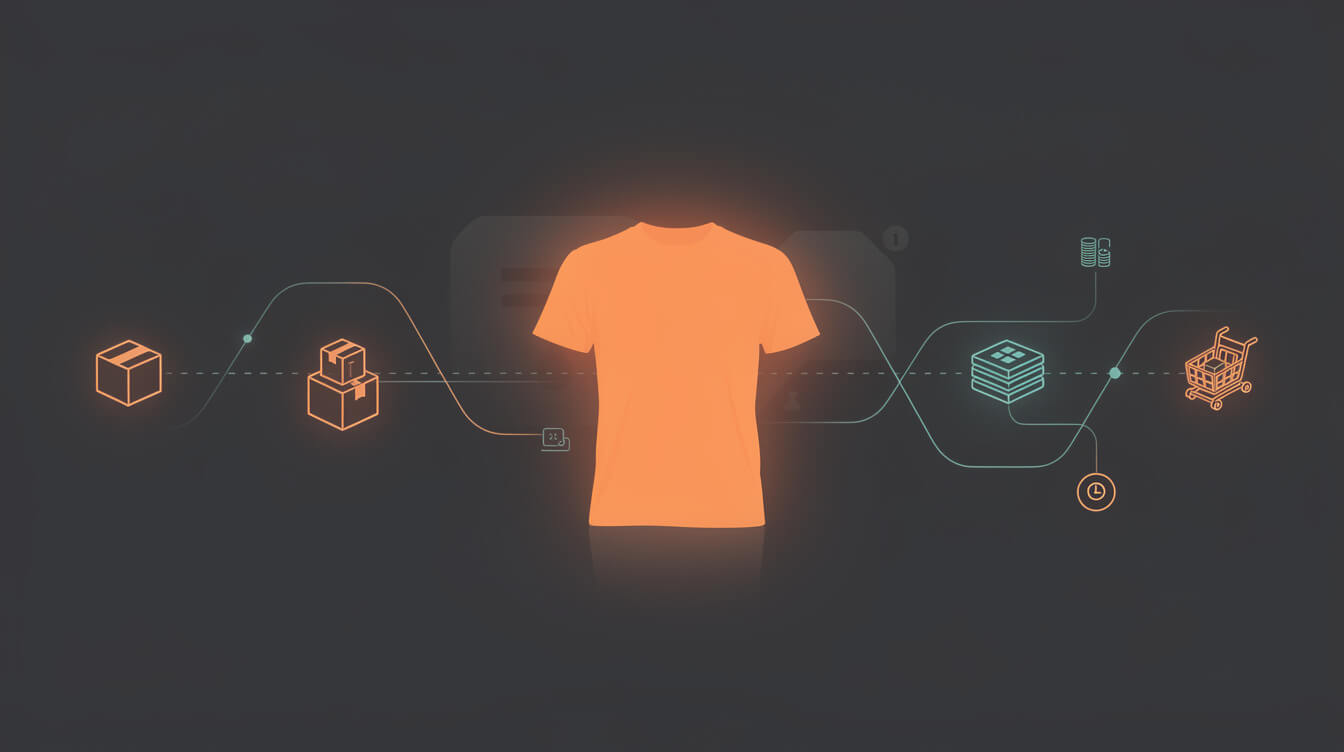
In t-shirt dropshipping, there is no inventory anywhere. A customer places an order. The POD supplier receives the order, prints your design on a blank shirt, and ships it directly to the customer. You never touch the shirt. You never own the blank.
The suppliers doing this at scale are Printful, Printify, Gooten, and a few specialty providers. They differ on product catalog, base cost, shipping speed, and print quality. What they share is the same fulfillment model: no inventory, no warehouse, no minimum order quantity.
This is not a nuance. It changes how you evaluate every cost decision you make. AliExpress dropshipping is about supplier margins and shipping times. T-shirt dropshipping is about print cost, platform fees, and listing volume.
The Reddit threads about this confirm the confusion. A $25 unit cost on a $35 shirt leaves $10 gross before platform fees, payment processing, and marketing. The guides do not explain where that $25 comes from or how to reduce it structurally. They say “find a good supplier.” That is not advice. It is noise.
Real unit economics: what Printful and Printify actually charge per shirt in 2026

The base cost on a standard unisex t-shirt through Printful in 2026 sits around $13.25 for the Bella + Canvas 3001. Through Printify, the same shirt via Monster Digital runs around $10.30. The difference looks significant until you add shipping.
Printful ships domestically for around $4.99 on the first item. Printify shipping varies by print provider but runs $4.00-$5.50 for most domestic US orders. So your landed unit cost for a single shirt in the US is roughly:
- Printful: around $18.24 per shirt (base plus shipping)
- Printify via Monster Digital: around $14.80-$15.80 per shirt (base plus shipping)
Retail price on a standard t-shirt in the POD space typically runs $24.99 to $34.99. At $29.99 retail and $18.24 landed cost on Printful, gross margin before platform fees is $11.75, or 39%. That is not bad. Then the platform fee arrives.
Printify offers a free plan. Premium is $24.99 per month and reduces base costs by roughly 20%. At scale, Premium pays for itself quickly. The monthly subscription is a fixed cost that matters more when order volume is low.
You can see a full cost breakdown in our analysis of whether Printify is actually free and in our review of Printful product pricing by category. The supplier cost is only one input. The platform running your store is the other, and it is the one most t-shirt dropshipping guides skip entirely.
The Shopify fee hiding under every t-shirt dropshipping sale

Shopify charges a 1% transaction fee on every sale if you do not use Shopify Payments. Even if you use Shopify Payments, you are on the Basic plan at $39 per month, the Shopify plan at $105 per month, or the Advanced plan at $399 per month. Shopify Payments is not available in every country.
On the Basic plan with Shopify Payments, the transaction fee drops to 0% but the card processing rate runs 2.9% plus $0.30 per transaction. On a $29.99 shirt, that is $1.17 in processing. Add the Basic subscription at $39 per month spread over 100 orders and you are at $0.39 per order in subscription cost. Total Shopify cost per sale at 100 orders per month: around $1.56 before any third-party app fees.
That sounds manageable. The problem scales with revenue. At $10,000 per month in revenue with Shopify Basic and Shopify Payments, you are paying roughly $375 in card processing plus $39 in subscription. That is $414 per month in platform cost. At $50,000 per month, the math worsens because you may need the Advanced plan at $399 to get the lower processing rate of 2.4% plus $0.30.
The deeper issue is ecosystem lock-in. Shopify charges for apps that WooCommerce includes for free or near-free. Print-on-demand Shopify apps like Printful’s native integration are free, but review tools, upsell apps, subscription management, and analytics add up fast. A typical Shopify POD store running at moderate scale pays $150-$300 per month in apps on top of the subscription.
We break down the full Shopify fee math for POD sellers in detail in our Shopify transaction fees post. The summary: Shopify is not free at scale. For a t-shirt dropshipping store doing $20,000 or more per month, the platform cost difference between Shopify and WooCommerce is measurable in thousands of dollars annually.
WooCommerce for t-shirt dropshipping: the flat-cost structure that changes the math

Smash print-on-demand. Join the engine room.
One short email a week. Real numbers, real teardowns, the unfiltered economics behind every move.

WooCommerce is free to install. It runs on WordPress, which you host yourself. Hosting for a serious e-commerce operation runs $20-$50 per month on SiteGround, WP Engine, or Cloudways. There are no transaction fees charged by WooCommerce itself. Payment processing fees are determined by your gateway: Stripe charges 2.9% plus $0.30, the same as Shopify Payments.
At $10,000 per month in revenue on WooCommerce with Stripe, you pay roughly $290 in card processing plus $30-$50 in hosting. Total: around $320-$340 per month. Compare that to Shopify Basic at roughly $414. The difference is $75-$95 per month, or roughly $900-$1,140 per year at that revenue level.
At $50,000 per month, the gap widens. WooCommerce stays at roughly $1,450 per month in payment processing plus $50 in hosting. Shopify Advanced runs $399 per month subscription plus 2.4% processing plus $0.30 per transaction. At 1,500 transactions averaging $33, that is $1,260 in processing plus $399, totaling $1,659. WooCommerce wins by roughly $160 per month at that scale, or nearly $2,000 per year, before factoring in app cost differences.
The Printful and Printify integrations for WooCommerce work well. Printful’s WooCommerce plugin connects directly to your store and syncs orders automatically. Printify’s WooCommerce plugin does the same. Neither requires a paid upgrade to use the integration.
Our full breakdown of WooCommerce pricing for POD stores walks through the complete cost structure including hosting tiers, plugin costs, and where WooCommerce genuinely has trade-offs compared to Shopify. WooCommerce gives you a fundamentally different fee structure, and for a t-shirt dropshipping store doing real volume, that structure is more predictable.
The owned store argument matters here. On Shopify, you are a tenant. Shopify can change pricing, add fees, or deprecate features. On WooCommerce, your store is yours. You control the hosting, the database, the backup strategy, and the upgrade path. Different POD platform models suit different revenue stages, but ownership compounds over time.
Manual listing is the second margin killer most t-shirt dropshippers ignore
Most t-shirt dropshipping conversations focus on the supplier cost and the platform fee. They skip the third cost: the time and output ceiling created by manual listing.
A manual product listing for a t-shirt dropshipping store involves generating a design, mocking it up, writing a title, writing a description, selecting product variants, setting prices, uploading to Printful or Printify, and then syncing to your store. A skilled operator doing this from scratch takes 45-90 minutes per product. At 10 products per week, that is 7-15 hours of listing work before any marketing, customer service, or SEO.
The Canva workflow many sellers use partially addresses the design step, but Canva does not automate the title, description, SEO, mockup generation, or store sync. Each of those is a manual step, and each is a bottleneck that limits how many products you can run.
The listing ceiling matters for t-shirt dropshipping because margin recovery depends on volume. A 39% gross margin per shirt looks different at 50 orders per month versus 500. Fixed costs amortize across more orders. At 50 orders per month, your per-order cost burden is high. At 500, it normalizes. Getting to 500 orders requires either heavy marketing spend or a large enough product catalog to capture organic search traffic across many keywords. Manual listing caps the catalog size.
This is the structural problem that platform choice and supplier selection cannot solve. The economics require either more volume or lower costs. Manual listing is the constraint on volume. It is the margin killer that gets the least attention in t-shirt dropshipping guides.
What automation changes about t-shirt dropshipping economics

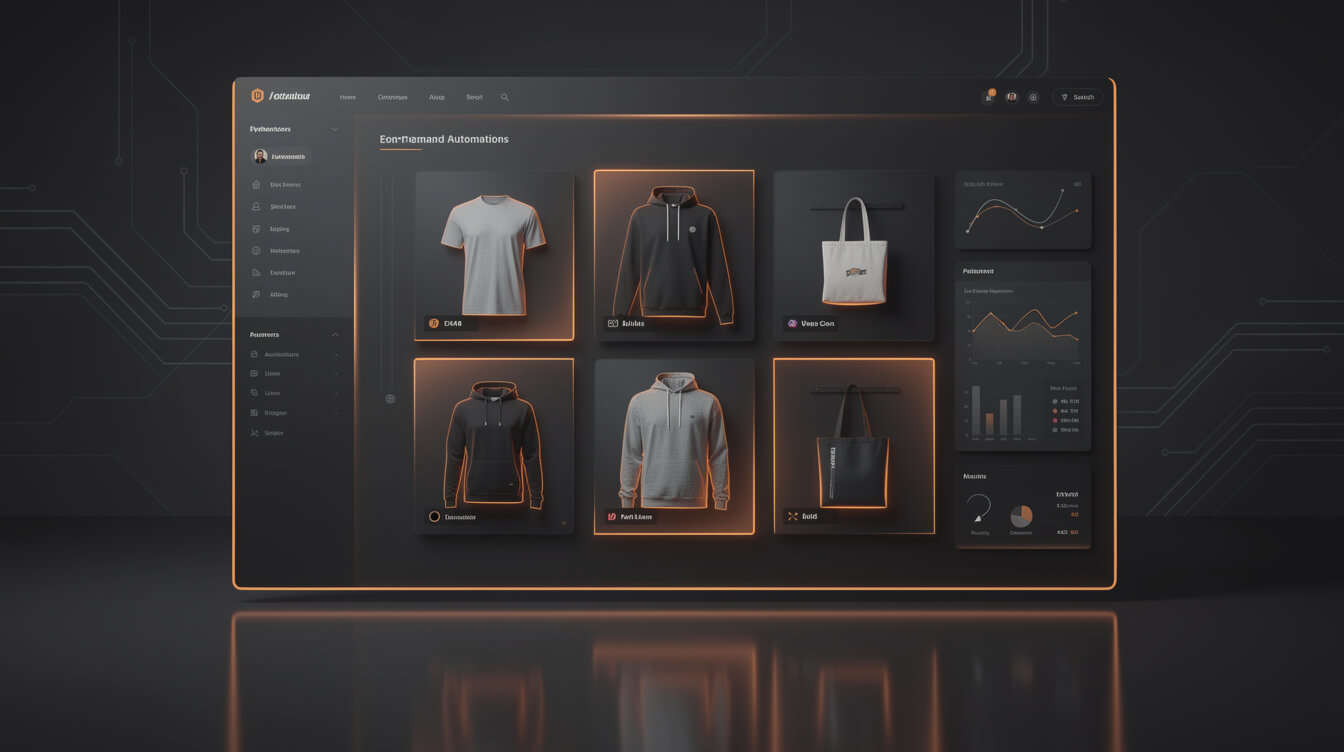
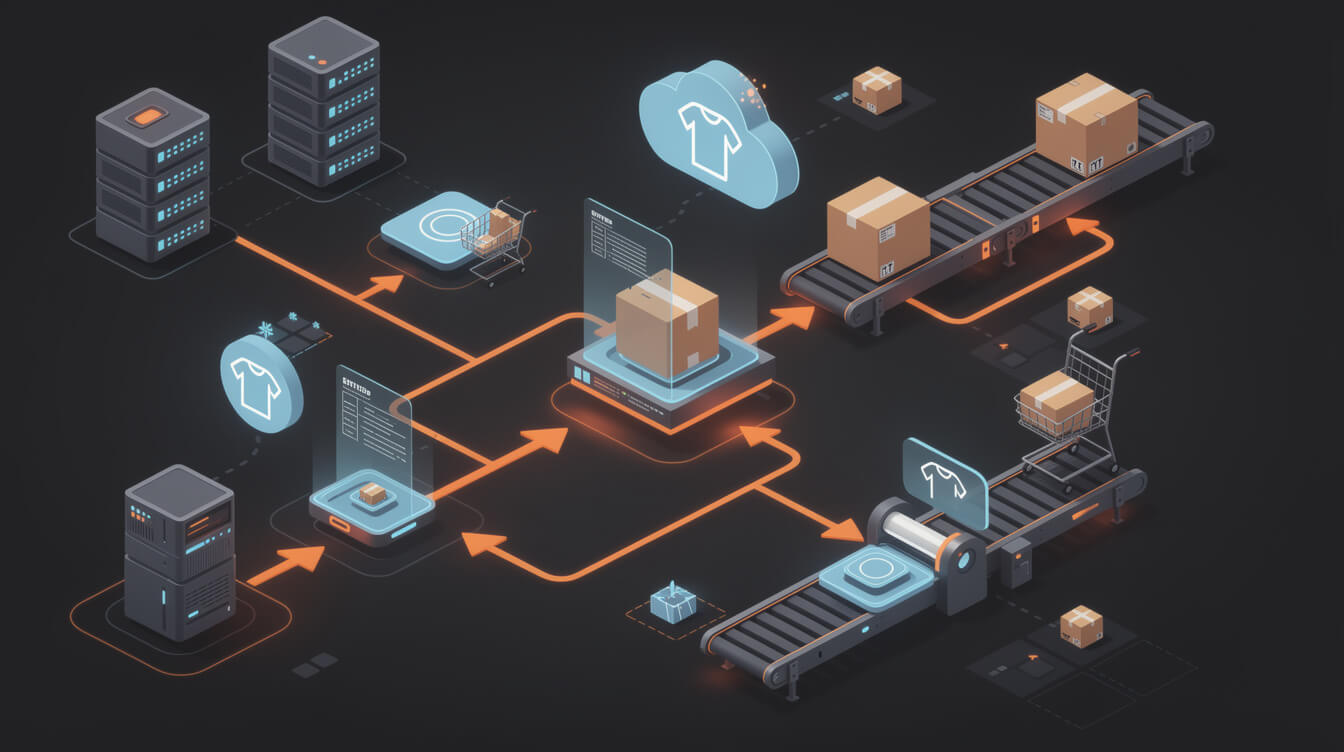
Automation in the context of t-shirt dropshipping is not just scheduling social posts. It is the ability to take a niche concept from research through design generation through product listing in minutes rather than hours.
A full automation pipeline for t-shirt dropshipping covers five stages:
- Niche research: Identifying which designs and product types have demand and low organic competition. Manual research takes hours. Automated tools query keyword volume, trend data, and competitor SERP structure in minutes.
- Design generation: Using AI image generation to create unique, print-ready artwork from a concept. This replaces Canva for the generation step, accelerating the draft phase significantly.
- Sizing and cropping: Printful and Printify require specific dimensions for DTG prints. Manually resizing for each product type is slow. Automated pipelines apply the right dimensions per product template.
- Mockup generation: Each product needs at least one mockup for the listing. Automated mockup generation removes a manual Photoshop or third-party tool step.
- Listing sync: Auto-pushing the product title, description, variants, pricing, and mockup to both the Printful or Printify catalog and the WooCommerce store in one operation.
MEGA automates the complete pipeline from niche research through live product listing on mega.management. The throughput difference is roughly 30x compared to a manual Canva-to-store workflow. That is the measured output difference between generating one product manually at 45-90 minutes and running the MEGA pipeline at under seven minutes per product, end-to-end.
At 30x throughput, the listing ceiling that limited a manual operator to 10 products per week becomes 200-300 per week. The catalog size that took months to build takes days. A larger catalog means more SKUs capturing long-tail search traffic, which compounds over time without additional ad spend.
The economics look different at that scale. The same 39% gross margin per shirt, applied to 1,000 or more active SKUs generating organic search traffic, produces a meaningfully different monthly revenue number than 50 SKUs relying on paid traffic to stay visible.
Which model fits which revenue stage

T-shirt dropshipping is not a single model. The right structure depends on where you are in revenue terms and what constraint you are solving for.
Under $1,000 per month: Use Printify’s free plan and Shopify Basic or a free WooCommerce setup. Your constraint is not platform fees, it is finding product-market fit. Focus on designs, not infrastructure. Manual listing is slow, but so is everything at this stage. Do not pay for automation tools you have not validated you need.
$1,000-$10,000 per month: Platform fees start to matter. If you are on Shopify, run the math on whether WooCommerce would save you $100 or more per month. At $5,000 per month revenue, the answer is usually yes. This is also when listing volume starts to matter: more products means more organic traffic entry points. Consider Printify Premium at $24.99 per month to reduce base costs, and start thinking about automation.
$10,000 or more per month: Platform fees are a material budget line. WooCommerce is the better choice for most stores at this revenue level unless you are Shopify-locked by existing infrastructure. Automation is no longer optional at scale: stores generating $20,000-$50,000 per month in POD revenue are not doing it with 50 hand-listed SKUs. They have catalog depth, and catalog depth requires either a large team or an automated pipeline.
The suppliers you use scale with you. Printify and Printful both support high order volumes. The technical bottleneck at scale is not fulfillment, it is how many SKUs you can create and maintain with high enough quality to convert. Automation solves the creation side. The platform fee math solves the margin side. Both matter.
Our comparison of Printify t-shirt margin math and our look at which POD platform model fits which revenue stage go deeper on the trade-offs by store size. Every structural decision in t-shirt dropshipping either expands or constrains your margin, your catalog, and your ceiling.
The decision that compounds
T-shirt dropshipping margins are not fixed. They are a function of three variables: supplier cost, which you manage by choosing providers and plan tiers; platform fee, which you manage by choosing your store infrastructure; and listing volume, which you manage by choosing manual or automated production.
Most guides address the first variable. Some address the second. Almost none address the third. And the third is the one that determines whether your t-shirt dropshipping operation stays a side project or becomes a real business.
The suppliers charging you $13-$18 per shirt are not your cost problem. The platform taking $0.39-$1.56 per sale is a real cost but a solvable one. The ceiling on how many products you can list and maintain is the constraint that explains why most t-shirt dropshipping stores plateau.
Name the platform fee. Solve the listing bottleneck. Those are the two decisions that compound.

Implement AI. 30x your throughput. Get a 30-min call with the founder.
Drop your details and book a free 30-minute discovery call. Personalized advice on your POD stack, your margin, and where AI fits. No pitch, no fluff.