Custom brand clothing without the minimum order: how POD replaces the promotional products supplier
Custom brand clothing is one of the most searched terms in the branded apparel space, and nearly every result in Google serves the wrong answer. Type that phrase into search and you get Thread Logic, Queensboro, CustomInk, and 4imprint, all of them selling minimum-order bulk embroidery to corporate HR teams. None of them covers what most searchers actually want: a way to build a branded clothing line without committing five figures to inventory you may never sell. This post covers the print-on-demand path to custom brand clothing, the real margin math, and why your platform choice is the hidden variable that determines whether the economics work.
What brands actually want when they search for custom brand clothing
The search intent behind “custom brand clothing” splits into two camps that promotional products suppliers have never separated.
The first camp wants a one-time corporate order. They need 48 branded polos for a trade show, 72 hoodies for an employee gift, or 150 t-shirts for a conference. These buyers have a budget, a deadline, and a finite quantity. Minimum-order bulk pricing serves them reasonably well.
The second camp, which is larger and growing faster, wants something different. They want an ongoing branded clothing line. A fitness brand that sells branded training gear. A YouTube creator who wants merch their audience can buy year-round. A consultancy that wants branded apparel clients can purchase without having to ask. A local business that wants to turn its best customers into walking brand ambassadors.
This second group has different requirements. They need products available continuously, not on a once-a-year purchase cycle. They cannot absorb a $3,000 inventory commitment on an untested product. They have no way to predict size distribution across XS through 3XL. And critically, they want their customers to be able to buy online, on demand, not through a wholesale form.
The promotional products industry is not designed for this. Its entire economic model assumes you absorb upfront inventory cost in exchange for a lower per-unit price. For someone building a permanent branded clothing store, that trade-off is almost always wrong.
Print on demand solves this category mismatch. Before getting into the economics, it helps to understand exactly what promotional product suppliers are asking you to do.
The minimum-order problem: why most clothing suppliers start at 24-144 units

Traditional branded apparel suppliers run on a model that requires minimum orders because their production economics depend on setup costs. Screen printing requires a separate screen per color per placement. Embroidery requires digitizing a design into a machine file, which costs $20-100 per design. Both processes have a fixed setup cost that makes small runs uneconomical.
Here is what that looks like in practice. Thread Logic, a well-regarded promotional products supplier, typically requires 12-24 units for custom embroidered polos. For custom hoodies with a printed design, the common range is 24-48 units. 4imprint often starts at 12 units but the per-unit cost at minimums erases most of the pricing advantage versus retail.
Run the numbers on a modest custom hoodie order. At 48 units from a promotional products supplier, you might pay $22-28 per hoodie at that quantity, plus a setup fee of $100-200 for digitizing. You are looking at $1,250-$1,500 minimum outlay before knowing whether a single hoodie will sell.
That outlay creates three compounding problems.
First, cash flow. You spend $1,500 before generating a dollar in revenue. For a small business or creator, that ties up working capital that could go toward marketing or product development.
Second, size risk. You must guess the right split across XS, S, M, L, XL, 2XL, and 3XL before you have any customer data. Get it wrong and you either turn away buyers in undersupplied sizes or sit on dead inventory in oversupplied ones. Most first-time buyers underestimate demand for 2XL and 3XL and overestimate XS and S.
Third, the reorder cycle. When you sell through your initial run, you need to place another minimum order. If your brand is growing and demand varies, you are perpetually either undersupplied or over-buying.
For a corporate HR team buying 72 branded polos for a one-time event, these constraints are manageable. For someone trying to run a continuous branded clothing store, they are a structural mismatch. As we covered in our comparison of POD and bulk promotional merchandise, the economics diverge sharply once you account for inventory risk.
Print on demand as the no-inventory path to brand clothing

Print on demand flips the minimum-order model entirely. Instead of buying inventory upfront and fulfilling from stock, you upload your design, connect your store, and the fulfillment partner prints and ships each item individually when a customer orders.
There is no minimum order. You can list one branded hoodie in 12 sizes without buying a single unit. You can offer seven different colorways without committing to any inventory. You can launch a complete branded clothing line with 15 SKUs for the cost of a domain name and a monthly hosting plan.
Printful is the most established POD partner for this use case. Their catalog includes unisex hoodies from approximately $30-35 base cost, classic t-shirts from $14-17, long-sleeves from $19-22, and a growing range of cut-and-sew options for brands that want fully custom construction rather than printed-on blanks.
For brand clothing specifically, Printful’s embroidery service is worth noting. They offer direct-to-garment printing and embroidery with no setup fee and no minimum. You can offer an embroidered branded polo with your logo without digitizing fees or minimums. The cost per unit is higher than bulk embroidery at scale, but the zero-upfront model changes the risk profile entirely.
We covered the specifics in detail in our Printful custom hoodies breakdown, including which product models have the best print surfaces, margin structures, and size coverage for a branded clothing store.
The important reframe here: print on demand is not a wholesale channel or a dropshipping sideline. It is an owned-store model. You set the retail price. You own the customer relationship. Your branded clothing store is a real business asset, not a reseller account on a marketplace.
Margin math: what branded clothing actually costs through Printful vs. a promotional products supplier

Smash print-on-demand. Join the engine room.
One short email a week. Real numbers, real teardowns, the unfiltered economics behind every move.

Numbers first. Here is a direct comparison on a branded hoodie, which is the most common item in any brand clothing store.
Printful route (print on demand):
- Base cost: $32 (Printful unisex Heavy Blend Hoodie)
- Shipping: $6-8 domestic US
- Total landed cost per sale: $38-40
- Retail price: $65-75
- Margin per sale: $25-37 (38-49%)
- Upfront cost: $0
Promotional products supplier route (bulk, 48 units):
- Base cost: $24 per unit at 48-unit minimum
- Digitizing setup fee: $150
- Total inventory investment: $1,302
- Inbound shipping to you: $80-120
- Fulfillment per order (you pack and ship): $4-8 labor + $6-9 outbound shipping
- Total landed cost per sale: $28-35 if all 48 units sell
- Retail price: $65-75
- Margin per sale at full sell-through: $30-47
- Upfront cost: $1,382-$1,422
The bulk route offers modestly higher margins per unit, but only at full sell-through. If you sit on 12 of 48 units, which is a common outcome for first-time buyers who misjudge size distribution, your effective margin drops significantly. Unsold inventory at $24 per unit represents $288 in dead capital, which wipes out the per-unit margin advantage across several dozen sales.
The Printful route requires zero upfront spend. Your first sale is profitable at $25-37 margin. Your hundredth sale has the same margin as your first. There is no break-even unit count because there is no inventory investment to recover.
For a branded clothing store that expects to grow steadily rather than spike and clear out inventory on a fixed cycle, print on demand wins on economics when you account for working capital, size risk, and fulfillment labor.
If your goal is a branded clothing line where the unit economics work from day one, MEGA automates the entire product creation pipeline, from design generation to your WooCommerce listing, so you go from brand asset to live product in under seven minutes.
WooCommerce vs. Shopify for a brand clothing store (the 1% fee nobody talks about)

Platform choice has a measurable impact on the economics of a branded clothing store, and most founders pick Shopify without running the numbers.
Shopify charges a 1% transaction fee on every sale when you use a third-party payment processor, or when you use Shopify Payments in markets with exchange rate overhead. This fee exists on top of standard credit card processing (2.9% + $0.30 per transaction), on top of the monthly Shopify plan fee ($39/month for Basic in 2026), and on top of app costs for email, reviews, and anything else you add.
On a $70 branded hoodie, the Shopify 1% fee is $0.70 per sale. That sounds small until you look at it across a year of sales.
- 100 hoodie sales per month at $70 average: $70/month, $840/year
- 200 sales per month: $140/month, $1,680/year
- 500 sales per month at $70 average: $350/month, $4,200/year
These amounts are pure margin bleed on a business that already operates on POD margins of 40-50%. You are giving Shopify a guaranteed cut of every transaction regardless of whether your business is profitable.
WooCommerce on self-hosted WordPress has no transaction fee. Your payment processor takes its cut, as it does on Shopify, but there is no additional platform percentage. The hosting cost for WooCommerce runs $20-30/month. Printful integrates with WooCommerce through their official plugin, which works identically to the Shopify integration in terms of catalog access, mockup generation, and automatic order routing.
Over 12 months at $10,000/month in branded clothing sales, here is the platform cost comparison:
- Shopify Basic: $468/year (plan) + $1,200/year (1% transaction fee) = $1,668/year minimum
- WooCommerce: $300-360/year (hosting) + $0 (no transaction fee) = $300-360/year
That is a $1,300/year difference on a $120k annual revenue store. At $50,000/month in revenue, the gap widens to over $7,000/year. All of it stays in your margin instead of going to Shopify.
We ran the detailed numbers in our WooCommerce pricing post and in our Shopify transaction fee breakdown. The math is consistent: WooCommerce is the lower-cost platform at every revenue level for a store that expects to grow.
Build your branded clothing line 30x faster
MEGA takes your brand assets and generates complete WooCommerce product listings in under seven minutes. Research, design, mockup, title, SEO, and live listing, all in one automated run. No Canva. No manual uploads.
How to set up a branded clothing line on WooCommerce with Printful in one afternoon
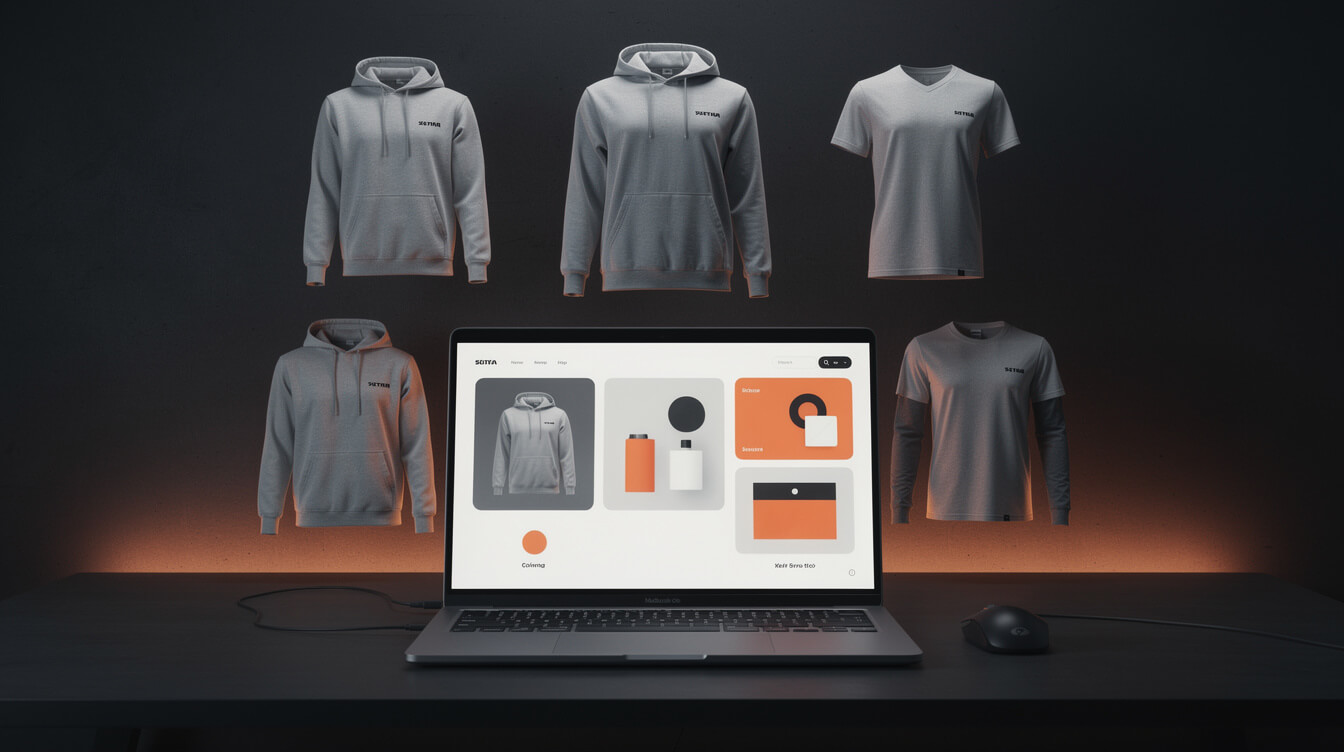
The setup process is straightforward if you have your brand assets ready. Here is what a single afternoon looks like.
What you need before you start:
- A domain name ($15/year)
- WordPress hosting ($20-30/month)
- WooCommerce installed (free plugin)
- A Printful account (free)
- Your logo or brand mark in PNG format at 300 DPI minimum
The setup sequence:
Install WooCommerce on your WordPress site and complete the basic store setup. Set your currency, tax handling, and shipping options. This takes about 20 minutes for a standard store configuration.
Connect Printful by installing their official WooCommerce plugin and authorizing your Printful account. This creates a direct sync between your store and Printful’s fulfillment network. Orders placed in your WooCommerce store automatically route to Printful without manual intervention.
Choose your initial product lineup. For a branded clothing line, a practical starting set is one hoodie, one classic t-shirt, one long-sleeve tee, and one cap. Four products, each available in multiple colors, gives you a complete catalog without overwhelming visitors.
Upload your design in Printful’s product designer. If you have a multi-color logo, note that screen printing charges per color but direct-to-garment printing is flat-rate regardless of design complexity. For embroidery, Printful charges by stitch count with no setup fee.
Set your retail prices using the margin math from the previous section as your baseline. A branded hoodie at $65-75 with a $32 base cost gives you 40-49% margin before platform costs.
Sync the products to your WooCommerce store. Printful’s plugin creates the product listings automatically, including size variants and color options. You write your product descriptions and the listings go live.
That is the core setup. One afternoon if your brand assets are ready. If you need to create designs from scratch or generate mockups across multiple colorways, that step adds time. We covered how to build and scale this kind of branded merchandise operation in our custom merchandise for business guide, including catalog depth, pricing strategy, and the transition to hybrid fulfillment as you scale.
Where MEGA fits: automating brand clothing product creation end-to-end

The manual setup process described above works well for a four-product launch. It becomes a bottleneck once you want to scale a branded clothing line.
Consider what it takes to build a 20-SKU branded clothing catalog across three product types and multiple colorways. You need research to identify which products have search volume in your niche. You need designs created or adapted for each product. You need mockups generated for each colorway. You need titles, descriptions, and SEO metadata written for each listing. Each step requires a separate tool and a separate workflow.
Done manually through Canva, Printful’s designer, and a WooCommerce product form, building 20 SKUs takes 2-3 days of focused work. That is not a scalable production rate for a business trying to grow.
MEGA is the research-to-product pipeline that replaces this manual stack. It takes a niche idea, runs competitor research and search volume analysis, generates AI-designed images sized and cropped for each Printful product template, creates mockups, writes titles and SEO descriptions, and pushes complete product listings to WooCommerce in a single automated run. The throughput difference is 30x compared to the manual Canva workflow.
For a branded clothing business, MEGA’s value is most visible at two stages. First, at launch, when you want to populate a complete catalog quickly. Instead of spending a week on product creation, you can have 20-30 live listings in a day. Second, at ongoing expansion, when you want to add seasonal designs, limited colorways, or new product types without rebuilding the entire workflow each time.
The platform connects to WooCommerce natively. Your listings include all Printful variant information, size ranges, and fulfillment routing by default. The only step left is reviewing the output and deciding what to publish.
Frequently asked questions about custom brand clothing and print on demand

Can I add my brand logo to Printful products without a minimum order?
Yes. Printful’s direct-to-garment printing and embroidery services have no minimum order requirement. You can order a single unit to validate quality before scaling your catalog. The per-unit cost is higher than bulk embroidery at 48+ units, but the zero-minimum flexibility changes the economics for a branded clothing line that is still testing the market.
What is the difference between custom brand clothing and print-on-demand merch?
In practice, they are the same production model. “Brand clothing” implies a consistent identity across products, a branded store experience, and ongoing availability. Print-on-demand is the fulfillment mechanism. You build a branded clothing line using print-on-demand suppliers like Printful as the production layer. The distinction matters for how you present your store to customers, but the backend is identical.
How much does it cost to start a branded clothing line with WooCommerce and Printful?
The upfront costs are low. A domain name runs $15/year. Managed WordPress hosting with WooCommerce runs $20-30/month. Both Printful and WooCommerce core are free to use. Your total startup cost for a functional branded clothing store is approximately $25-30 in the first month, plus any design costs if you need to create brand assets from scratch. There is no inventory investment required.
Is WooCommerce harder to set up than Shopify?
WooCommerce requires WordPress hosting, which adds one setup step compared to Shopify’s fully hosted model. For a technical first-timer, that extra step takes about 30 minutes. In return, you eliminate the 1% Shopify transaction fee and get ownership of your store infrastructure. Most managed hosting providers (Bluehost, WP Engine, SiteGround) have one-click WordPress installations that make the process straightforward.
What happens if a customer orders a size that is temporarily out of stock at Printful?
Printful manages their own inventory of blank garments and handles stock issues directly. When a specific blank is temporarily unavailable, Printful holds the order until stock is replenished or notifies you to offer an alternative. Unlike a bulk inventory model where you are responsible for managing stock levels and backorders, the fulfillment risk sits with Printful rather than with you. This is one of the structural advantages of the POD model for branded clothing.
The bottom line on custom brand clothing without minimum orders
The promotional products industry built its model around minimum orders because its production economics require them. Screen printing setup costs, embroidery digitizing fees, and press run minimums make small quantities uneconomical for traditional suppliers.
Print on demand eliminates this constraint at the cost of a modestly higher per-unit price. For a business building a continuous branded clothing store, that trade-off is correct. You trade a small margin difference per unit for zero upfront inventory risk, no size-split guessing, and a store that can sell any size, any color, any quantity at any time.
The platform question matters more than most people expect. WooCommerce and Printful together give you the same fulfillment capability as Shopify and Printful, at $300-360/year in hosting instead of $1,668+/year in Shopify plan and transaction fees at $10k/month in revenue. That gap grows with your store, and it compounds year over year.
If you are building a branded clothing line, start with four products, run the margin math on your specific Printful catalog, and verify that your retail prices work before you invest in a larger catalog. The minimum-order barrier is gone. The only thing left is building the store.
Implement AI. 30x your throughput. Get a 30-min call with the founder.
Drop your details and book a free 30-minute discovery call. Personalized advice on your POD stack, your margin, and where AI fits. No pitch, no fluff.