T-shirt printing machine for small business: the break-even math vs print on demand
The question arrives in almost every small business owner’s search history at some point: should I buy a t-shirt printing machine for my small business or keep outsourcing to print on demand? The appeal is obvious. If you are paying $18 per shirt to a POD supplier and selling at $35, you wonder what your margins look like when you own the printer. The answer is more nuanced than the equipment sellers want you to believe, and this article runs the real numbers.
We cover the three main machine types, the full cost stack most buyers miss, a break-even model across three volume scenarios, and a decision framework for when owning equipment actually makes sense versus when print on demand wins on economics. If you have ever felt the pull of buying your own printer, this is the honest accounting you need first.
Why small businesses search for their own t-shirt printing machine
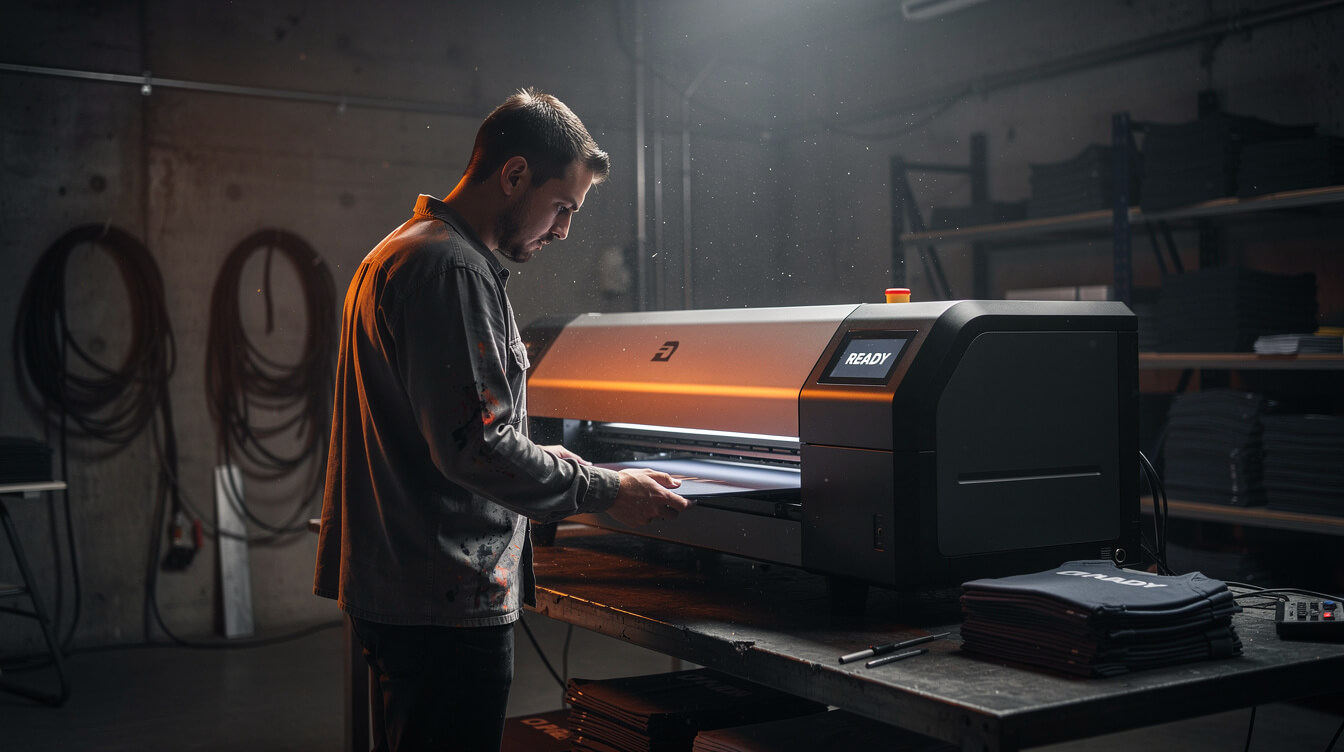
The math looks seductive at first glance. You are paying Printful $14-18 for a standard Bella+Canvas tee, printed and fulfilled. You sell it for $35. That is a $17-21 gross margin, roughly 50-60%. Compared to a software company’s 80% gross margin, that feels thin for physical goods.
Then you see a DTG printer advertised for $3,000. Back-of-envelope: if each shirt costs $8 in materials and you own the machine, your margin jumps to $27. The printer pays for itself in 111 shirts. That sounds achievable within a few months.
Here is the problem with that math: it is missing almost all the real costs. The equipment purchase price is the headline number. The true cost stack is a different story, and we will build it out section by section below.
The other driver is control. Machine owners can run small custom batches, offer next-day turnaround, and handle rush orders that POD suppliers cannot. For certain businesses, that speed and flexibility is the product itself. That is a legitimate reason to own equipment. We flag where it applies in the decision framework at the end.
Before running the numbers, you need to understand what each machine type actually does, because DTG, DTF, and heat press are not interchangeable tools and their cost profiles are completely different.
DTG vs DTF vs heat press: what each machine actually does and costs
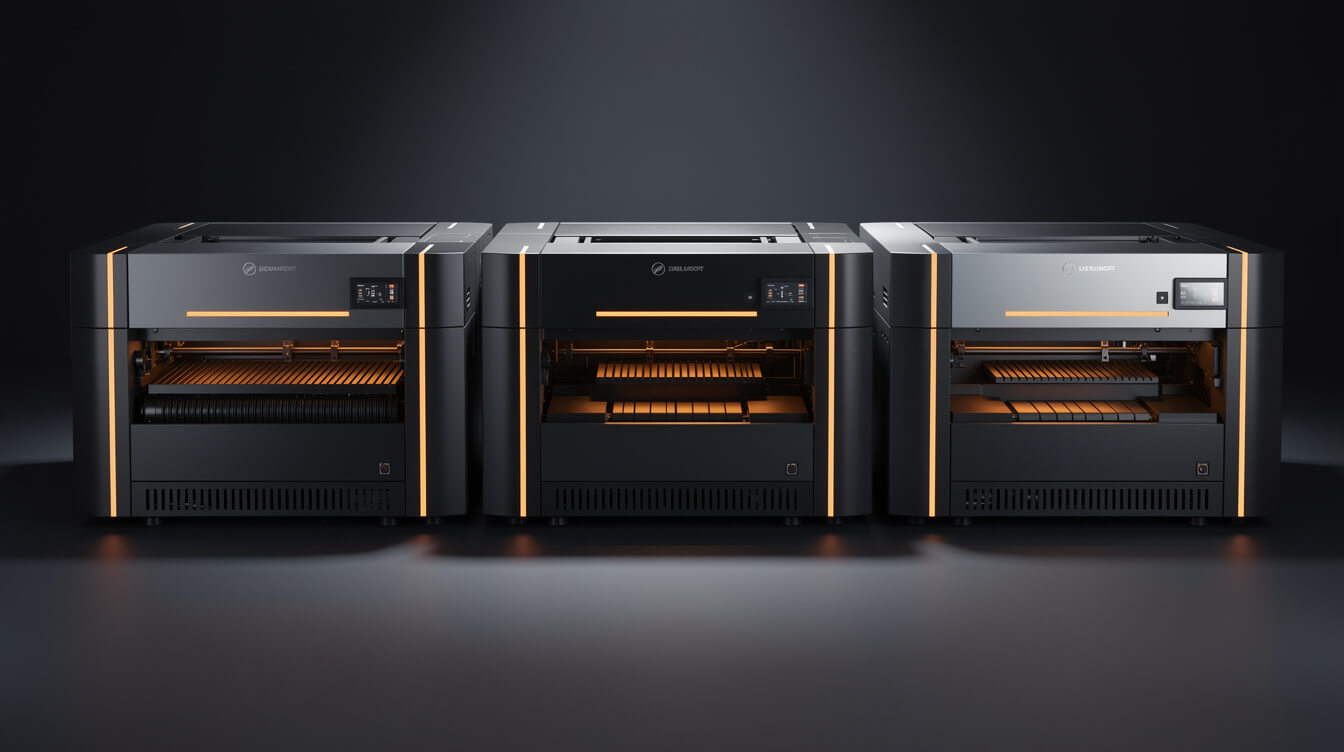
We covered the print technology differences in depth in our DTG vs DTF breakdown for POD sellers and our DTG printing vs screen printing comparison. Here is the summary that matters for the buy-versus-outsource decision.
DTG (direct-to-garment)
DTG printers jet water-based inks directly onto fabric. They produce photo-quality prints with unlimited colors and no minimum orders. The constraint is fabric type: DTG works best on 100% ring-spun cotton with a high thread count. Blends require pretreatment, and results vary by blend percentage. Entry-level DTG machines: $3,000-$8,000 (Epson SureColor F170, Brother GTX series). Mid-range: $10,000-$20,000. Production-grade: $50,000+.
DTF (direct-to-film)
DTF printers print the design onto a PET film, apply a hot-melt adhesive powder, then heat-transfer the film onto the garment. DTF works on nearly any fabric type, including polyester, blends, and dark garments without pretreatment. It produces a slightly raised texture that some buyers notice on fine garments. Entry-level DTF: $800-$3,000 (ProColored, Inksonic). Mid-range: $3,000-$10,000. Production-grade: $20,000+.
Heat press
A heat press is a finishing tool, not a print tool. You still need to produce the transfer somewhere (vinyl cutter for simple designs, DTF printer, or third-party transfer sheets). Heat presses cost $200-$2,000. The real cost is in the upstream transfer production. Some small businesses buy pre-made transfer sheets in bulk, but that limits design flexibility significantly.
Machine category matters because the cost stack is completely different for each one. We will model DTG and DTF since those are the primary paths for sellers moving beyond basic POD fulfillment.
The real cost breakdown: machine + ink + substrate + maintenance + labor

This is where most equipment-buying decisions go wrong. Equipment sellers quote the machine price. They rarely quote the total cost of ownership. Here is what a full setup actually costs in year one and on an ongoing basis.
DTG cost stack (mid-range machine)
One-time costs:
- Machine: $8,000 (Epson SureColor F570 equivalent)
- Pretreatment machine: $500-$2,000 (required for dark garments, skippable for light-only runs)
- Heat press for curing pretreatment: $500
- Initial ink supply: $400-$800 (white ink is expensive and must stay circulating through the heads)
- Total initial outlay: $9,400-$11,300
Per-shirt variable costs:
- Blank shirt (Bella+Canvas 3001): $4-$6 in small quantities
- Ink per shirt: $0.50-$2.00 (varies by design complexity, color count, and whether white underbase is needed for dark garments)
- Pretreatment solution for dark garments: $0.25-$0.75 per shirt
- Total variable cost per shirt: $4.75-$8.75
Fixed monthly overhead:
- Head maintenance prints (required daily even when idle): $2-$10 per day in consumed ink
- White ink circulation cost (must run even on non-print days): $20-$60/month
- Machine depreciation over a 5-year lifespan on an $8,000 machine: $133/month
- Labor at 15 minutes per shirt (setup, print, cure, QC) at $20/hour: $5.00 per shirt
Adding it up honestly: a small-volume DTG operation costs $9.75-$13.75 per shirt in variable costs plus $153-$193/month in fixed overhead. At 50 shirts/month that overhead adds $3.06-$3.86 per shirt, bringing total cost to $12.81-$17.61 per shirt. That is in the same range as Printful, before you have touched the machine purchase amortization.
DTF cost stack (mid-range machine)
- Machine: $2,500-$5,000
- Heat press: $500
- PET film and ink per shirt equivalent: $0.30-$0.80 (DTF ink is significantly cheaper than DTG white ink)
- Blank shirt: $4-$6
- Labor: $2.50-$4.00 per shirt (faster setup than DTG, no pretreatment step for most fabrics)
- Total variable per shirt: $6.80-$10.80
DTF has a better variable cost profile than DTG, particularly at lower volumes. The tradeoff is the tactile feel of the transfer layer and performance variation on certain fabric types. For many small businesses running blended garments, DTF is the more practical choice.
POD economics for comparison: what Printful and Printify charge per shirt
Smash print-on-demand. Join the engine room.
One short email a week. Real numbers, real teardowns, the unfiltered economics behind every move.
To make the comparison meaningful, let us put POD pricing on the same page. We looked at Printful products and their real pricing in detail earlier this year. Here is the summary that matters for this calculation.
Printful pricing (zero upfront cost, production + shipping):
- Bella+Canvas 3001 unisex tee: $12.95 production cost (US facility, standard delivery)
- Gildan 64000: $9.85 production cost
- Shipping: $4.49 first item US, passed to buyer in most setups
- All-in fulfillment excluding shipping: $10-$15 for standard tees
Printify pricing (varies by print provider):
- Bella+Canvas 3001: $7.49-$9.99 depending on provider and US region
- Gildan 64000: $5.49-$7.99
- Printify Premium plan at $24.99/month: 20% discount off all products, bringing the Bella+Canvas to $5.99-$7.99
One variable most POD sellers undercount: on Shopify, you pay an additional 1% platform fee on every transaction on top of Shopify’s payment processing fees. On $10,000/month revenue that is $100 per month going to Shopify, not to your cost of goods or margin. On WooCommerce, there is no platform transaction fee. You pay for hosting and plugins, which typically runs $30-$60/month flat regardless of revenue. We covered this in our analysis of at-home t-shirt printing options and it is a structural advantage that compounds over time.
MEGA automates the product generation side of POD entirely, from niche research to a published WooCommerce listing in under seven minutes. If you are evaluating whether to buy a printer, it is worth modeling what the same capital would look like deployed toward product pipeline speed instead. Try MEGA to see the comparison for your catalog.
Break-even calculator: at what monthly volume does owning the machine pay off
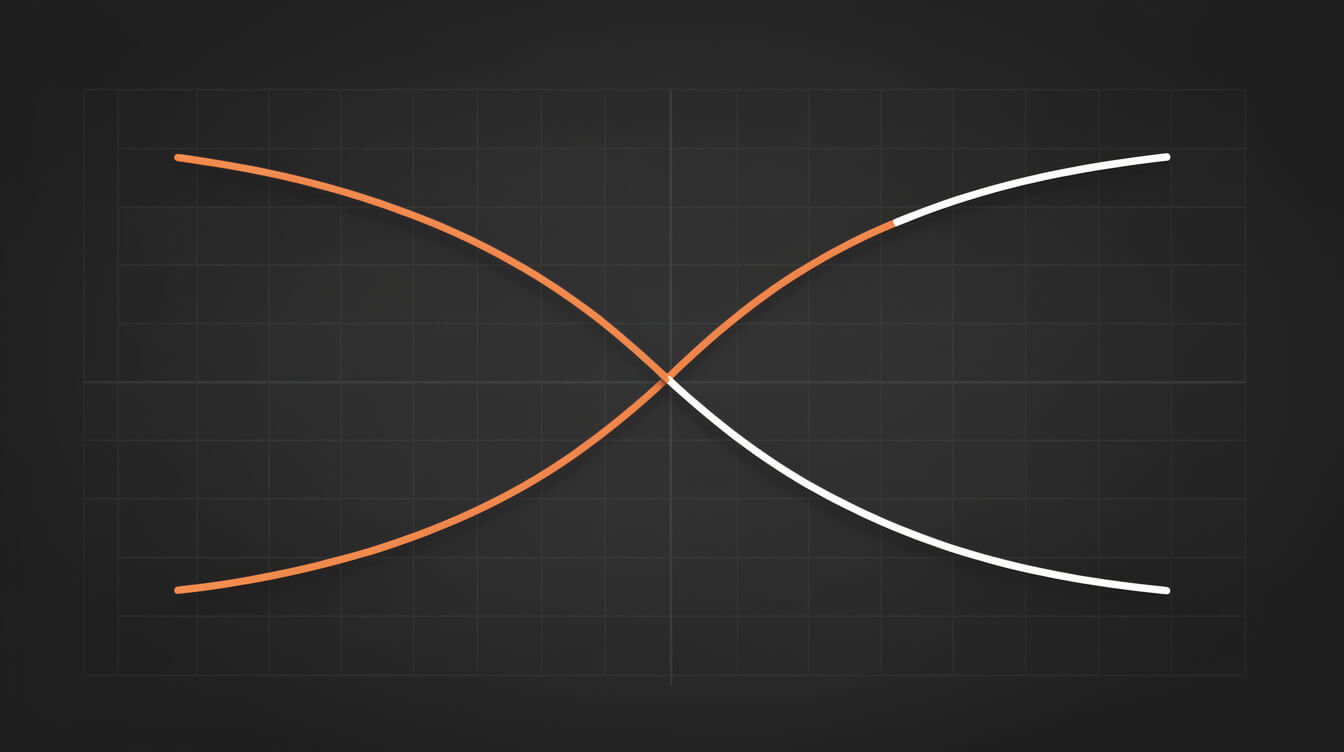
Now let us build the actual break-even model. Three volume scenarios, comparing owned DTG versus Printify Premium on WooCommerce with no Shopify transaction fee drag.
Model assumptions
- Selling price: $35 per shirt
- Blank shirt cost (owned): $5 per shirt
- DTG ink plus pretreatment (owned): $1.50 per shirt average
- DTG labor: $5.00 per shirt (15 minutes at $20/hour)
- DTG machine: $9,500 one-time, amortized over 60 months = $158/month
- DTG maintenance overhead: $100/month (ink circulation, daily head cleans)
- Printify Premium: $25/month
- Printify per-shirt cost (Gildan 64000 with Premium): $6.49
At 50 shirts per month
Owned DTG total cost: $11.50 variable x 50 shirts = $575 + $258 fixed = $833. Revenue: $1,750. Gross margin: $917 (52%).
Printify on WooCommerce: $6.49 x 50 = $324.50 + $25 fixed = $349.50. Revenue: $1,750. Gross margin: $1,400.50 (80%).
POD wins by $483.50/month at 50 shirts.
At 200 shirts per month
Owned DTG: $11.50 x 200 = $2,300 + $258 = $2,558. Revenue: $7,000. Gross margin: $4,442 (63%).
Printify on WooCommerce: $6.49 x 200 = $1,298 + $25 = $1,323. Revenue: $7,000. Gross margin: $5,677 (81%).
POD wins by $1,235/month at 200 shirts.
At 500 shirts per month
Owned DTG: $11.50 x 500 = $5,750 + $258 = $6,008. Revenue: $17,500. Gross margin: $11,492 (66%).
Printify on WooCommerce: $6.49 x 500 = $3,245 + $25 = $3,270. Revenue: $17,500. Gross margin: $14,230 (81%).
POD wins by $2,738/month at 500 shirts.
The consistent result here is not accidental. The labor cost is the weight that keeps owned DTG from closing the gap. If you treat your own printing labor as free, the model shifts. At 500 shirts/month with unpaid owner labor, owned DTG becomes cost-competitive around a $9/shirt variable rate. But that only holds as long as you are personally doing the printing, which is not a scalable plan.
The volume at which owned equipment genuinely wins: 1,000+ shirts per month with a paid production operator, or 2,000+ with a production-grade machine that changes the ink-cost math entirely. Below that, POD fulfillment on WooCommerce is the stronger economic position in almost every honest model.
What machine owners miss: setup time, pretreatment, color profiles, print head clogs
Equipment sellers demo the machine running a perfect print in 45 seconds. They do not demo the 20 minutes before and after that print. Here is what first-time equipment buyers consistently report as unexpected.
Pretreatment for dark garments
Printing on dark or colored garments requires applying a pretreatment solution to the fabric before printing. The solution must be applied evenly, then dried and cured using a heat press before the print run. That adds 5-10 minutes per shirt for dark garments. Pretreatment application is messy and requires protective gloves and a mask. Inconsistent pretreatment is the leading cause of DTG print defects and customer returns.
ICC color profiles and calibration
Accurate color reproduction on a DTG printer requires loading the correct ICC profile for each ink set and fabric type combination. A missing or incorrect profile means your royal blue comes out teal and your brick red looks orange. Setting up profiles correctly takes hours the first time. Changing garment suppliers means recalibrating. This is ongoing work that print-on-demand suppliers handle invisibly on your behalf.
Print head maintenance: the hidden daily cost
DTG machines use scaled-up inkjet print head technology. White ink, which is required for printing on dark garments, contains titanium dioxide pigment that settles and clogs print heads when left idle. Most DTG machines require a daily “head clean” routine of 5-15 minutes, consuming $2-$5 in ink, even on days you do not print a single shirt. Skip this routine for a week and you are looking at clogged nozzles. Skip it for two weeks and you risk permanent print head damage at $500-$2,000 to replace. Print head health is the single largest ongoing maintenance concern in DTG printing.
Garment preparation and quality control
Each garment must be pre-pressed to remove moisture and wrinkles before loading. Loading precision matters. A garment that shifts mid-print wastes the shirt and the ink. Quality control involves a test print on each new garment lot before running production. These small time costs add up across a high-SKU catalog.
The opportunity cost calculation
POD sellers running WooCommerce stores with Printful or Printify spend exactly zero minutes on pretreatment, color profile management, head cleaning, or garment prep QC. Every hour spent running a DTG printer is an hour not spent on product research, design creation, or catalog expansion. For sellers whose constraint is time rather than per-unit margin, this tradeoff matters significantly.
When to buy vs when to outsource: the decision framework
After running the numbers, here is the honest framework for this decision. There is no universal right answer, but there are clear signals pointing one direction or the other.
Buy the machine if:
- You have a dedicated print operator. Owner-operated printing is the most common economics error. If you are simultaneously the designer, marketer, customer service team, and print operator, the printing role removes you from higher-leverage work. A paid operator changes the labor math.
- You consistently print 1,000 or more shirts per month. At that volume, owned equipment begins to provide meaningful margin improvement, particularly on production-grade DTG machines where ink costs drop at scale.
- Rush orders and same-day turnaround are your core differentiator. POD suppliers typically process in 2-5 business days. If next-day or same-day delivery is your product, owning a machine may be necessary to fulfill that promise.
- You have validated demand at volume first. Do not buy a printer to test a niche. Buy a printer to scale a niche that is already generating consistent order volume through POD fulfillment. Validation comes before equipment investment.
Stay with POD if:
- You are below 500 shirts per month. The break-even model is clear. POD wins at low to medium volume when you account for your own time honestly.
- Your model is catalog-based with many SKUs. Testing designs across dozens of products requires the flexibility of no minimums and no setup cost per design. Owned equipment adds friction to SKU proliferation.
- You are on WooCommerce. The flat hosting cost structure versus Shopify’s transaction fee means your POD margin is already significantly better than sellers on Shopify. At WooCommerce plus Printify Premium, you are at 80%+ gross margin on standard tees. That is competitive with owned-equipment math at most realistic small-business volumes.
- Your constraint is product throughput, not per-unit margin. The MEGA model scales the number of products you generate, not the production volume per SKU. If the bottleneck is catalog creation speed rather than printing cost, equipment solves the wrong problem. Automation of the research-to-product pipeline is the right lever.
The reframe that matters
The question is rarely whether to buy a printer. The real question is: what is my current scaling constraint? If the constraint is per-unit cost at high and proven volume, equipment investment may help. If the constraint is catalog size, design throughput, or product research speed, equipment solves nothing.
For POD sellers who want to generate more products faster on an owned WooCommerce store, MEGA handles the entire research-to-listing pipeline — from niche identification to published product, without touching a printer.
Final thoughts: the t-shirt printing machine for small business decision
The t-shirt printing machine for small business decision is almost always a volume problem disguised as a margin problem. Sellers look at the per-unit cost difference and assume equipment ownership wins. The honest full accounting, including machine amortization, ink overhead, pretreatment, maintenance, and the value of your own time, changes the picture significantly at the volumes most small businesses actually run.
POD fulfillment through Printify on WooCommerce delivers 80% gross margins at any volume with zero capital tied up in equipment and zero time spent on print maintenance. That is a strong baseline to beat. The math genuinely shifts only around 1,000 consistent monthly shirts with a dedicated operator and a machine built for that throughput.
If your current constraint is product creation speed rather than per-unit margin, the more valuable investment is in automation that expands your catalog without adding headcount or equipment overhead. That is the economics MEGA is built to improve.
Implement AI. 30x your throughput. Get a 30-min call with the founder.
Drop your details and book a free 30-minute discovery call. Personalized advice on your POD stack, your margin, and where AI fits. No pitch, no fluff.