How to start a print on demand clothing business: the fee math no platform will show you
Starting a print on demand clothing business in 2026 costs less than $100 to launch. The guides that explain how will tell you to pick a niche, choose a platform, upload your designs, and start selling. Zero of them show what you actually pay as revenue grows. Platform fees are the variable that every competitor guide omits, and they compound as you scale. At $5,000 per month in clothing sales, the platform tax is already significant. At $20,000, it rivals a part-time employee. This post does that math, breaks down unit economics by clothing category, and shows where an automated pipeline changes what is possible for a solo POD seller.
What is a print on demand clothing business (and what most guides skip)
A print on demand clothing business sells custom-printed apparel without holding inventory. When a customer orders a shirt, the order routes automatically to your print partner, who prints it and ships it directly to the customer. You never buy stock upfront. You never pack boxes. The margin is the difference between what the customer pays and what the print partner charges per unit.
This model is the reason POD clothing businesses can launch for under $100. There is no minimum order quantity. There is no warehouse. The capital risk sits almost entirely with the print partner, not with you.
What most guides skip is the second layer: infrastructure costs. Your store runs on a platform that charges you every month, and in many cases on every transaction. Those fees are invisible in the “pick a niche, upload designs” framework because they only become painful at scale. A seller doing $1,000 per month in revenue barely notices them. A seller doing $15,000 per month notices immediately.
The platform decision is not cosmetic. It determines how much of each sale you actually keep as revenue grows. Sections 3 and 4 do the math directly.
The three-part model: product, platform, partner
Every POD clothing business runs across three components:
- Product: the specific clothing items you offer (t-shirts, hoodies, leggings, sweatshirts, joggers)
- Platform: the storefront that handles your cart, checkout, and customer data (Shopify, WooCommerce, Etsy)
- Partner: the print-and-fulfillment company that makes and ships each order (Printful, Printify, Gooten)
Most beginner content focuses entirely on product and partner. Platform gets one sentence: “set up a Shopify store.” That one sentence carries a fee structure that follows you for the life of the business.
The 4 cost layers every POD clothing seller pays but most guides ignore

When you calculate margin on a POD clothing item, most tutorials give you a simple formula: retail price minus base product cost equals margin. That formula is correct but incomplete. There are four distinct cost layers every POD clothing business pays, and only one of them appears in the “how to start” guides.
Layer 1: Base product cost
This is the fee your print partner charges per unit, including printing. A Bella+Canvas 3001 unisex t-shirt printed through Printful runs approximately $10.95 at the base tier. A Gildan 18500 hoodie runs approximately $18. These costs drop slightly at higher volume tiers, but POD margins do not scale the same way screen printing bulk orders do. You are paying for print-on-demand convenience, not wholesale pricing.
Layer 2: Platform fees
This is the fee structure your storefront charges. On Shopify, this includes the monthly plan fee plus a transaction fee on every order when you use a third-party payment processor. On the Shopify Basic plan, that transaction fee is 2% of revenue. On the Shopify plan, it is 1%. The platform fee applies to gross revenue, not to profit, which means it takes a larger bite out of margin than the headline percentage suggests.
WooCommerce charges no platform transaction fee. Your payment processor (Stripe or PayPal) takes its standard rate, which applies equally on both platforms. WooCommerce’s monthly cost is your hosting bill and nothing more.
Layer 3: App and plugin costs
A functioning Shopify POD store typically runs 6 to 10 apps: your print partner integration, an email platform, a review app, an upsell tool, a page builder, and analytics. These average $150 to $300 per month for a production store. WooCommerce plugins are often one-time purchases or carry lower recurring fees. The base WooCommerce plugin is free. The cost delta between platforms at $10,000 per month in revenue is often $200 to $400 per month when apps are included.
Layer 4: Design time cost
This one does not appear on any invoice, but it is real. A manual Canva workflow for a single POD clothing product runs 60 to 90 minutes: concept research, design creation, sizing to print specifications, mockup generation, product setup, and listing copy. Multiply that by 10 products and you have a full work day spent on production, not on marketing or customer acquisition. The design bottleneck is addressed directly in section 6.
Platform math: what Shopify costs a clothing POD store at 5k, 10k, and 20k per month

The following numbers assume a Shopify plan ($79 per month) with a third-party payment processor, which triggers the 1% transaction fee. POD sellers outside the US, or those with existing processor relationships, frequently land here.
| Monthly revenue | Shopify plan fee | 1% transaction fee | Apps (estimate) | Total Shopify cost |
|---|---|---|---|---|
| $5,000 | $79 | $50 | $150 | $279/month |
| $10,000 | $79 | $100 | $200 | $379/month |
| $20,000 | $79 | $200 | $250 | $529/month |
At $10,000 per month, Shopify costs $379 per month in pure infrastructure. That is 3.8% of revenue going to the platform before a single unit is printed or shipped.
The transaction fee compounds because it applies to gross revenue, not profit. A t-shirt that sells for $24 and costs $11 to produce has a $13 gross margin. A 1% transaction fee on the $24 sale is $0.24, which equals 1.8% of the gross margin on that unit. At thin margins, the fee bites harder than the percentage suggests.
On the Shopify Basic plan ($29 per month), the transaction fee rises to 2%. At $10,000 per month in revenue, that is $200 in transaction fees alone. Many early POD clothing sellers start on Basic and do not upgrade the plan until they feel the fee pressure directly, by which point they have paid the higher rate for months.
For a complete breakdown of how Shopify’s fee structure works for POD sellers across different plan tiers, see our analysis of Shopify transaction fees for POD sellers.
WooCommerce vs Shopify for POD clothing: the owned-store economics

Smash print-on-demand. Join the engine room.
One short email a week. Real numbers, real teardowns, the unfiltered economics behind every move.

WooCommerce is an open-source plugin for WordPress. It charges no platform transaction fee. The infrastructure cost is a flat hosting bill, typically $20 to $50 per month for a VPS or managed WordPress environment. Payment processing runs through Stripe or PayPal at their standard rates, the same rates Shopify Payments users pay.
Here is the same revenue comparison on WooCommerce:
| Monthly revenue | Hosting | Platform transaction fee | Plugins (estimate) | Total WooCommerce cost |
|---|---|---|---|---|
| $5,000 | $30 | $0 | $30 | $60/month |
| $10,000 | $30 | $0 | $30 | $60/month |
| $20,000 | $50 | $0 | $50 | $100/month |
The WooCommerce cost is essentially flat regardless of revenue. The platform does not benefit when you scale. At $20,000 per month, the difference between WooCommerce ($100) and Shopify ($529) is $429 per month. Over a year, that is $5,148 in recovered margin. That is a paid media budget. That is a tool investment. That is 12 months of design automation paid for by the platform savings alone.
What the owned-store model gives you beyond the fee savings
WooCommerce stores are self-hosted. Your customer data, your order history, and your store configuration are not held on a third-party platform that can change its terms or its pricing. For a POD clothing business focused on building owned distribution, this ownership compounds in value as the audience grows.
The trade-off is setup complexity. WooCommerce requires more technical setup than Shopify. Shopify is faster to launch and has better documentation for first-time store builders. For sellers who want to move immediately, Shopify is the easier starting point. For sellers who want to build a business where the infrastructure cost does not scale with revenue, WooCommerce is the lower long-term cost path.
For a full breakdown of what WooCommerce actually costs a POD store month to month, see our WooCommerce pricing guide for POD stores.
Print partner selection: unit economics by clothing category (t-shirts, hoodies, leggings)
Choosing a print partner is choosing the floor on your margin. The base product cost varies by item category, print complexity, and fulfillment location. Below are the unit economics for the three core clothing categories on Printful, the most widely integrated print partner for both WooCommerce and Shopify POD stores.
T-shirts: the volume product
The Bella+Canvas 3001 is the flagship unit for most POD clothing sellers. Printful’s base cost sits at approximately $10.95 for a standard front print. At a retail price of $24, the gross margin before platform fees is $13.05, or 54%. Add a 1% Shopify transaction fee on the $24 sale and the effective margin drops to $12.81, or 53.4%.
At $10,000 per month in t-shirt sales (roughly 416 shirts at $24), the 1% platform fee costs $100 per month. At $20,000, it costs $200. The design is the same. The print cost is the same. The platform is the only variable that changes the margin math.
Hoodies: the high-AOV unit
Printful’s Gildan 18500 hoodie has a base cost of approximately $18 to $20 depending on color and print placement. At a retail price of $42, gross margin before fees runs 55 to 57%. Hoodies are higher average order value items, which means the same transaction fee percentage hits a larger dollar amount per sale. A 1% fee on a $42 hoodie is $0.42. Across 200 hoodie sales per month ($8,400 in revenue), that is $84 per month in platform tax on hoodies alone.
For a breakdown of specific hoodie models, print options, and margin math on Printful, see our Printful custom hoodies guide.
Leggings: the premium all-over print category
All-over print (AOP) leggings are a higher-cost, higher-margin category. Printful’s AOP leggings run $22 to $28 in base cost depending on print complexity. Retail pricing typically falls between $45 and $60. Margin at $50 retail and $25 base cost is 50%. The higher ticket price means AOP items are less affected by a fixed transaction fee percentage than t-shirts, but the absolute dollar amount per unit is larger.
The pattern across all three categories is consistent: the platform fee does not disappear as you grow, it scales. What starts as a rounding error at $1,000 per month becomes a material cost center at $10,000 and above.
Printify offers similar products at comparable base costs. In some categories, Printify print partners undercut Printful by $1 to $3 per unit. For an overview of how Printify works and how its catalog compares, see our guide on how Printify works.
The design bottleneck: 6 hours of Canva vs the automated pipeline

Unit economics and platform fees determine the margin ceiling. The design workflow determines how fast you can fill the catalog to reach it.
The manual Canva workflow for a single POD clothing product runs 60 to 90 minutes:
- 15 minutes for niche and trend research to inform the design concept
- 30 to 45 minutes designing in Canva and resizing to print file specifications
- 15 minutes generating mockups and setting up the product listing
- 15 minutes writing the listing copy (title, description, tags, SEO fields)
Ten products per batch equals 10 to 15 hours of production work. For a solo seller building a POD clothing brand around organic search discovery, that time cost is the real bottleneck. Most POD sellers do not fail because they chose the wrong platform or mispriced their products. They stall because the design pipeline is too slow to build the catalog depth that drives organic discovery and sustained conversion.
The automated pipeline changes this equation. AI image generation handles the design. Automated sizing and cropping handles the print file preparation. Mockup generation is automated. Listing copy is generated from the design brief. The result is a complete POD product listing in under 7 minutes, from niche idea to live product on your store.
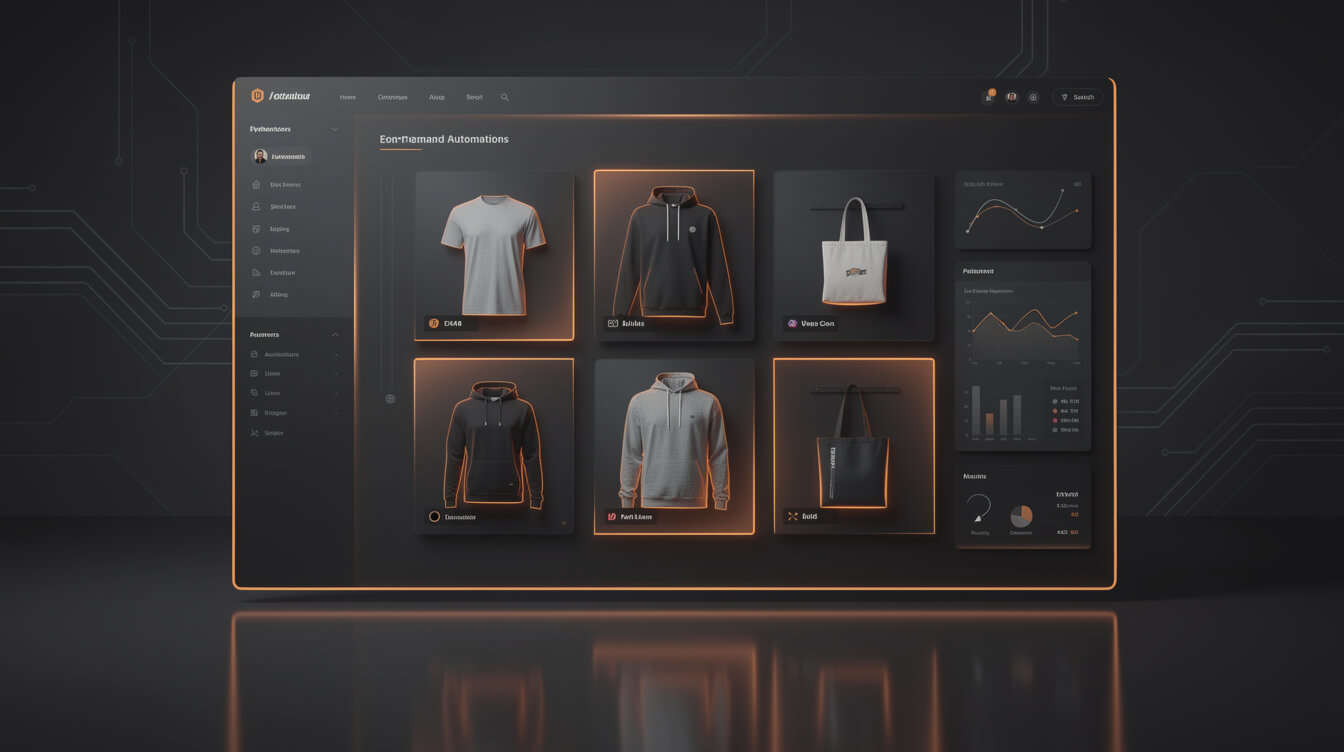
MEGA is the research-to-product pipeline built specifically for this workflow. It handles image generation, sizing, mockups, product titles, SEO metadata, and Printful product creation end to end. Where Canva takes 6 hours for 10 products, MEGA automates the same output in under 70 minutes. For a POD clothing seller building catalog depth without a design team, the throughput difference compounds quickly. You are doing 30x the volume in the same production window.
For a breakdown of what good design execution looks like at the product level, see our guide to t-shirt printing design for POD sellers.

30x the throughput. 7 minutes per product. Try MEGA.
MEGA automates the full POD pipeline: niche research, image generation, mockups, sizing, listing copy, and Printful product creation. One prompt, one product, under 7 minutes. Built for WooCommerce and Printful.
Starting lean: 3 steps to your first POD clothing sale without inventory risk

The fastest path to a first print on demand clothing sale is a focused 3-step setup. The goal is not a perfect store on day one. The goal is a working product, a working checkout, and a real sale tracked. Everything else is iteration.
Step 1: Choose your platform and connect a print partner
If you want to move within a week, Shopify with Printful is the fastest integration. If you want the long-term economics described in sections 3 and 4, WooCommerce with Printful is the better path. Both integrations are well-documented and both offer a free tier to test before committing to a paid plan.
Do not try to optimize the platform decision before you have your first sale. Pick one, connect Printful or Printify, and move to step 2. The platform can be migrated later. The market research and design library you build while selling cannot be rebuilt easily.
Step 2: List 10 focused products in your first two weeks
Start with one niche and one product type. Ten t-shirts in the same niche, each with a distinct design, gives you enough catalog depth to test organic discovery and audience response. Avoid launching 10 different niches with one product each. Niche depth outperforms niche breadth in POD search discovery, both on marketplaces and in organic Google search.
For design execution, the manual Canva workflow is viable at 10 products. At 50 products, the time cost becomes a real bottleneck. Plan for the transition to an automated workflow early, before you hit the wall rather than after.
Step 3: Price for sustainable margin from day one
Price to survive your platform fees, not just your print costs. If you are on Shopify with a 1% transaction fee, build that fee into your margin calculation from the first listing. A t-shirt priced at $22 with an $11 print cost looks like 50% gross margin. With a $0.22 transaction fee and $0.30 in payment processing, the working margin is closer to 48%. At scale, those fractions matter.
The rule: price for the platform you have, not the platform you wish you had. If the margin math only works after subtracting the transaction fee, the product is mispriced.
What comes after the first 10 products
The first 10 products validate the niche. The next 50 validate the pipeline. That second phase is where the design bottleneck becomes real. Manual workflows that take 10 hours for 10 products take 50 hours for 50 products. The POD clothing sellers who scale past 100 products without hiring design help are almost universally running an automated design pipeline. For a deeper look at how Printful performs as your primary partner at that scale, see our Printful review for 2026.
Frequently asked questions about starting a print on demand clothing business
How much does it cost to start a print on demand clothing business?
The baseline startup cost is under $100 for the first month. Shopify Basic runs $29 per month, or WooCommerce hosting costs $20 to $50 per month. Your Printful account is free to create and there are no minimum order commitments. The real cost is the time invested in design and product setup, which is where most early POD sellers underestimate the workload. At 90 minutes per product, 10 products costs a full workday before you make your first sale.
Is a print on demand clothing business profitable?
Profitability depends on your platform fees, unit economics, and order volume. At low volume (under $1,000 per month), the margin math is forgiving even with Shopify fees. At $10,000 and above, platform fees become a significant cost center. A Shopify store paying the 1% transaction fee at $10,000 per month pays $1,200 per year to the platform above and beyond monthly plan fees. That is margin that goes to infrastructure rather than growth.
Can I use WooCommerce with Printful?
Yes. Printful has a native WooCommerce integration. Orders sync automatically, fulfillment is handled end to end, and the integration itself is free. WooCommerce plus Printful is the owned-store alternative to Shopify plus Printful, with no platform transaction fee. The setup requires more technical work than Shopify, but the long-term cost structure is significantly lower.
What clothing products have the best margins in print on demand?
T-shirts have the best margin percentage at scale because base costs are the lowest in the clothing category. Hoodies have strong absolute dollar margin per unit and benefit from higher average order values. All-over print leggings and joggers are premium items with strong retail pricing, but they require higher design investment per SKU because the print wraps the full garment. Start with t-shirts to validate the niche, add hoodies once you have confirmed demand.
How many products do I need before I start making consistent sales?
There is no universal number, but 30 to 50 focused products in a single niche is the common threshold where organic discovery starts to compound. Below 10 products, the catalog is too thin for search algorithms to assign meaningful authority. The design bottleneck is the primary reason most POD clothing sellers never reach 50 products, and it is the bottleneck an automated pipeline solves directly.
The bottom line on starting a print on demand clothing business

A print on demand clothing business has genuinely low startup costs and zero inventory risk. The model works. What the standard beginner guide skips is where the margin actually goes as revenue scales: platform fees, app stacks, and the compounding time cost of a manual design workflow.
The platform decision is not a preference question. It is a math question. A WooCommerce store running at $15,000 per month keeps $429 more per month than the equivalent Shopify store paying the 1% transaction fee. Over a year, that is $5,148 in recovered margin. That covers a marketing budget, an automation tool, or a full year of catalog development without touching revenue from sales.
Start with the platform math. Price for the platform you have. Build catalog depth with a design workflow that can actually scale. The sellers who move from 10 products to 100 without burning out are the ones who solved the design bottleneck before it became a ceiling.
The three levers that determine the outcome of a POD clothing business are unit economics, platform cost, and design throughput. The first two are fixed by your choices at setup. The third is the operational variable you control every week.
Implement AI. 30x your throughput. Get a 30-min call with the founder.
Drop your details and book a free 30-minute discovery call. Personalized advice on your POD stack, your margin, and where AI fits. No pitch, no fluff.