Custom shower curtains for POD stores: which providers support them, sublimation printing explained, and the margin math at $50 retail
The custom shower curtain is one of the most overlooked products in print-on-demand. Bathroom decor sits at the intersection of high average order value, daily product visibility, and repeat-purchase demand — exactly the conditions where the POD model performs. And yet, when you search for editorial guidance aimed at sellers who want to list and dropship custom shower curtains, you find nothing aimed at them. The top results are all consumer-facing design services selling direct to end buyers at $60-290 per curtain. That gap is the opportunity. This guide breaks down which providers carry custom shower curtains with no minimum order quantity, how sublimation on 100% polyester works, what the unit cost math looks like from wholesale to retail, and which niches actually convert in bathroom decor.
Which POD providers carry custom shower curtains
Not every print-on-demand provider carries shower curtains. This is the first decision gate for any POD seller considering the category.
Printful carries sublimation-printed polyester shower curtains in a 71×74-inch standard size. There is no minimum order quantity. Each unit is printed, finished, and shipped on demand when a customer places an order. The base production cost runs approximately $18-22 depending on the current catalog pricing. Shipping adds $5-7 for domestic US orders. You can connect Printful directly to a WooCommerce store and have the product live in under 30 minutes.
Printify does not carry shower curtains in its own fulfillment network directly, but its marketplace connects you to third-party print vendors who do. Availability and pricing vary by vendor and region. If you use Printify, check the product creator for current shower curtain options — the catalog changes as vendors join and leave the network.
SPOD (Spreadshirt’s POD platform) carries custom shower curtains with its 48-hour production guarantee. SPOD’s production speeds are among the fastest in the industry, which matters for bathroom decor orders placed as gifts with a specific event date in mind.
For POD sellers starting in bathroom decor, Printful is the most reliable entry point: the product is confirmed in their standard catalog, the WooCommerce integration is native, and the quality of their sublimation on polyester substrate has been verified consistently across the niche.
Sublimation on polyester shower curtains: what the print method means for quality and durability

Sublimation is the only viable print method for full-coverage shower curtains. Understanding why matters before you design a product line or explain the product to a customer who asks.
Sublimation is a heat-transfer process where dye is converted from solid to gas under high pressure and temperature, and the gas bonds directly with the polymer chains in the fabric at a molecular level. There is no ink layer sitting on top of the fabric — the color becomes part of the material itself. This means no cracking, no peeling, no fading in the wash, and a hand feel that is identical to an unprinted curtain.
For shower curtains specifically, this durability matters. The product lives in a wet environment, gets washed periodically, and is exposed to steam and humidity daily. A sublimated curtain holds its print through hundreds of wash cycles because the dye is chemically bonded to the polyester fiber. Screen-printed or DTG designs on polyester cannot match this durability.
The key technical constraint: sublimation only works on light-colored or white polyester substrate. It does not bond to cotton, linen, or any natural fiber. A 100% polyester shower curtain with a white base is the standard canvas. Any design element you want to appear on the curtain must be designed on that white ground — the polyester itself becomes the color through the dye-sublimation reaction.
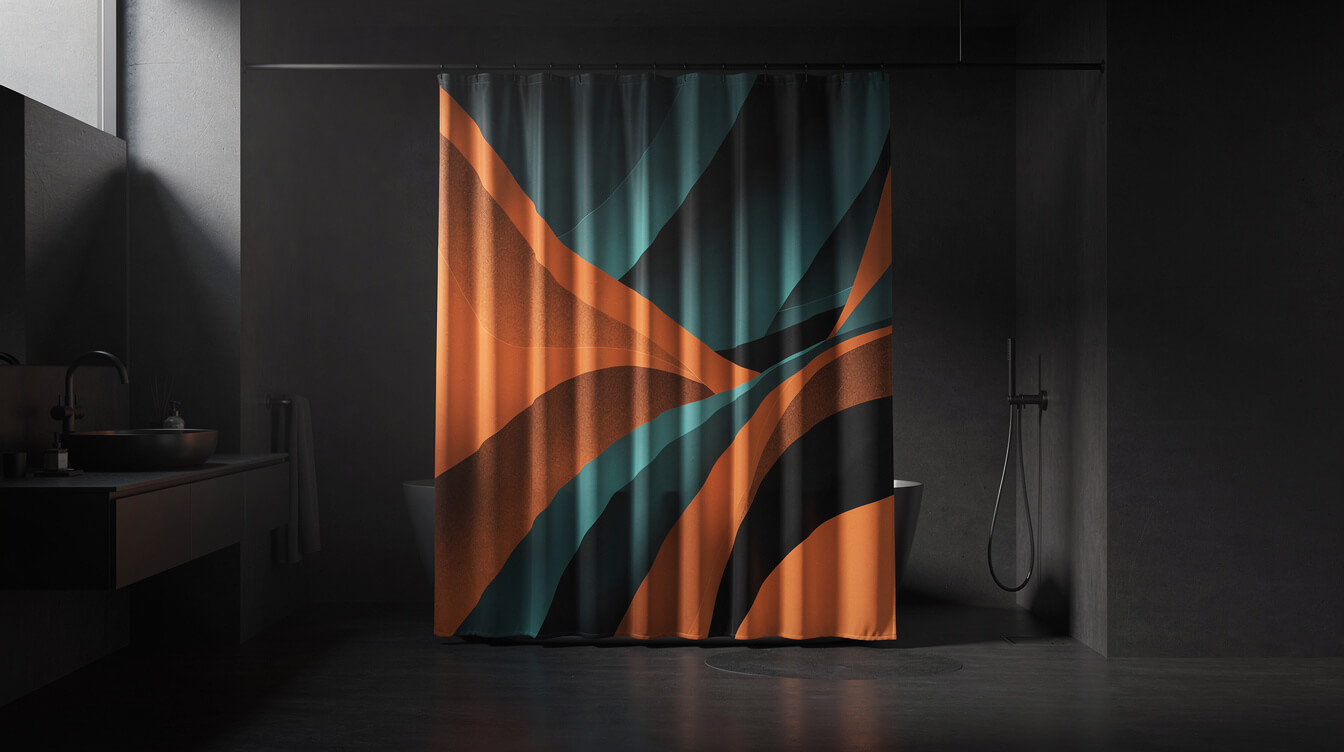
Printful’s shower curtain substrate is a 100% polyester woven fabric, coated on one side for water resistance. The print surface has a slightly textured matte quality that gives the image a soft, photographic finish rather than the shiny appearance of a vinyl banner. The result looks more like a premium bath textile than a commercial print job, which is the aesthetic that converts at $55-65 retail.
Design file specifications: set your canvas to 74×71 inches (height x width) at 150 DPI minimum. Allow 0.25 inches of bleed on all sides. High-resolution AI-generated artwork, watercolor-style designs, and photographic pet portraits all render well at this scale because the dye-sublimation process is continuous-tone and does not use halftone dots.
Unit cost math: Printful wholesale vs retail at 1, 10, and 50 units

The economics of custom shower curtains are what make the category worth building a product line around. Here are the actual numbers.
Printful wholesale cost per unit: approximately $20-22 base production cost. This is the price you pay to Printful per curtain before shipping.
Shipping cost per unit (domestic US): approximately $5.50-7.00 for standard shipping.
Total landed cost per unit: $25.50-29.00.
At $55 retail:
- Gross margin: $55 minus $27 (midpoint landed cost) = $28 gross margin
- Gross margin percentage: approximately 51%
At $65 retail:
- Gross margin: $65 minus $27 = $38 gross margin
- Gross margin percentage: approximately 58%
This is among the strongest margin structures in home decor POD. Compare it to custom blankets — a $48 retail price with a $15-22 base cost yields 35-45% gross margin. The custom blanket POD economics guide covers that math in detail. Shower curtains hold their own on both percentage and absolute dollar amount per transaction.
At 10 units per month — a modest niche store volume — you generate $280-380 in gross margin from shower curtains alone, before platform fees, payment processing, or marketing spend. At 50 units per month, that becomes $1,400-1,900 in gross margin. That is sufficient to fund a meaningful marketing budget or sustain a profitable niche store with minimal overhead.
The POD model does not offer volume discounts. Your 50th unit costs the same as your 1st. This is by design: you carry zero inventory, zero risk, and zero minimum-order commitment. For a POD seller operating without a warehouse or capital to carry stock, that is the correct trade.
For comparison: a factory-direct approach buying shower curtains in bulk requires a minimum of 50-100 units per design, upfront capital of $600-1,500, and the inventory risk if the design does not sell. POD removes that risk entirely. You list the product, it sells, Printful prints and ships it.

Generate 47 shower curtain listings in one afternoon
MEGA handles the research, image generation, product listings, and SEO from a single niche input. Seven minutes per product. No Canva workflow.
The Shopify 1% fee at $50-65 AOV: a real dollar calculation that changes the math

Smash print-on-demand. Join the engine room.
One short email a week. Real numbers, real teardowns, the unfiltered economics behind every move.
If you are running your shower curtain store on Shopify, there is a platform cost that does not appear as a labeled line item on your profit-and-loss statement but is being extracted from your margin on every transaction.
Shopify charges a 1% platform override fee on gross revenue when using Shopify Payments. At the $60 AOV for a custom shower curtain, that is $0.60 per sale — added on top of the standard payment processing fee. At 200 shower curtains per month:
- Shopify 1% override: 200 x $0.60 = $120 per month
- Annual Shopify 1% cost at this volume: $1,440 per year
That $1,440 is margin that WooCommerce sellers keep. WooCommerce has no platform override fee. You pay payment processing (2.9% + $0.30 via Stripe), your hosting, and your domain. Monthly overhead is $15-30, regardless of revenue.
At $10,000 per month in shower curtain revenue on Shopify, the 1% override extracts $100 per month, $1,200 per year. At $25,000 per month, it is $250 per month, $3,000 per year. For a niche home decor store that hits $25k/month in revenue, the platform fee gap between Shopify and WooCommerce exceeds $3,000 per year in kept margin.
The WooCommerce advantage extends beyond the fee structure. A custom product add-on field — such as a photo upload for a personalized shower curtain — is native WordPress functionality. On Shopify, a file upload field requires a third-party app at $19-49 per month. On WooCommerce, the WooCommerce Product Add-Ons plugin handles this natively. That removes another recurring cost from the overhead stack.
We have covered the full fee math in our WooCommerce vs Shopify breakdown for POD sellers — the comparison at $5k, $10k, and $20k monthly revenue is documented there.
Niche verticals that make custom shower curtains work in POD
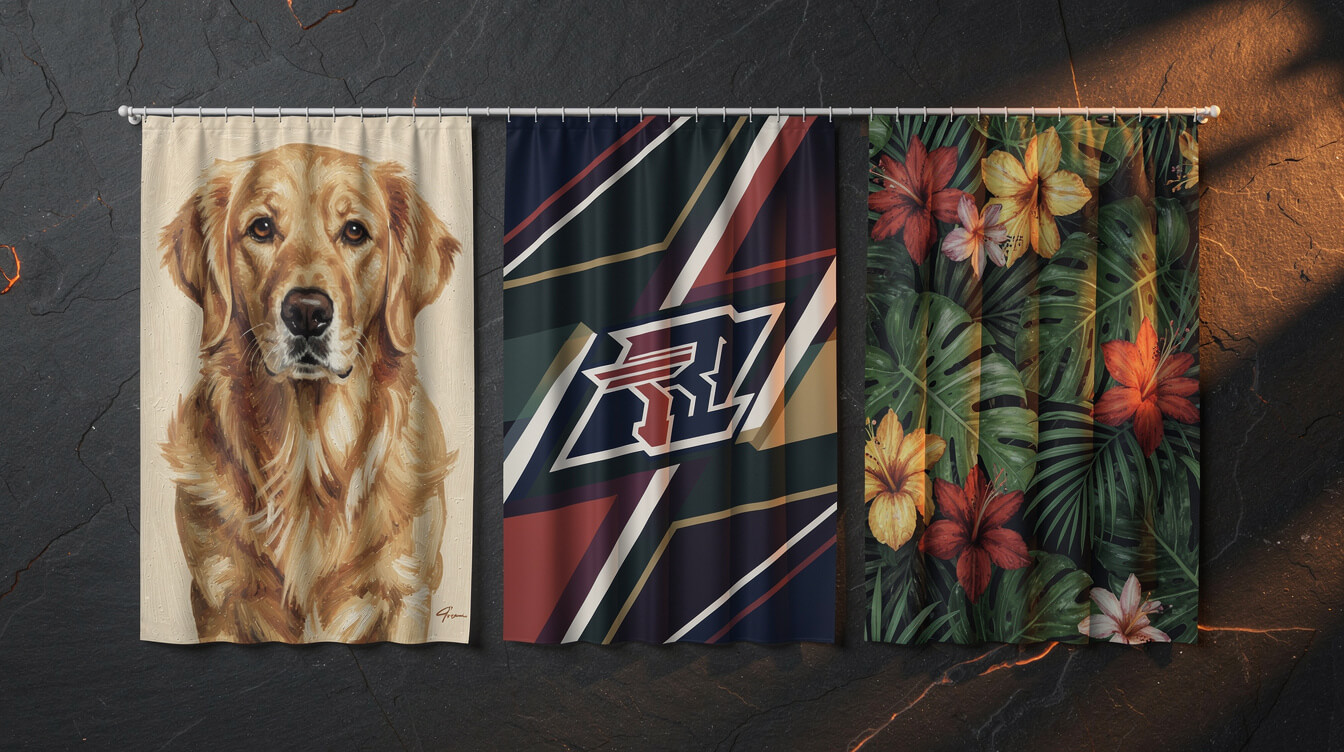
Not all shower curtain niches convert equally. The categories below have the buyer psychology, repeat-purchase dynamics, or gifting occasion that makes custom bathroom decor a consistent revenue driver.
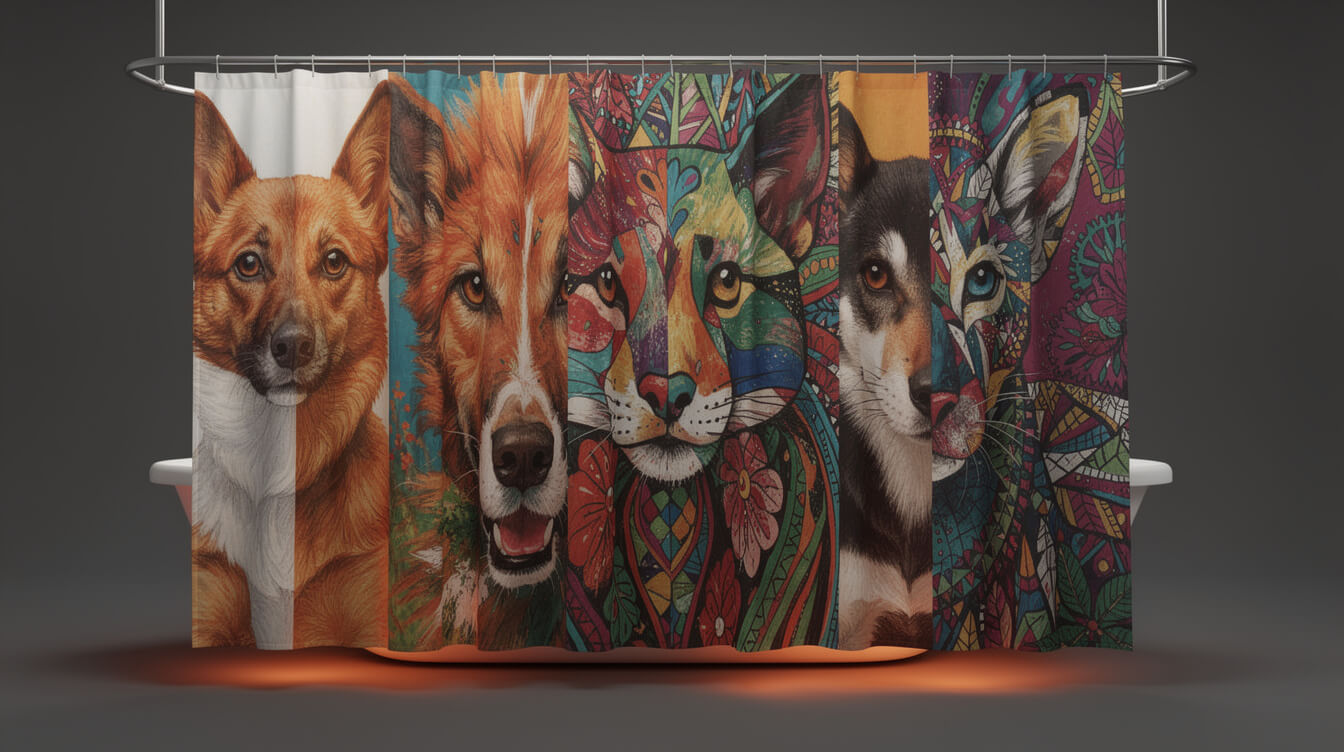
Pet portraits. This is the strongest niche in custom home decor POD, and shower curtains are no exception. A buyer who spends $40 on a custom face sock of their golden retriever will spend $60 on a custom shower curtain with the same image. The product is visible every day, which extends the emotional satisfaction of the purchase and makes it a strong gift option. Pet portrait shower curtains work best as a personalization product: the customer uploads a photo of their pet, and the design is placed on a repeating pattern or centered on a white-background curtain.
Funny and novelty bathroom decor. The bathroom is one of the few rooms in the home where humor in decor is not only acceptable but expected. Novelty shower curtains with absurdist humor, pop culture references, or irreverent design aesthetics sell because they are a low-commitment, shareable, and gift-friendly product. Buyers in this category often have a specific recipient in mind — a sibling with a particular sense of humor, a friend who collects niche kitsch. Social sharing potential is high.
Sports fan decor. Sports fan home decor is a year-round category with predictable demand spikes around season openers, playoffs, and championship events. A sports fan who has personalized their living room has likely not touched their bathroom decor — that is the gap you fill. Note: you cannot use licensed team logos or official branding. You can use team colors, abstract patterns, and fan-culture aesthetics that reference the sport without infringing on trademarks.
Holiday and seasonal drops. Halloween, Christmas, and Valentine’s Day all drive bathroom decor gifting. A limited-edition Halloween shower curtain with original illustrated artwork can sell through a 90-day window and be retired after the season. The no-inventory POD model makes seasonal products economically rational — you carry no unsold stock when the season ends.
Airbnb host gifts and vacation rental decor. This is a B2B-adjacent niche with repeat-order potential. A vacation rental operator who receives compliments from guests on a distinctive shower curtain may reorder for additional properties, or refer the store to their network. The purchase trigger is often practical rather than emotional — the current curtain is worn, a new property needs decor, or the operator wants a consistent brand marker across their listings.
MEGA automates the research-to-product pipeline for niches like these — if you want to see how the system generates and lists bathroom decor products in under 7 minutes, start at mega.management.
Setting up custom shower curtains on WooCommerce and Printful: the no-minimum workflow
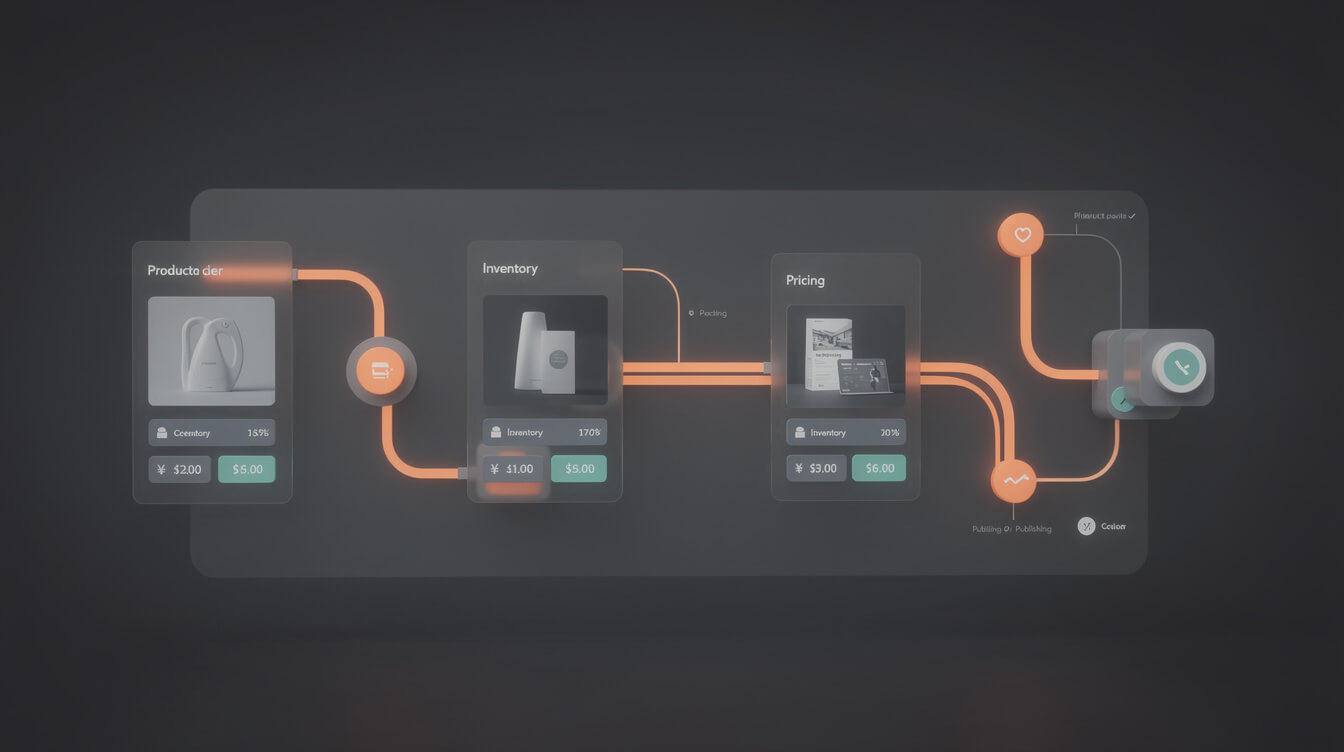
Once you have confirmed the niche and the design approach, the setup process is straightforward. Here is the workflow for listing a custom shower curtain on a WooCommerce store connected to Printful.
Step 1: Create the design. Use a canvas of 74×71 inches at 150 DPI. If you are using AI-generated artwork for the print, specify a portrait-oriented composition for a curtain that will be viewed vertically. High-contrast designs with clear focal elements — a pet portrait, an illustrated landscape, a repeating pattern — work better than fine-detail artwork at this scale.
Step 2: Create the product in Printful. In the Printful dashboard, navigate to Products, add the shower curtain, and upload your design file. Printful generates a mockup with the design placed on the curtain. Review the mockup carefully — check bleed, check how the design interacts with the edge, and confirm that the curtain rings at the top do not cut into the primary visual element of the design.
Step 3: Sync to WooCommerce. Once the product is set up in Printful, the Printful WooCommerce plugin synchronizes it automatically to your store. The product title, description, variants (if any), and base price are inherited from the Printful setup. You then edit the product page in WooCommerce to add your SEO-optimized title and description, set the retail price, and add any product add-on fields.
Step 4: Set the product add-on for photo personalization. If you are selling a pet portrait curtain, the customer needs a way to upload their photo at checkout. Install WooCommerce Product Add-Ons and add a file upload field labeled “Upload your pet’s photo.” This field captures the file at order time and you forward it to Printful via their order notes or custom design workflow. This is native WooCommerce functionality — no third-party subscription required.
Step 5: Set pricing and markup. At a Printful base cost of $20-22 plus $6 shipping, your landed cost is approximately $26-28. Price the retail listing at $54.99-64.99 depending on your positioning. A pet portrait curtain with personalization can push to $69.99 without resistance in that market segment. A novelty curtain with a fixed design sits better at $49.99-54.99.
We have covered a comparable setup workflow for home decor sublimation products in our guide to custom doormats for POD stores — the Printful sync and WooCommerce product setup steps are nearly identical across sublimation home decor products.
Bathroom decor as a repeat-purchase POD category: who buys and when

The highest-value buyer in custom home decor is not the one who buys once. It is the one who buys again — for a different room, a seasonal update, or a second property. Bathroom decor has structural dynamics that make this more likely than most other POD categories.
Shower curtains are replaced more frequently than most home decor items. The average shower curtain in an American household is replaced every one to two years due to mildew, wear, or a decor change. A buyer who purchases a custom curtain from your store is a repeat-purchase candidate at the same interval. If you have their email address — which you do, on a WooCommerce store with owned customer data — you can reactivate them with a seasonal campaign or new design launch when the replacement cycle comes around.
The gifting economy drives first-time purchases disproportionately. Custom shower curtains purchased as gifts tend to be bought by a buyer who does not own the product themselves. This creates a secondary network effect: the gift recipient sees the curtain, likes it, and becomes a direct buyer for their own home. The product functions as its own advertisement inside the recipient’s bathroom.
The seasonal demand curve for bathroom decor follows the same pattern as most home goods: peaks around Q4 (holiday gifting), a secondary peak around Q1 (new year, home refresh), and moderate demand through spring and summer. Pet portrait curtains have a more stable demand curve because the gifting occasion — birthdays, pet adoption anniversaries, holidays — is distributed throughout the year.
For POD sellers building a durable niche store rather than a one-off product line, bathroom decor is worth including in the product mix. The sublimation quality holds up through regular use, the AOV is strong relative to base cost, and the category has not been crowded by POD sellers the way apparel has. The SERP for “custom shower curtain” is still 100% B2C consumer services with zero editorial content for POD sellers — which means you are building in an uncontested lane.
We have covered the broader home decor sublimation opportunity in our guides to custom canvas prints and custom blankets for POD stores — the pattern is consistent: high AOV, strong sublimation durability, and a SERP full of direct-to-consumer brands with no editorial competition for the POD seller angle.
The case for custom shower curtains in your POD store
Custom shower curtains check the boxes that matter for a sustainable POD product line: no-minimum sublimation from Printful, 50-58% gross margin at standard retail pricing, and a buyer base that includes gift purchasers, niche enthusiasts, and repeat buyers on a predictable replacement cycle. The WooCommerce setup is native. The Shopify 1% fee math favors a platform switch at any meaningful sales volume.
The niche is uncontested at the editorial level. If you are building a bathroom decor POD store and publishing content around it, you are writing in a lane where no competitor is targeting POD sellers. That window is worth moving on.
Implement AI. 30x your throughput. Get a 30-min call with the founder.
Drop your details and book a free 30-minute discovery call. Personalized advice on your POD stack, your margin, and where AI fits. No pitch, no fluff.