Custom desk mats for POD sellers: which providers carry them, sublimation explained, and the WFH niche math
A custom desk mat is one of the highest-impact upgrades a POD seller can add to their store. It covers the entire desk surface from corner to corner, turns a plain workspace into a branded statement, and carries a $40-60 retail price that most smaller accessories cannot reach. Printful carries extended desk mats at 24×14 inches with no minimum order requirement, using the same rubber-backed sublimation method as mouse pads but at nearly three times the coverage area. The SERP for “custom desk mat” is entirely consumer photo-upload services. There is no editorial guide for POD sellers. This post covers providers, print method, design specs, cost math, and the niches driving $40+ repeat purchases.
What is a custom desk mat, and how does it differ from a mouse pad?
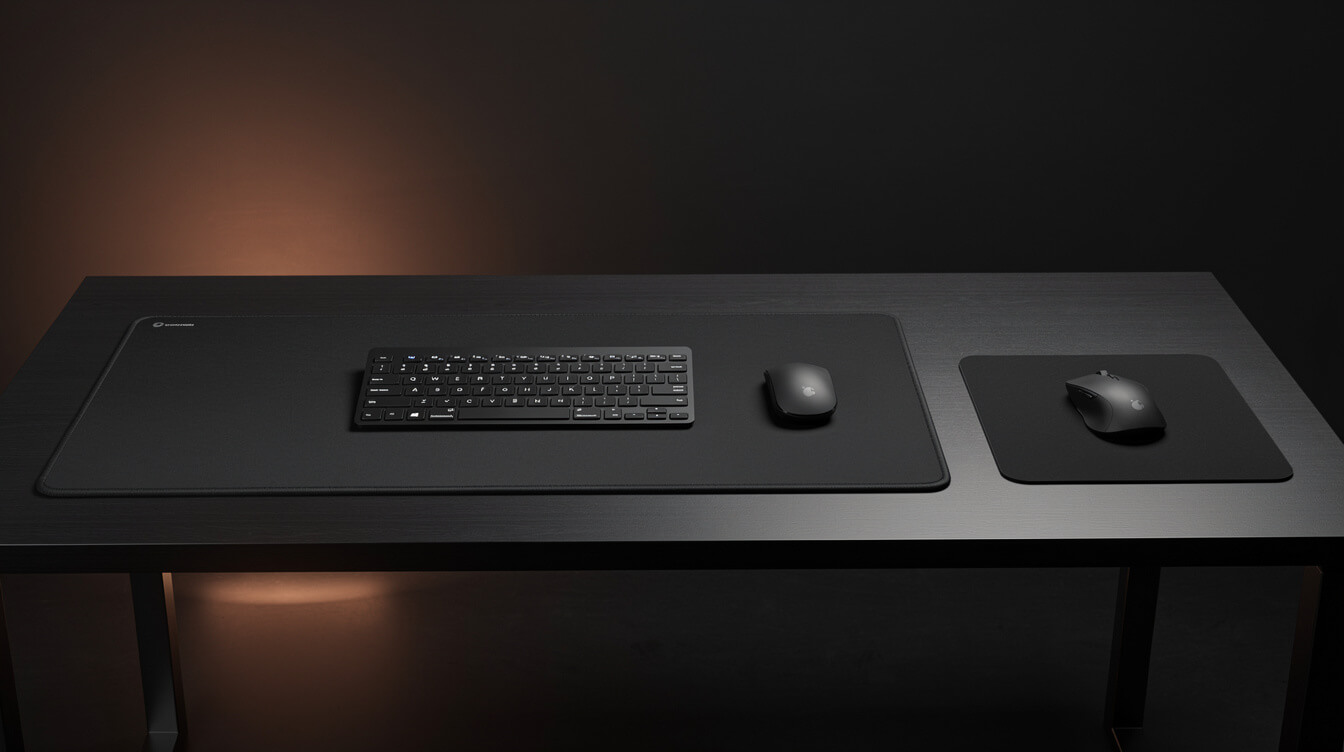
A standard mouse pad covers roughly 12×10 inches, which is just enough surface for a mouse. A desk mat, by contrast, covers the full working surface of a desk, typically 24×14 inches at the entry level and up to 36×18 inches in extended formats. The mat runs under the keyboard, the mouse, and everything else on the desk simultaneously.
The visual difference is significant. A mouse pad is a small accent. A desk mat is the foundation of the entire setup. When a customer buys a custom desk mat with a design they chose, that art is visible every time they sit down to work or play.
From a POD seller perspective, the desk mat is the premium tier of the custom mouse pad vertical. The sublimation method, the substrate, and the fulfillment chain are identical. The price point is approximately double. If you already sell mouse pads, adding desk mats requires no new print knowledge, only a larger design file and a higher retail listing.
The consumer market for custom desk mats skews toward two groups: gamers who treat their desk as a permanent creative investment, and remote workers who want their WFH setup to feel intentional and personal. Both groups are willing to pay $40-60 for a product that is always visible on their desk.
Which POD providers carry custom desk mats at no minimum order

Not every print-on-demand platform carries desk mats. Here is the current state of the major providers.
Printful carries a 24×14 inch extended desk mat with rubber backing and a polyester surface, available at no minimum order quantity. Base cost is approximately $18-22 depending on shipping destination. The mat ships from their standard fulfillment centers. Production time is 2-5 business days. This is the most reliable no-MOQ option for desk mats.
Printify does not manufacture desk mats directly, but its vendor network includes suppliers who carry them. You will need to search the Printify product catalog to confirm current availability and pricing at the time you are building listings. Vendor availability in Printify’s network changes over time, so verify before committing to a store build around a specific vendor.
Gelato and Gooten have also offered desk mats at various points. Check their product catalogs directly, as SKU availability shifts seasonally.
The practical implication for most sellers is straightforward: Printful is the confirmed, stable, no-MOQ desk mat provider. Printify gives you access to vendor competition and potentially lower base costs, but you accept more variability in product consistency and vendor reliability. If you are building your first desk mat listings, start with Printful to validate the niche before optimizing margins through Printify.
One important note on the custom desk mat category: the consumer market is dominated by photo-upload services like CustoMEnvy and InkedGaming, which sell directly to end consumers. None of these are competitive threats to a POD seller. They are B2C services, not editorial authorities. The SERP has no editorial coverage of desk mats from the POD seller’s perspective, which means there is no competitor telling your potential customers how the economics work.
How sublimation printing works on rubber-backed desk mats
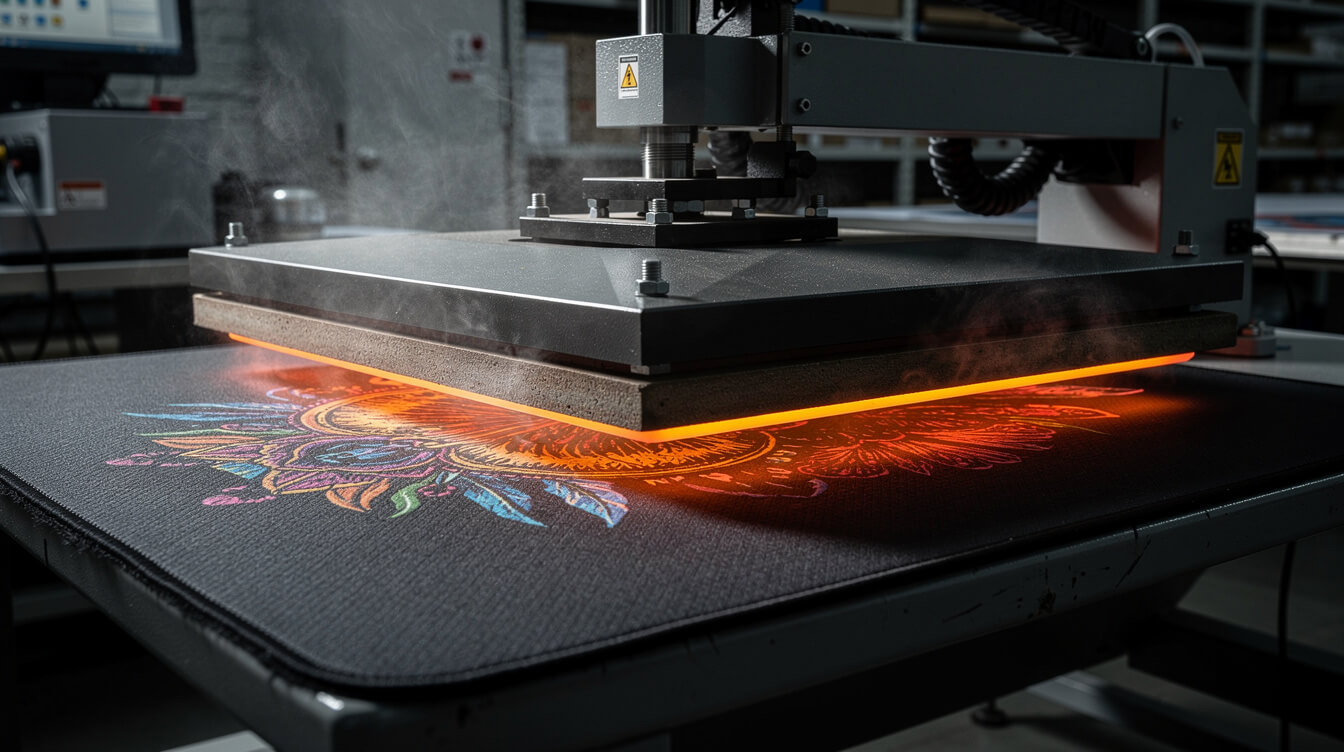
Sublimation is the print method for custom desk mats. Understanding how it works helps you set accurate expectations with customers and write better product descriptions.
The desk mat substrate is a polyester fabric face bonded to a rubber backing. The rubber provides the non-slip base that keeps the mat stationary on the desk. The polyester face is the print surface. Sublimation works specifically because polyester has a chemical structure that accepts dye at the molecular level under heat and pressure.
The sublimation process uses solid dye embedded in a transfer paper or film. When the press reaches 375-400 degrees Fahrenheit, the dye converts from solid to gas and bonds directly into the polyester fiber structure. When the mat cools, the dye is locked inside the fabric permanently. There is no ink sitting on the surface of the mat. There is no layer that can crack, peel, fade from UV exposure, or delaminate from washing.
This is the core reason desk mats have a strong durability story. The image does not degrade through normal use. A custom canvas print on a wall fades over years from ambient light. A custom desk mat handles daily mouse friction and keyboard vibration without degradation because the color is part of the fiber, not on top of it.
One constraint of sublimation is the polyester requirement. Cotton desk pads and wool felt desk covers cannot be sublimated. If a supplier offers a cotton desk mat, it is using a different print method, likely UV inkjet or screen printing, with different durability characteristics. The rubber-backed polyester sublimation mat from Printful is a distinct and superior product for full-color artwork.
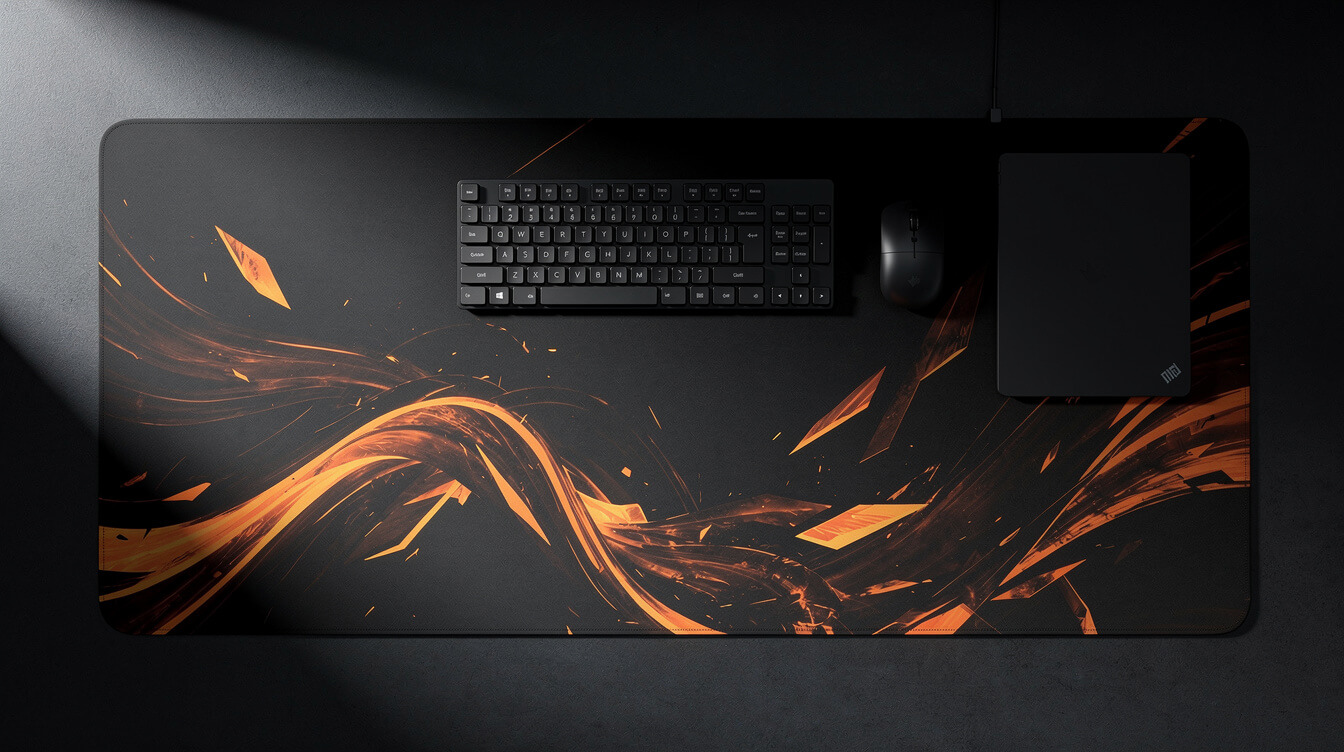
The sublimation process also produces edge-to-edge full coverage with no white border. Every part of the 24×14 surface can carry color and design. This matters for art that relies on dark backgrounds or full-bleed compositions.
Design specs: file size, resolution, and layout rules for desk mats

Smash print-on-demand. Join the engine room.
One short email a week. Real numbers, real teardowns, the unfiltered economics behind every move.
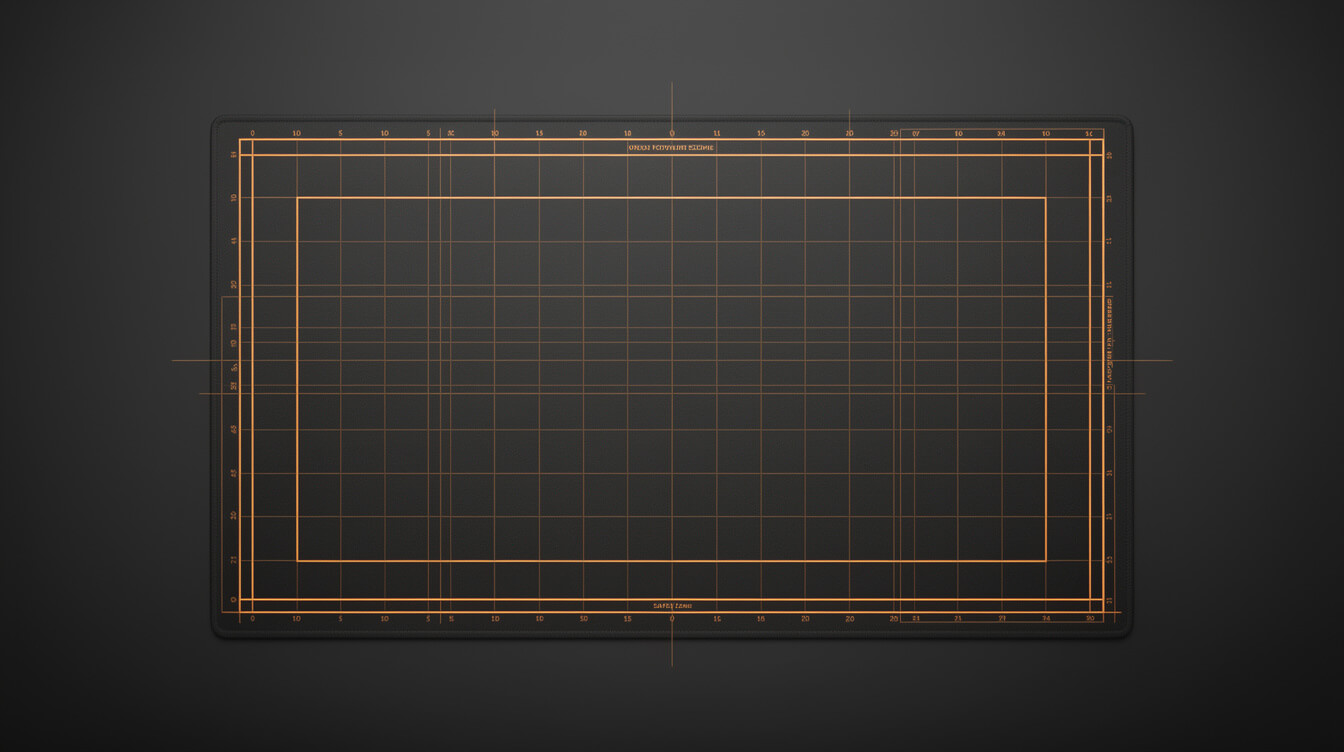
Getting the design file right before you submit avoids production delays and rejected orders. Here are the specifications for a 24×14 inch desk mat.
Minimum resolution: 150 DPI at print size. For a 24×14 inch mat, that is a file of at least 3,600×2,100 pixels. 300 DPI gives you more flexibility for detail work, but 150 DPI is the accepted floor for sublimation at this size. Do not submit a small file upscaled to the correct pixel count. Upscaling does not add information. Use a design built at the correct dimensions from the start.
Bleed: Add 0.25 inches of bleed on all sides. This means your working canvas should be 24.5×14.5 inches with the mat content at 24×14. Any design elements you want to appear near the edge should not be placed exactly at the trim line, because slight alignment variation in production can shift the print by 1-2 millimeters. Background colors and gradient fills should extend into the bleed area.
Color mode: Use RGB. Sublimation transfers are processed through a raster image pipeline, and RGB is the native color space for this workflow. Do not submit CMYK files.
Composition rules for desk mats: Think in landscape orientation. The mat is wider than it is tall, and the right third of the mat is typically occupied by the mouse. This means the primary focus of the design, the part the customer will see most clearly when looking at their setup, is the left two-thirds of the surface. Place hero elements and primary artwork there. Avoid centering a circular design element, because the mouse blocks the right side of a center composition.
Dark background designs perform best on desk mats. They hide surface grime that accumulates from keyboard use, they photograph well in dark gaming setups, and they maintain visual impact over time. Bright white backgrounds show every piece of dust and do not hold up visually after a few months of daily use.
Custom desk mat unit cost math: what you pay versus what you charge

Here is the cost breakdown for a standard 24×14 desk mat through Printful.
Base cost: $18-22 depending on fulfillment center and promotion tier. Standard seller accounts pay the higher end. Printful Premium subscribers pay less per unit.
Shipping: $5-7 for domestic US delivery. International shipping adds $4-8 depending on destination. For this math, assume domestic.
Landed cost: $23-29 total to fulfill a single order.
Retail pricing: $38-48 for a standard 24×14 desk mat at accessible price points. Premium extended formats (36×18 and larger) justify $50-65 retail. The market ceiling for premium custom desk mats is around $75 for limited-edition or artist-collaboration products.
Gross margin: At $40 retail and $25 landed, you keep $15, or 37.5%. At $48 retail and $25 landed, you keep $23, or 47.9%. At $60 retail and $28 landed (extended format), you keep $32, or 53.3%.
For comparison, a custom mouse pad at $22 retail and $12 landed gives you $10, or 45.5% gross. The dollar amount per order is lower even though the percentage is similar. At 100 desk mat orders per month at $48 retail and $25 landed, you generate $2,300 in gross margin. At 100 mouse pad orders at $22 retail and $12 landed, you generate $1,000 in gross margin. Same order volume, 2.3 times the gross margin dollars.
This is the core argument for adding desk mats to any POD store that already sells mouse pads or other flat sublimation products. The fulfillment chain is identical. The gross dollar margin per order is materially higher.
MEGA automates this product creation pipeline end-to-end, from niche research through image generation and product listing, in under 7 minutes per product. If you want to build a desk mat product line without the manual design and upload workflow, try MEGA for the research-to-product pipeline that replaces the Canva session.

Build your desk mat store without the 6-hour Canva workflow
MEGA handles niche research, image generation, sizing, and product listings end-to-end in under 7 minutes. No manual uploads. No Shopify override eating your margin. Owned WooCommerce store from day one.
The gaming and WFH niche: who buys custom desk mats and why they spend $40+
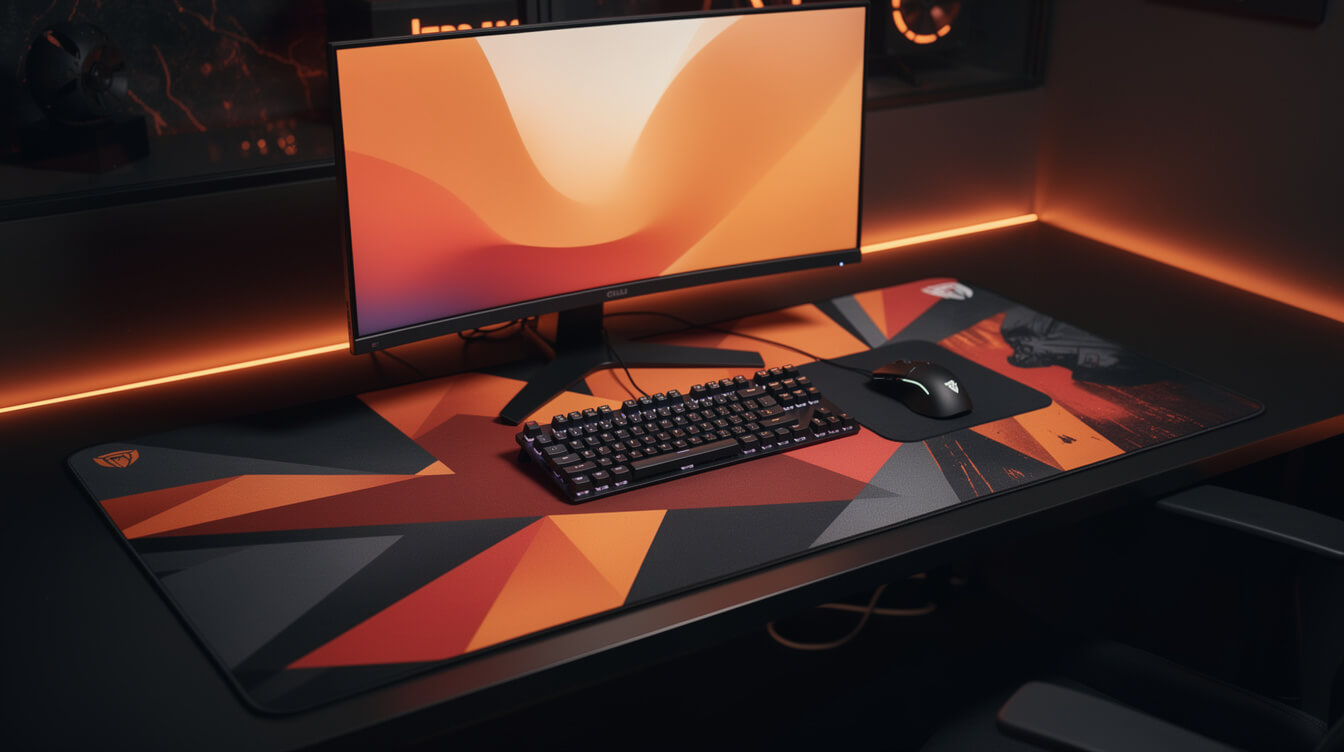
The desk mat category has two primary buyer groups. Understanding both helps you build listings that convert.
Gaming setup buyers are the largest segment. The gaming community has established a visual language around the full-desk mat. Browse any gaming setup post on Reddit or YouTube and you will see desk mats in nearly every image. Gaming buyers treat their desk setup as an ongoing investment. They replace components, upgrade peripherals, and refresh the mat to match new themes. They are not one-time buyers. The per-unit spend is high because a $40 desk mat is a small fraction of a total setup cost that often runs $1,000-3,000.
Gaming niches that perform well: original geometric and abstract art in dark palettes, anime art (your own original characters, not licensed IP), game-inspired abstract art that evokes a game without using trademarked assets, and custom art commissioned from the buyer’s own design. The last category is the highest AOV because it involves personalization.
WFH and remote work buyers are the second primary segment and a growing one. The permanent home office market emerged at scale in 2020 and has not reverted. WFH buyers want their desk to feel intentional and professional. A custom desk mat with a design they chose signals that their workspace is a real creative environment, not a temporary arrangement at the kitchen table.
WFH niches that convert: productivity and motivational quotes (executed as clean typographic art, not garish poster text), botanical and nature art for a calm workspace aesthetic, pet portrait desk companions (a customer’s dog or cat rendered in a flat art style), and minimalist brand-identity pieces for freelancers and small business owners who want their desk to match their professional brand.
Both buyer groups share one key trait: they take photos of their setup and share them. A desk mat is always visible in any desk photo. When a satisfied buyer posts their setup in a gaming subreddit or a WFH community, the mat is in the image. This is organic word-of-mouth that has a reach effect far beyond the initial sale.
Link to related wall art products your desk mat buyers might also want: check out our guide to custom canvas prints for POD sellers and custom poster stores to build a complete desk-plus-wall aesthetic for the WFH buyer.
Shopify 1% versus WooCommerce for desk mat stores: the annual fee math

The Shopify 1% transaction fee applies to every order processed through Shopify Payments or any third-party payment gateway. On a $40 custom desk mat, that is $0.40 per order that goes to Shopify regardless of your margin. It sounds small. It compounds.
At 100 orders per month and $40 average order value: $40 per month, $480 per year.
At 200 orders per month and $45 average order value: $90 per month, $1,080 per year.
At 500 orders per month and $48 average order value: $240 per month, $2,880 per year.
This is before the Shopify platform subscription ($29-$299/month depending on tier), before third-party app fees for product personalization, and before the app fees for print-on-demand integration. A Shopify store doing $20,000 per month in desk mat revenue at $40 AOV (500 orders) pays $3,180-$6,000 per year in pure platform overhead, depending on tier and apps. The 1% override alone is $2,880 of that.
WooCommerce charges a fixed hosting cost, typically $15-30 per month at standard managed WordPress hosts. At 500 orders per month, the WooCommerce overhead is $180-360 per year. The difference between Shopify and WooCommerce at that volume ranges from $2,820 to $5,820 per year, money that stays in your gross margin on WooCommerce.
WooCommerce also handles the product personalization use case natively. Custom desk mats with a buyer’s own pet portrait, name, or photo require a file upload field on the product page. WooCommerce provides this through the Product Add-Ons extension, which is either bundled with managed WooCommerce plans or available as a one-time plugin purchase. Shopify requires a $19-49 per month third-party app to accomplish the same thing. Over 12 months, that app adds $228-588 to annual overhead on top of the 1% override.
For a desk mat store targeting $5,000-20,000 per month in revenue, WooCommerce is structurally cheaper at every volume level. The savings compound as revenue grows, because the Shopify 1% grows with revenue while WooCommerce hosting stays flat. See the full comparison in our guide to WooCommerce vs. Shopify for POD sellers.
Conclusion: the desk mat is the premium tier of the mouse pad vertical
The custom desk mat case is straightforward. The product uses the same sublimation-on-polyester method as mouse pads, with the same fulfillment infrastructure from Printful, the same design workflow, and the same no-MOQ structure. What changes is the surface area, the visual impact, and the retail price.
At $40-60 retail versus $18-28 for a mouse pad, the desk mat doubles the gross margin dollars per order at equivalent volume. The gaming and WFH audiences who buy desk mats have established purchasing patterns around $40-60 for premium setup accessories. The SERP for “custom desk mat” is entirely consumer-facing services with no editorial competition in the POD seller lane.
If you already have a mouse pad product in your store, add a desk mat. The design file is a horizontal resize of the same artwork. The listing is the same structure with different dimensions. The margin is materially higher. For sellers building a new store, the desk mat is a strong anchor product for any gaming, WFH, or productivity-focused niche.

Implement AI. 30x your throughput. Get a 30-min call with the founder.
Drop your details and book a free 30-minute discovery call. Personalized advice on your POD stack, your margin, and where AI fits. No pitch, no fluff.