Custom posters for POD stores: which providers support them, what the unit cost looks like, and the wall art niche math
A custom poster is one of the most underrated products a print-on-demand seller can carry. Base cost from Printful’s giclée line runs $5 to $12 depending on size. Retail prices hold comfortably at $15 to $30. That is a 40-to-60 percent gross margin before shipping, and it beats almost every apparel product on a per-unit basis. Yet when you search “custom poster,” every result is a consumer photo print service aimed at someone who wants one photo print for their apartment. Not one editorial resource exists for the POD seller who wants to list 200 poster SKUs in a WooCommerce store and fulfill them without touching inventory.
This guide covers the full picture: which POD providers carry posters and what sizes and finishes they offer, the unit cost math at 1, 10, and 50 units, how platform fees interact with a $15-to-$30 price point, how AI-generated wall art turns posters into a high-throughput catalog play, and the niche verticals where poster stores build repeatable buyers.
What “custom poster” means in a POD context
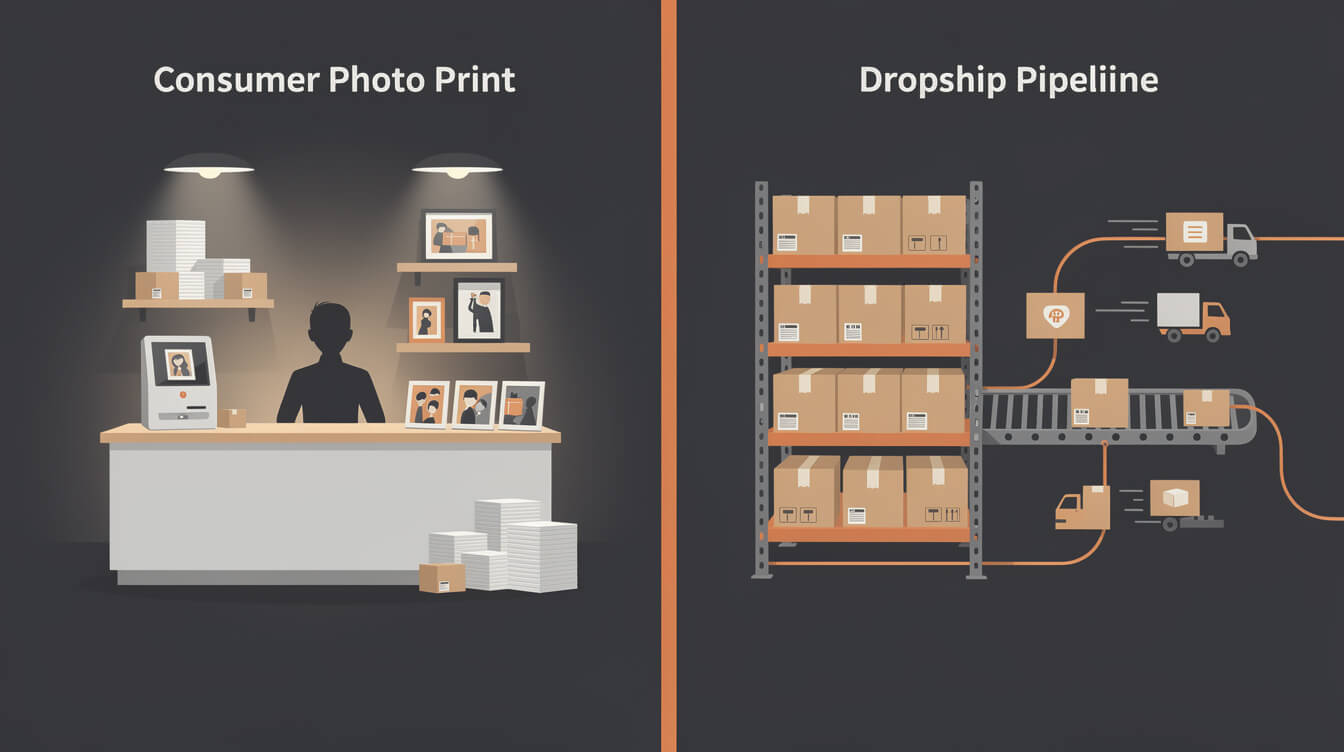
The search phrase “custom poster” has 12,100 monthly searches in the US. The top five results are Walmart Business Print, MYPOSTER, Walgreens Photo, and similar one-off consumer print services. All of them sell to end consumers who want a single photo blown up and shipped to their home. None of them serve a POD seller who needs a supplier that fulfills individual orders automatically at retail volumes.
That ambiguity matters because the two models are completely different.
A consumer photo print service asks you to upload a file, select a size, pay at checkout, and receive one print in the mail. There is no API. There is no WooCommerce integration. There is no fulfillment-on-demand pipeline. You cannot list that service’s product in your store and have orders routed automatically to the printer.
A POD print provider, by contrast, integrates with WooCommerce or Shopify, accepts orders automatically when a customer buys in your store, prints and ships directly to the customer without you ever touching the product, and bills you the base cost after each fulfilled order. Your WooCommerce store carries the design. The provider handles production, postage, and returns.
That is the model this article is about. When a POD seller asks “can I sell custom posters,” they mean: can I connect a provider to my store, list poster SKUs with my designs, and fulfill orders automatically at zero inventory risk? The answer is yes, and the provider options are better than most sellers realize.
Which POD providers carry custom posters
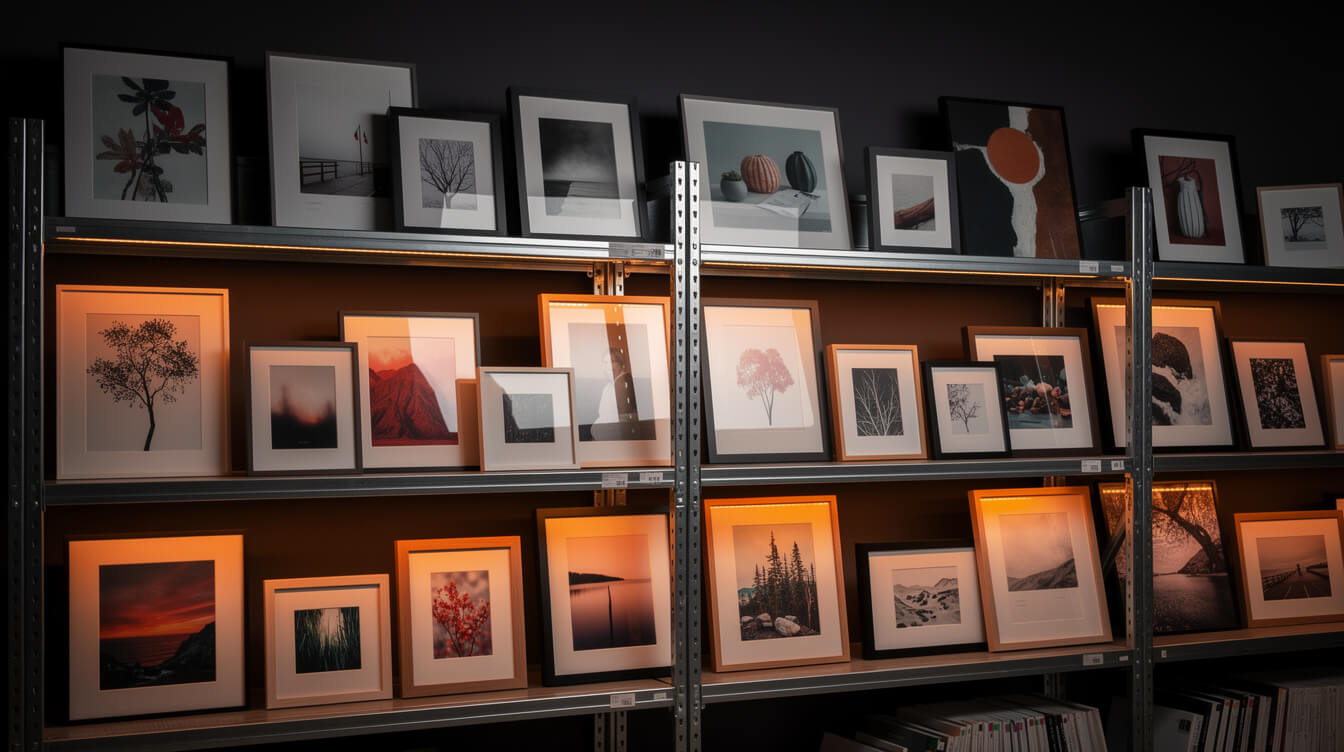
Four providers stand out for poster dropshipping. Each has meaningful differences in print method, size range, and base cost.
Printful carries premium giclée poster prints. Giclée uses high-resolution inkjet on archival-grade paper, the same print method used in fine art reproduction. Printful offers sizes from 8×10 inches up to 24×36 inches in matte, satin, and glossy finishes. Base cost runs approximately $6 for an 8×10 up to $12 for an 18×24. Printful’s WooCommerce plugin is the most mature integration in the category. Order routing is automatic. Return policy is handled provider-side. The trade-off: Printful’s base costs sit at the higher end of the market, which is why the margin math at $15 AOV is tighter than at $25.
Printify connects sellers to a network of print providers rather than owning its own facilities. For posters, this means you can choose between multiple vendors at different price points. Some Printify print partners offer poster base costs starting below $5 for smaller sizes, which opens a lower retail price point without collapsing margin. The trade-off: print quality varies between Printify’s network providers, and shipping times differ. If you use Printify for posters, test order from two or three providers before scaling catalog.
SPOD (Spreadshirt Print On Demand) produces posters with a 48-hour production time guarantee, one of the fastest in the category. SPOD integrates directly with WooCommerce via plugin. Size range is comparable to Printful. Base cost positions between Printful and the lower end of Printify’s network. SPOD is underutilized by most POD sellers despite competitive unit economics, largely because it has less brand recognition than the two market leaders.
Gooten is a B2B-first fulfillment provider that offers posters alongside a wider print catalog. Gooten is best suited to sellers running higher monthly volumes who want negotiated pricing tiers. Minimum order commitments are required to access the best rates. At early store volumes, Printful or Printify is the more practical starting point.
The safest starting point for most WooCommerce poster stores is Printful for core sizes (8×10, 11×14, 16×20, 18×24) and a Printify network provider for one or two lower-cost entry-level SKUs. You are not locked to one provider, and the WooCommerce plugin architecture supports multi-provider catalogs.
Unit cost math for custom posters at 1, 10, and 50 units

Posters have the best base cost margin of any POD home decor product. Here is how the math looks across three volume tiers for a Printful 11×14 matte poster at a $20 retail price.
1 unit (single order): Printful base cost for an 11×14 matte poster is approximately $7.50. Standard shipping to a US address runs $4.50. Total landed cost to fulfill is $12.00. At $20 retail, gross margin is $8.00, or 40 percent. That is before payment processing (typically 2.9% plus $0.30, so roughly $0.88 per transaction). Net margin after payment processing: approximately $7.12 per poster, or 35.6 percent.
10 units (small catalog run): Unit economics do not change in pure dropship because you are still fulfilling one order at a time. What changes at 10-unit volume is the cost of learning. Running 10 test orders lets you confirm print quality, verify shipping times, and audit the packaging before scaling catalog. Budget $120 for 10 test orders. That is product development spend, not waste.
50 units (scaled catalog): At 50 monthly fulfilled units, the real lever is no longer the cost per unit. It is the number of SKUs you have live. A store with 50 active poster designs can generate 50 units from 50 different designs at the same margin. The throughput advantage compounds as you add more designs because each new SKU is a new indexed URL, a new Printful product, and a new fulfillment path, all at zero additional inventory cost.
Compare that margin to other POD home decor. A custom canvas print has a base cost of $18 to $30, which pushes the retail price to $45 to $80 before margin compresses. A custom ornament has seasonal demand concentration and a $10 to $15 AOV that leaves less room for shipping cost absorption. Posters sit in the best position: low base cost, defensible retail price, and steady demand across all 12 months.
The Shopify 1% reality at a $15 to $30 poster AOV

Smash print-on-demand. Join the engine room.
One short email a week. Real numbers, real teardowns, the unfiltered economics behind every move.

Shopify charges a platform override on every transaction processed through third-party payment gateways. On Shopify Basic, the fee is 2.0 percent. On Shopify Standard (“Shopify” plan), it is 1.0 percent. Most established POD sellers run the Standard plan to reduce the override, so the 1.0 percent figure is the common real-world case.
At a $20 poster sale, 1.0 percent is $0.20. That sounds negligible until you run the volume.
At $5,000 monthly revenue from poster sales, the Shopify platform override costs $50 per month, or $600 per year. At $10,000 monthly revenue, it is $100 per month, or $1,200 per year. At $20,000 monthly revenue, it is $200 per month, or $2,400 per year. That is revenue leaving the business to Shopify, not to Printful, not to shipping, not to advertising. It is a recurring tax on every dollar of GMV the store generates.
On WooCommerce with WooCommerce Payments or Stripe Direct, there is no platform override. The payment processor fee (2.9% + $0.30) applies regardless of platform. But the Shopify-specific override does not exist. At $10,000 monthly revenue, that difference is $1,200 per year that stays in the business instead of going to Shopify.
The poster category makes this calculus more visible than high-AOV categories like blankets or canvas prints because the transaction count is higher at the same revenue level. Selling 500 posters at $20 each to generate $10,000 creates 500 transactions. Selling 100 canvas prints at $100 each creates 100 transactions at the same revenue. The platform override applies per dollar of revenue, not per transaction, so the absolute cost is the same. But the psychological impact is clearest in high-velocity, low-AOV categories where sellers see the fee on every single order summary.
See the full breakdown in our WooCommerce vs Shopify comparison for POD sellers.
AI-generated wall art: populating a custom poster catalog with MEGA

The manual approach to a poster catalog looks like this: find a design tool, create a concept, export at the right resolution, upload to Printful, configure the product, write a title, write a description, set a price, publish. Repeat for each design. At 30 to 45 minutes per SKU, a 50-product catalog takes 25 to 35 hours of manual effort.
The MEGA approach starts with a niche prompt. MEGA generates the image via Replicate’s Flux 2 Pro model at the correct resolution and aspect ratio for Printful’s poster specs. The image is compressed via Tinify, uploaded to the media library, and a product listing is created with title, description, and SEO metadata. The full cycle runs in under seven minutes per SKU. MEGA automates this entire design pipeline from niche research to live listing, and poster products are the clearest demonstration of the throughput advantage because the SKU count per store is naturally high and the unit economics reward volume.
A seller building a minimalist botanical poster store, for example, can generate 50 botanically-accurate, uniquely-styled designs in a single afternoon session. Each design goes live as a separate product with a unique URL, indexed by Google, and fulfillable the moment a customer purchases. Zero inventory. Zero minimum order. Zero manual design time per SKU.
The 30x throughput advantage MEGA provides is most legible in categories exactly like this one: low base cost, high SKU tolerance, no licensing concerns on AI-generated original artwork, and steady evergreen demand. You can read the full AI design workflow walkthrough for the step-by-step pipeline detail, adapted for any POD product category including posters.
Niche verticals with proven custom poster demand

Not all poster niches are equal. The highest-performing poster stores concentrate on one or two verticals rather than offering a generic “everything” catalog. Here are the six verticals with the clearest demand signals.
Motivational and inspirational quotes. This is the largest evergreen segment in the poster category. Demand is consistent across all 12 months with a slight lift in January (New Year goal-setting) and September (back-to-school and desk setup season). The competitive challenge is differentiation: the niche is well-populated on Etsy and Redbubble. The angle that works is visual design distinctiveness rather than quote uniqueness. A seller who owns a specific design aesthetic (dark moody, Scandinavian minimal, maximalist color) builds a brand that a generic quote poster store cannot replicate.
Minimalist line art. Botanical prints, abstract geometric shapes, and fine-line portraits have a proven buyer demographic in the 25-to-45 age range furnishing first homes and apartment rentals. These designs generate strong average order values because buyers frequently purchase multiple pieces for a gallery wall arrangement. A three-piece set listing priced at $45 to $55 outperforms three individual $20 listings on conversion rate while maintaining the same per-unit margin.
Travel and city map art. Custom city map posters have consistent demand from gift buyers. The trigger event is relocation: someone moves to a new city, or celebrates a milestone tied to a place. Top-performing map poster stores focus on 20 to 30 specific cities rather than trying to cover every location. Depth beats breadth in this niche because it signals genuine curation rather than automated mass production, even when the production is automated.
Pet portrait posters. The pet portrait niche generates high buyer intent and strong word-of-mouth because the purchase is inherently personal. A poster that captures someone’s specific dog or cat is a gift no general retailer can replicate. The AI-generation angle works here if the model output is genuinely high quality. Buyers in this niche are inspecting the final product closely. Test the output quality before building catalog at scale.
Sports and music fan art. Original fan art that does not reproduce trademarked team logos or licensed artist imagery is a legitimate POD category. Abstract, stylized, or tribute-style art avoids direct IP infringement while capturing the fan buyer. This niche has the highest demand volume of any in the list, but also requires the most design discipline to stay on the right side of copyright. Stick to original compositions that evoke rather than reproduce.
Astrology and zodiac art. Zodiac art has predictable seasonal demand spikes tied to birthday months. A Scorpio-themed poster store sees its peak in late October and November. Seasonal awareness lets you front-load new designs before the demand spike rather than reacting to it. The niche has proven commercial viability across Etsy and Amazon Merch, and the AI-generation workflow produces strong results for this style category.
WooCommerce vs Shopify for a wall art store: the fee math

A wall art store has specific economics that make the platform decision more consequential than it might appear at first.
Poster stores typically run high SKU counts (100 to 500 active products), high transaction frequency, and relatively low AOV ($15 to $30 per order). That combination means the Shopify platform override accumulates faster in absolute dollar terms than in a lower-volume, higher-AOV store. At $10,000 monthly revenue across 500 poster transactions, the Shopify Standard plan adds $100 per month in platform fees that WooCommerce does not charge. Over 12 months, that is $1,200.
WooCommerce has its own costs: hosting (typically $20 to $60 per month for a managed WooCommerce host), the WooCommerce plugin itself (free core), and any premium extensions you need. A realistic WooCommerce cost at this revenue level is $30 to $50 per month all-in. The Shopify Standard plan is $79 per month before the platform override. At $10,000 monthly revenue, the fully loaded Shopify cost is $79 plus $100 in overrides, or $179 per month. WooCommerce at $40 per month hosting is $40. The difference is $139 per month, or $1,668 per year.
A second advantage is customer data ownership. On Shopify, customer email addresses and purchase history live in Shopify’s database. When you migrate away from Shopify, you can export your data, but your buyer relationships are mediated by the platform. On WooCommerce, the database is yours. Your email list, your order history, your customer segments are owned assets you can move to any email provider, CRM, or segmentation tool without platform permission.
For a poster store building a repeat-buyer audience, that data ownership matters. A customer who bought a botanical poster set from you is a strong candidate for a complementary travel map set six months later. Re-marketing to that customer from a WooCommerce-owned list costs nothing. Re-marketing from a Shopify store to a customer list that Shopify co-owns costs nothing either, until you want to migrate the data to a tool Shopify does not prefer, or until Shopify changes its data export policies.
The print-on-demand business setup guide covers the full platform decision framework for new stores. For an existing Shopify seller evaluating migration, the poster store math above is one of the cleaner illustrations of where the fee difference compounds.
Conclusion: why custom posters belong in every POD catalog
Posters earn their place in a POD catalog because the numbers work cleanly. The base cost is the lowest of any POD home decor product. The retail price holds at a point consumers find accessible. The margin survives shipping without collapsing. The niche verticals have proven demand across all 12 months. And the SKU count per store can scale to hundreds of products without requiring a single unit of inventory.
The only thing standing between most POD sellers and a profitable poster store is catalog production time. The manual Canva-and-upload workflow makes it economically irrational to build a 200-product poster catalog by hand. The AI-generation pipeline changes that calculation entirely. At seven minutes per SKU, 200 poster products is a two-week part-time project, not a six-month commitment.
Run the platform fee math. Pick the verticals that match your audience. Build the catalog with the right tools. Posters are the clearest example in POD of a product category where the economics reward scale, and where the barrier to that scale is lower than most sellers assume.

Implement AI. 30x your throughput. Get a 30-min call with the founder.
Drop your details and book a free 30-minute discovery call. Personalized advice on your POD stack, your margin, and where AI fits. No pitch, no fluff.