Cheap custom t-shirts: why the blank is not your actual unit cost
Search for cheap custom t-shirts and you will find prices starting at $4 a blank. Screen printers, bulk suppliers, and promotional merchandise sites all compete on that number. The problem is that $4 is not your unit cost. It is the cost of a blank shirt sitting on a warehouse shelf before anyone touches it. By the time you add printing, minimum order requirements, shipping, and the platform fee on every sale, the real number looks completely different. This post breaks down the full unit economics of cheap tshirt custom printing for print-on-demand sellers, where the break-even crossover sits, and exactly when each model wins.
The $4 shirt myth: why blank price is not your unit cost
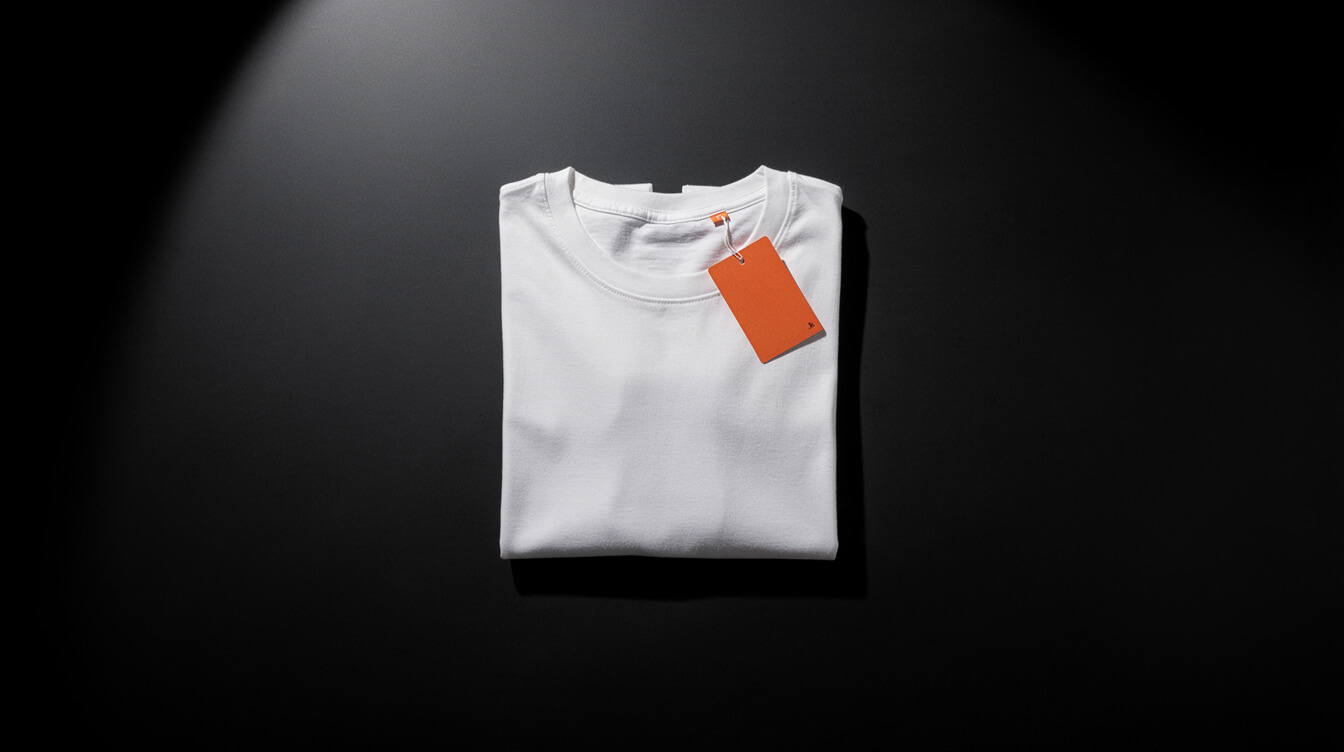
The $4 shirt headline appears everywhere. BoltPrinting lists blanks at $4.01. Promo sites show $3.79 for a 72-piece run. Those numbers are real, but they describe one narrow thing: the cost of an unprinted garment purchased in bulk from a wholesale supplier.
Your actual unit cost includes every dollar that touches the shirt before a customer receives it. That list is longer than most new sellers expect.
- Blank garment cost: $4 to $7 depending on supplier and garment weight
- Screen printing setup fee: $25 to $75 per color, per design, per run
- Per-unit print charge: $2 to $5 per shirt on a 24-piece run
- Shipping to you: typically $0.75 to $2 per shirt depending on weight and distance
- Inventory carrying cost: storage, potential dead stock, cash tied up
- Platform fee: if you sell on Shopify, add 1% on every transaction
Run those numbers on a 24-shirt order at $4 blanks with a single-color print and you land at roughly $11 to $14 per shirt total cost before you count your time. That is before platform fees hit the sale price.
The $4 blank is real. Your unit cost is not $4.
Screen printing services target buyers who want hundreds of shirts in one design. For sellers who need flexibility, want to test designs, or run an online store serving individual customers, the bulk model carries penalties that never show up in the headline price.
We have covered this cost structure in depth in our post on custom t-shirt printing for POD sellers, specifically what the $4 shirt actually costs your store across the full fulfillment chain.
Screen printing minimum orders: what MOQ penalties cost small sellers

Most screen printers require a minimum order quantity (MOQ) of 12 to 24 shirts per design. Some go higher: 36 or 48 is common for specialty inks or dark garments. A few budget printers go as low as 6, but the per-unit price rises sharply.
The MOQ penalty hits sellers in three specific ways.
1. Setup fees per run. A single-color screen printing setup fee typically runs $25 to $75 per color. If you have a two-color design, that is $50 to $150 before a single shirt is printed. On a 12-piece run at $4 blanks, your setup fee alone adds $4 to $12 per shirt.
2. Design lock-in. Once you order a batch, those shirts exist. If the design does not sell, you are sitting on inventory with real carrying costs. A 24-shirt order at $12 unit cost means $288 locked up in physical stock, plus storage space, plus the risk of dead stock at the end of a season.
3. Size distribution guessing. Selling online means you do not know what sizes your customers will order. Ordering 24 shirts with your best guess at size distribution (typically 2 XS, 4 S, 6 M, 6 L, 4 XL, 2 XXL) means you will almost certainly sell out of one size and sit on others. That leftover stock is a real cost.
The math changes completely at higher volumes. At 144 shirts per design, setup fees dilute to under $1 per unit and the blank cost can drop to $3.50 on some styles. But most independent POD sellers are not moving 144 units of a single design on a single channel. They are testing multiple designs, running small audiences, and building catalogs of dozens of products.
MOQ is not a problem for the screen printing industry. It is a structural mismatch between how screen printing economics work and how modern online POD businesses operate.
POD unit economics: what Printful, Printify, and Gooten actually charge per shirt

Print-on-demand eliminates the MOQ entirely. You list a shirt, a customer orders it, the provider prints and ships directly. No setup fees. No inventory. No dead stock.
Here is what the three major POD providers charge for a standard unisex t-shirt in 2026:
- Printful: Bella+Canvas 3001 at $12.95 base, Gildan 64000 at $8.95 base. Shipping to the US typically $3.99 to $5.99 for the first item.
- Printify: Premium plan unlocks lower rates. Printify’s own Gildan 64000 equivalent starts at $7.00 to $9.50 depending on print provider. Shipping adds $3.65 to $5.50.
- Gooten: Next Level 3600 starts around $9.75 to $11.25. Shipping comparable to Printful at $3.99 to $5.50 first item.
On a $25 retail price, here is what the math looks like across providers:
- Printful (Bella+Canvas): $12.95 base + $4.99 shipping = $17.94 fulfilled cost. Margin: $7.06 before platform fees.
- Printify (budget provider, premium plan): $7.50 base + $4.00 shipping = $11.50 fulfilled cost. Margin: $13.50 before platform fees.
- Gooten: $10.50 base + $4.50 shipping = $15.00 fulfilled cost. Margin: $10.00 before platform fees.
Notice that none of these numbers look like $4. But they also include printing, fulfillment, and shipping to the customer. Screen printing’s $4 blank requires you to add all three of those on top. When you do the same comparison on a per-shirt-delivered basis, screen printing at 24 units lands at $13 to $18 per shirt shipped. Printify at 1 unit lands at $11 to $15. The gap is smaller than most people assume.
We broke down the full Printify catalog in our deep-dive on Printify custom t-shirts, including which models deliver the best margin and when the math tips in WooCommerce’s favor over Shopify.
The break-even crossover: at what quantity does screen printing beat POD

Smash print-on-demand. Join the engine room.
One short email a week. Real numbers, real teardowns, the unfiltered economics behind every move.

There is a quantity at which screen printing becomes cheaper than POD on a per-unit basis. That number is not 12. It is not 24. It is typically 72 to 144 shirts per design, per run, depending on your specific costs.
Here is how to find your crossover point.
Screen printing total cost formula: (Setup fee per color x number of colors) + (blank cost x quantity) + (print charge per unit x quantity) + (shipping per unit x quantity) = total cost. Divide by quantity for unit cost.
On a 24-shirt run with a single-color design:
- Setup: $40
- Blanks: 24 x $5.50 = $132
- Print charge: 24 x $3.50 = $84
- Shipping to you: 24 x $1.50 = $36
- Total: $292 / 24 = $12.17 per shirt (not including shipping to customer)
On a 72-shirt run with the same design:
- Setup: $40
- Blanks: 72 x $4.25 = $306
- Print charge: 72 x $2.00 = $144
- Shipping to you: 72 x $1.20 = $86.40
- Total: $576.40 / 72 = $8.00 per shirt (again, before shipping to each customer)
If you then sell those shirts from your own storage and ship yourself, add your time plus $4 to $6 per package in postage. That brings screen printing’s all-in delivered cost to $12 to $14 at 72 units, which is competitive with Printify’s fulfilled cost at $11 to $15.
The crossover at 72 to 144 units is real. But it requires you to pre-buy, store, pick, pack, and ship everything yourself. For most POD sellers building automated catalogs, that trade is not worth it until a single design is proving 50-plus consistent monthly units.
This is the same math we worked through in our analysis of t-shirt printing machines for small business. The economics of owning equipment or pre-buying bulk follow the same crossover logic: the unit cost advantage only materializes at volumes that most catalog sellers have not yet reached on any individual design.
Platform fees add up: Shopify 1% on every cheap shirt you sell

The unit cost math above does not include one of the most significant cost lines in a Shopify POD store: the platform override fee.
Shopify charges a 1% transaction fee on every sale processed through third-party payment processors on their Basic and Grow plans. On a $25 shirt, that is $0.25 per transaction. That sounds small. At 200 shirts a month, it is $50. At 500 shirts a month, it is $125. At 2,000 shirts a month, it is $500. That is $6,000 per year in fees on a $600,000 annual revenue store, money that buys nothing and goes to no one except Shopify.
The fee does not apply on Shopify’s Advanced plan at $299 per month, which waives the third-party fee. But to justify that plan, you need enough volume that the $3,588 annual plan cost is cheaper than 1% of your revenue. The crossover is at $358,800 in annual revenue. Below that, you pay either the monthly upgrade or the per-transaction tax.
WooCommerce has no equivalent fee. Your payment processor charges their standard rate (typically 2.9% + $0.30 via Stripe), and nothing else sits between you and your margin. For sellers moving cheap custom t-shirts at high volume on thin margins, that difference compounds fast.
We have a full breakdown of this cost in our dedicated post on Shopify transaction fees for POD sellers. The Shopify 1% is not the only fee to account for, but it is the one most sellers overlook when comparing platform costs against their POD provider fees.
How to price cheap custom t-shirts for real margin
Real margin requires pricing from unit cost up, not from what competitors charge down. Here is a framework that works for POD t-shirt sellers.
Step 1: Know your fulfilled unit cost. Take your POD provider base price, add their standard shipping rate, and confirm which plan you are on. A Printify premium plan subscriber with a $7.50 base shirt at $4 shipping has a $11.50 fulfilled cost.
Step 2: Add platform fees. On Shopify Basic, add 1%. On WooCommerce, add 0%. On a $25 sale, Shopify adds $0.25. On 500 monthly units, that is $125 per month in fees your WooCommerce competitor does not pay.
Step 3: Apply a minimum margin target. Most sustainable POD businesses target 40% to 50% gross margin on apparel. At 40% margin on a $11.50 fulfilled cost, your floor price is $19.17. At 50% margin, it is $23.00. Most sellers price standard t-shirts between $22 and $29 depending on design quality and niche.
Step 4: Test against the SERP. Search for your exact product on the platforms where your target customers shop. What are comparable products selling for? If the market ceiling is $24, your $23 floor is tight. If the market ceiling is $35 for premium designs in your niche, you have room.
Step 5: Account for ads, if applicable. If you run paid traffic, add your customer acquisition cost per unit. At a 2% conversion rate on paid traffic costing $0.80 CPC, your CAC is $40 per customer. If that customer buys one $25 shirt, your margin evaporates entirely. POD margin math gets punishing fast with paid traffic on low-AOV products.
The sellers who build durable POD businesses on custom t-shirts typically do one of three things: serve a specific niche with high design affinity so organic traffic converts, build a catalog wide enough that repeat customers drive AOV, or move to WooCommerce to recover the Shopify fee and reinvest it in content or product quality.
MEGA calculates break-even math automatically for every product in your pipeline, so you see margin projections before you list, not after you have already priced yourself thin. Try MEGA to run the numbers on your next design before you set a price.
When bulk printing wins and when POD wins: the decision tree

The screen printing versus POD decision is not binary. The right model depends on your specific situation.
Use screen printing (bulk) when:
- You have a proven design already selling 50-plus units per month on a single channel
- You have storage space and are willing to handle pick-and-pack fulfillment yourself
- Your design is simple (1 to 2 colors) and uses the same garment in a standard size run
- You are fulfilling for a specific event, organization, or community with a known size distribution
- Your retail price is high enough ($30 to $45) that the unit cost savings justify the inventory risk
Use print-on-demand when:
- You are testing a new design and do not yet know demand
- Your catalog has more than 20 active designs and you cannot pre-buy them all
- You are building an automated pipeline where the product listing, fulfillment, and customer service all run without your daily involvement
- Your customers need size or color options that require separate SKUs in bulk
- You sell internationally and do not want to manage international shipping yourself
For most online-first POD sellers building catalogs, the decision tree points to POD at every stage until a single design reaches consistent 50-plus monthly units. At that point, it is worth running the bulk quote to see if the unit cost savings justify a partial buy of the top-selling sizes.
The sellers we see struggling most are the ones who buy bulk inventory based on projected demand rather than proven demand. A design that looked popular in a Facebook group does not always convert when it reaches your store. Ordering 144 shirts based on social engagement is a fast way to learn an expensive lesson.
We reviewed the full cost comparison between screen printing and POD in our earlier post on custom t-shirt screen printing vs print on demand, including specific break-even tables by order quantity. If you are at the point where one of your designs is approaching the crossover volume, that post has the detailed math.
What the cheap custom t-shirt math actually tells you
The $4 blank is not a lie. It is a real price for a real product, purchased in specific quantities, for a specific use case. The lie is the implication that $4 is your starting point as an online POD seller.
Your starting point is your fulfilled unit cost: garment, print, and shipping to the customer, all-in, with no minimum order, tested on a real design with real customers. For most POD providers, that number lands between $11 and $18 depending on garment quality, print complexity, and provider.
Whether that number is competitive depends on your pricing, your platform, and your volume. On WooCommerce with Printify’s premium plan, your margin at $25 retail is meaningful. On Shopify Basic with Printful, it is tight. The difference between those two scenarios is not the shirt. It is the infrastructure around the shirt.
Cheap custom t-shirts are available. What determines whether they are actually cheap for your business is the full economics of your pipeline from blank to customer doorstep, and whether your platform takes a percentage of every sale before you see the margin.

Implement AI. 30x your throughput. Get a 30-min call with the founder.
Drop your details and book a free 30-minute discovery call. Personalized advice on your POD stack, your margin, and where AI fits. No pitch, no fluff.