Custom drinkware for POD sellers: sublimation explained, provider comparison, and the unit cost math
The custom drinkware market is built for corporate procurement teams. Search for “custom drinkware” and you land on pens.com quoting 72-piece minimums, 4imprint showing pricing that assumes a $2,000 promotional budget, and moo.com pitching branded merchandise for company swag programs. None of those results are written for a POD seller who wants to add a 20-oz sublimation tumbler to a no-inventory WooCommerce store. This guide exists because that gap is real. The unit cost math, the provider options, the sublimation mechanics, and the platform fee reality for custom drinkware are all covered here.
What the custom drinkware SERP is actually selling (and what it misses for POD sellers)
Type “custom drinkware” into Google and the top results split into two categories. The first is B2B promotional vendors: companies that print your logo on 50 to 500 units and ship them to a conference room or trade show booth. The second is premium consumer brands like YETI, which license their names for corporate gifting programs.
Neither category speaks to a POD seller. The promotional vendor assumes you have a design team, a minimum order budget, and a shipping address for bulk delivery. The YETI-style result assumes you are buying a gift for a VP. There is nothing for someone who wants to list a 20-oz tumbler in their WooCommerce store, fulfil one unit at a time, and ship it directly to a customer who ordered at 11pm.
That gap is the opportunity. Sublimation-compatible tumblers, water bottles, and ceramic mugs are available through Printful and Printify with no minimum order quantity. A seller can list them, take orders one at a time, and never touch inventory. The margin math is tighter than apparel but the category is high-search-volume and low-editorial-competition.
The SERP gap also matters for SEO. Because all the top results are product pages or B2B landing pages with zero educational content for sellers, a well-written editorial piece explaining POD drinkware has essentially no ranking competition. That is the gap this content is built to fill.
Which POD providers carry drinkware: Printful vs Printify catalog comparison
Both Printful and Printify carry drinkware, but the catalogs are not identical and the fulfillment economics differ at scale.
Printful drinkware catalog
Printful carries tumblers, mugs, and water bottles under their drinkware category. The flagship items include:
- Sublimation tumblers (20oz and 30oz stainless steel, full-wrap capable)
- White ceramic mugs (11oz and 15oz, print wrap or panel)
- Stainless steel water bottles (17oz)
- Eco-friendly tumblers with bamboo lids and double-wall insulation
Printful fulfils from facilities in the US, Europe, Mexico, and Japan. That geographic spread reduces international shipping times but base product costs are slightly higher than Printify equivalents.
Printify drinkware catalog
Printify’s catalog is larger because they aggregate multiple print providers. Drinkware options include tumblers in multiple size variants, ceramic mugs, enamel camping mugs, travel mugs, and sports bottles. The key advantage is price competition between providers: you can pick the cheapest fulfiller for a given SKU or the one with the fastest shipping to your primary market.
The tradeoff is quality variability. Because Printify is a network rather than a single operation, print quality can differ between providers. Testing before listing is essential, especially for sublimation items where color accuracy on curved surfaces varies by equipment calibration.
Which to choose
For sellers who want consistency and premium positioning, Printful is the lower-risk option. For sellers who want the widest product selection and lowest possible per-unit cost, Printify’s network wins on catalog depth. Many operators run both simultaneously: Printful for their hero drinkware SKU and Printify for specialty items not in Printful’s catalog.
For a detailed Printful vs Printify comparison on tumblers specifically, the custom tumbler deep-dive covers unit cost differences by provider.
How sublimation works on drinkware (full-wrap vs panel, the polyester coating requirement)
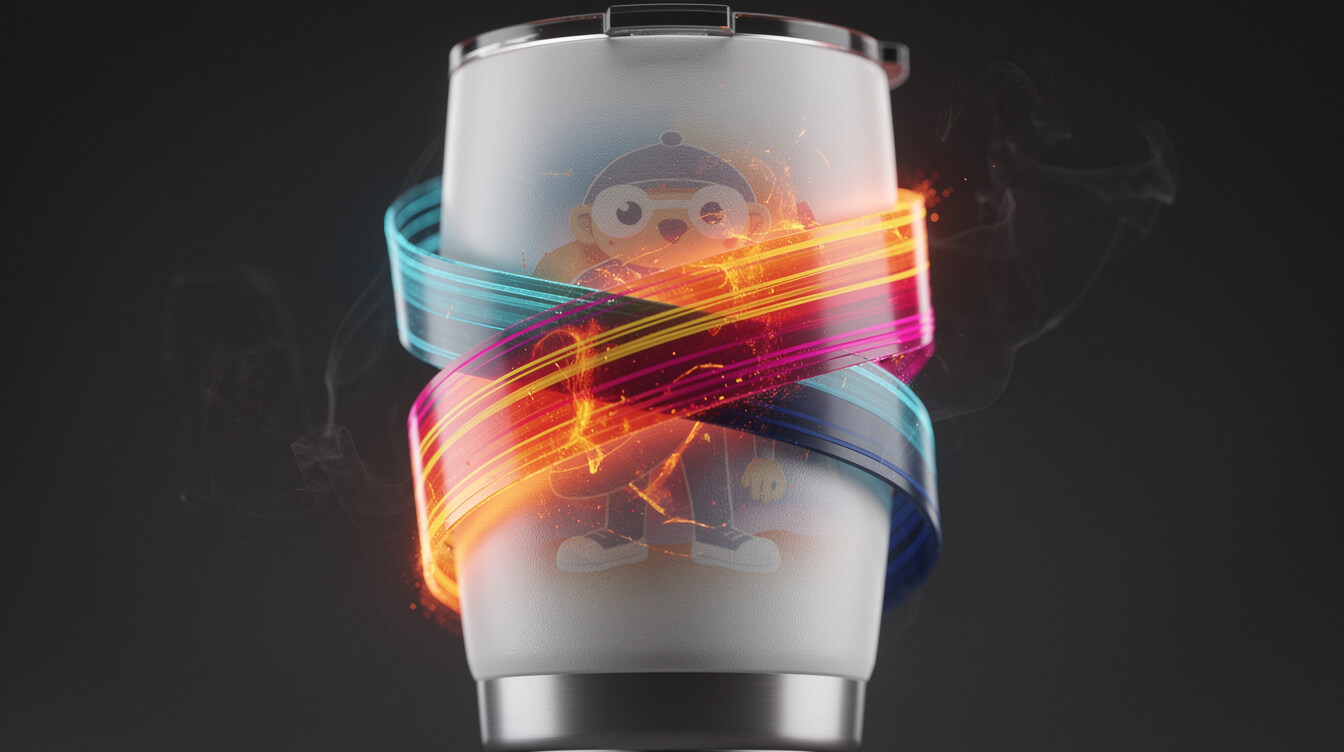
Sublimation is the dominant print method for drinkware. Understanding how it works tells you what designs will succeed and which product specs matter when sourcing from a POD provider.
The sublimation process in brief
Sublimation printing uses heat and pressure to convert solid ink dye into gas, which bonds permanently with a polymer-coated surface. Unlike inkjet printing, the ink does not sit on top of the material. It fuses with the coating at a molecular level. The result is a print that will not peel, fade, or crack under normal washing and use.
The constraint: sublimation only bonds with polyester-based or polymer-coated surfaces. That is why sublimation tumblers are stainless steel with a polymer coating on the exterior, not raw metal. Ceramic mugs work because the ceramic glaze is treated to accept sublimation dye at high temperature. Pure cotton, raw metal, and uncoated glass cannot accept sublimation ink.
Full-wrap vs panel printing
Full-wrap sublimation covers the entire exterior surface of the drinkware item, seam to seam and top to bottom. Panel printing covers only a defined area, typically the front face of a mug or a rectangular section on a bottle.
Full-wrap produces more visual impact and works well for all-over patterns, photography, and illustrated designs. Panel printing is simpler and cheaper but limits the design space. For POD sellers, full-wrap tumblers command higher perceived value and support better pricing. A $24 cost-of-goods tumbler with a full-wrap design can retail at $42 to $48 without resistance. The same tumbler with a small panel print struggles to justify more than $34 to $38 retail.
Design template rules
Full-wrap designs must account for the seam and any handle attachment point. Every POD provider supplies design templates with safe zones marked. Work within those templates to avoid critical design elements landing on the seam. A design that looks perfect on screen will print with a visible interruption if the seam placement is ignored.
Unit cost math: 1 tumbler, 1 water bottle, 1 mug — what each POD provider charges

Smash print-on-demand. Join the engine room.
One short email a week. Real numbers, real teardowns, the unfiltered economics behind every move.
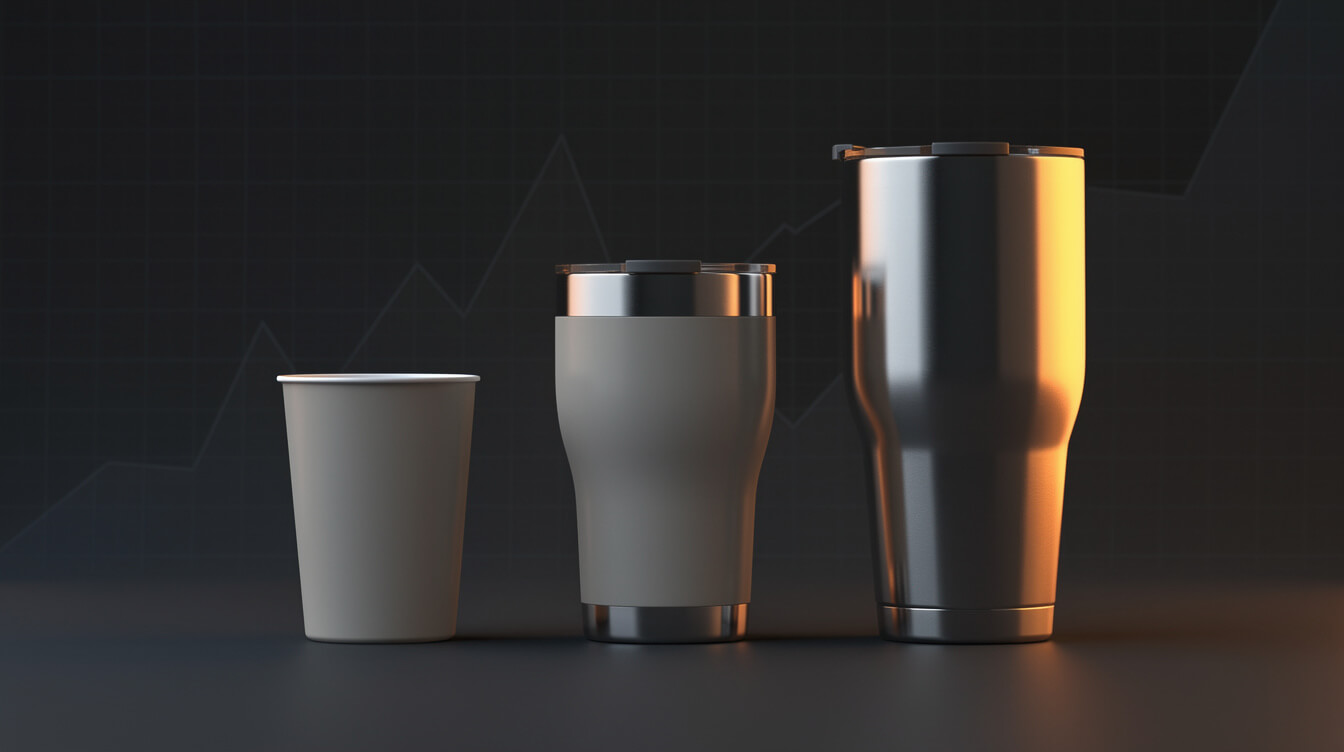
Here is the real cost math for one unit of each drinkware product type, using current Printful pricing as the reference. Printify costs vary by provider but the ranges are noted where they differ significantly.
20oz stainless steel tumbler (full-wrap sublimation)
- Printful base cost: approximately $15 to $17
- Shipping to a US customer: approximately $4.50 to $6
- Total landed cost: approximately $19.50 to $23
- Reasonable retail price: $38 to $45
- Gross margin at $40 retail: approximately $17 to $20 (42 to 50 percent)
17oz stainless steel water bottle
- Printful base cost: approximately $14 to $16
- Shipping to a US customer: approximately $4.50 to $5.50
- Total landed cost: approximately $18.50 to $21.50
- Reasonable retail price: $32 to $40
- Gross margin at $35 retail: approximately $13 to $16 (37 to 46 percent)
11oz ceramic mug (sublimation, full-wrap)
- Printful base cost: approximately $7 to $9
- Shipping to a US customer: approximately $4 to $5
- Total landed cost: approximately $11 to $14
- Reasonable retail price: $22 to $28
- Gross margin at $24 retail: approximately $10 to $13 (42 to 54 percent)
The mug carries the best percentage margin but the lowest absolute profit per order. At $10 profit per mug you need volume to build meaningful revenue. At $17 to $20 profit per tumbler, each order contributes more to covering fixed costs. That is why tumblers tend to be the anchor product for dedicated drinkware POD stores.
For a deeper look at ceramic mug unit economics specifically, the custom mug printing guide covers provider options and margin math in detail.
MEGA automates the entire unit cost calculation and product listing process. Instead of running these numbers in a spreadsheet and uploading designs manually, MEGA runs the full product pipeline from niche selection through to published Printful listings on WooCommerce.
Build your drinkware store 30x faster with MEGA
MEGA generates complete Printful product listings end-to-end: niche selection, design, mockups, SEO titles, and WooCommerce publication. No Canva, no manual uploads, no spreadsheet math.
The Shopify 1% fee at $30-45 AOV: the custom drinkware margin you lose on every order

Shopify’s 1% platform override fee applies to every transaction processed outside of Shopify Payments. For POD sellers on Shopify who use PayPal, Stripe directly, or any third-party gateway, that fee runs on top of the payment processor fee. On drinkware AOVs the numbers add up faster than most sellers realize.
Here is what the Shopify 1% fee costs on a $40 tumbler order:
- Shopify 1% platform override: $0.40
- Typical Stripe fee (2.9% + $0.30): $1.46
- Total transaction cost: $1.86
- Against a $17 gross margin, that is 11 percent of profit gone before fulfillment
At $35 AOV on a water bottle order:
- Shopify 1% platform override: $0.35
- Stripe fee: $1.32
- Total transaction cost: $1.67
- Against a $14 gross margin, that is nearly 12 percent of profit
For a store doing 100 drinkware orders a month at $40 AOV, the Shopify override fee alone costs $480 per year. That is approximately 24 additional tumbler orders needed just to cover the platform tax. The fee does not improve at volume because it is percentage-based. A store doing $200,000 in annual revenue pays $2,000 per year in pure platform override fees to Shopify.
This is the margin erosion that does not show up in Shopify’s marketing materials. The 1% fee is buried in the transaction fee structure and only becomes visible when you run the annual numbers. At moderate drinkware AOVs where margins are already tighter than apparel, that fee matters proportionally more.
WooCommerce vs Shopify for a custom drinkware POD store: the direct comparison

Running a drinkware POD store on WooCommerce removes the platform override fee entirely. WooCommerce is open-source software. There is no percentage cut on your revenue, no transaction fee, and no app-tax for accessing core functionality.
Here is the direct cost comparison for a drinkware POD store doing $5,000 per month in revenue:
Shopify Basic plan ($29/month)
- Monthly platform fee: $29
- Platform override fee (1% on non-Shopify Payments): $50/month at $5k revenue
- Payment processing (Stripe): approximately $175/month
- Essential apps (inventory, reviews, email): approximately $40 to $80/month
- Total monthly platform cost: approximately $294 to $334
- Annual cost: approximately $3,528 to $4,008
WooCommerce (self-hosted)
- Managed WordPress hosting: approximately $20 to $40/month
- Platform override fee: $0
- Payment processing (Stripe): approximately $175/month (same rate)
- Plugins (WooCommerce core free, paid extensions): approximately $15 to $30/month amortized
- Total monthly platform cost: approximately $210 to $245
- Annual cost: approximately $2,520 to $2,940
The WooCommerce saving at $5,000/month revenue is $1,000 to $1,500 per year in platform fees. At $10,000/month revenue the Shopify override fee alone doubles and the gap widens further.
The tradeoff is setup complexity. WooCommerce requires more initial configuration than Shopify. You manage your own hosting, plugin stack, and updates. For sellers who want a turnkey setup, Shopify is faster to launch. For sellers who want to own their platform economics long-term, WooCommerce is the correct choice. For a detailed look at how the same math applies to water bottle SKUs specifically, the custom water bottle guide runs the same comparison on that product.
Niche verticals worth testing for custom drinkware: pet portraits, sports teams, personalized gifting, corporate clients
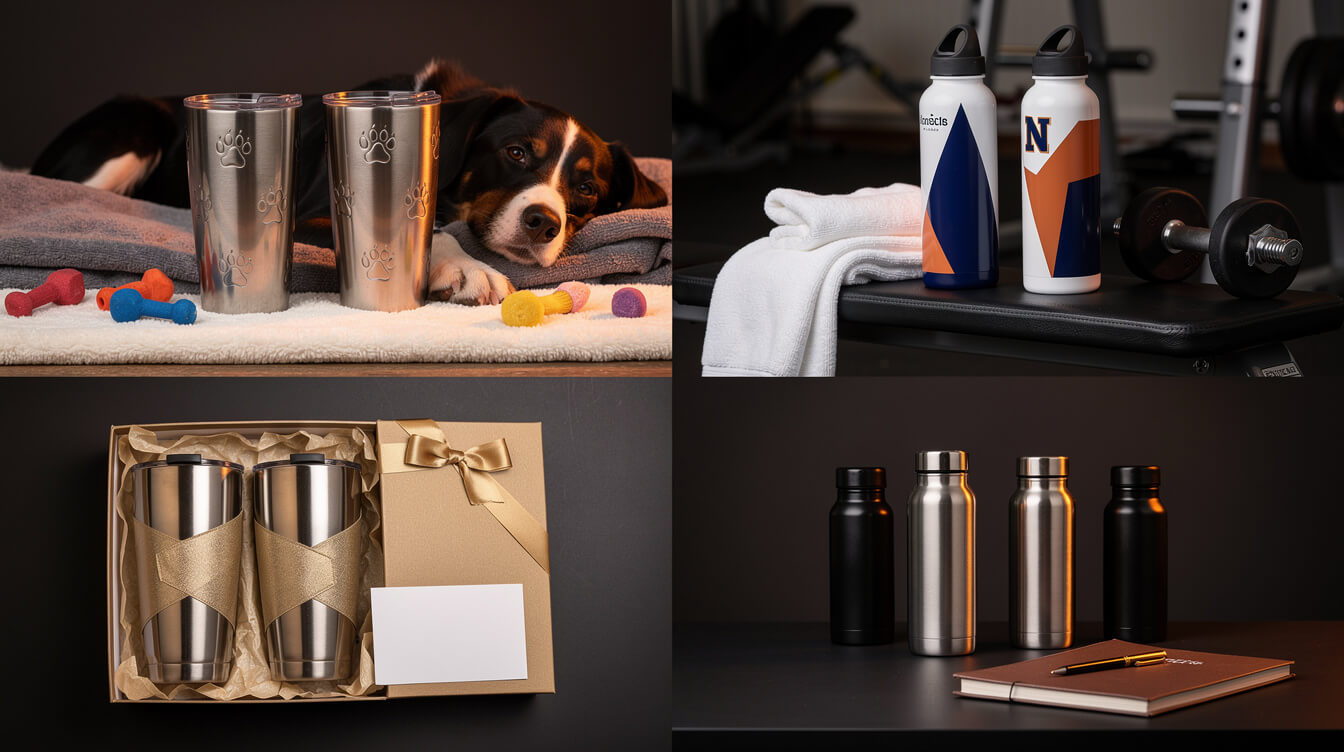
The strength of drinkware as a POD category comes from its cross-niche appeal. A tumbler is not locked to one audience. The same blank product can be positioned for a pet portrait buyer, a college sports fan, a wedding guest list, or a corporate gifting program. That flexibility means a single drinkware SKU can be repurposed across multiple marketing angles without any change to your fulfillment setup.
Pet portraits
The pet portrait niche is one of the highest-converting segments for photo-print drinkware. Pet owners buy merchandise that features their animal. A sublimation tumbler with a custom pet portrait photograph wrapped around the full exterior commands premium pricing, typically $42 to $55, with minimal price resistance. Buyers in this segment gift frequently and repeat-purchase seasonally.
Sports teams and fan gear
Local sports teams, recreational leagues, and alumni groups are recurring buyers for team-branded drinkware. A set of 20oz tumblers with a team logo or player number can be positioned as a fundraiser or team purchase, with each member buying their own unit. The no-MOQ POD model is ideal here because team sizes vary and pre-ordering in bulk creates financial risk that individual fulfillment eliminates.
Personalized gifting
Birthdays, anniversaries, graduations, and holidays drive consistent drinkware gift demand. Name-personalized tumblers and monogrammed mugs perform well in gift searches. The key is clear product photography and a checkout flow that lets buyers specify their personalization without friction.
Corporate and small business clients
Small businesses, real estate agents, and service professionals buy branded drinkware in small quantities for client gifts and referral programs. A quantity of 10 to 25 branded tumblers is a common order profile. POD fulfils this without the 50-unit minimums that promotional vendors require. Positioning your store as a low-minimum solution for professional gifting opens a B2B lane alongside the consumer audience.
For comparison, see how the same niche framework applies in the custom tote bags bulk vs POD guide, which covers the break-even math when niche buyers order in small quantities rather than bulk.
Custom drinkware works best as a supporting category alongside an apparel or accessories anchor product. A buyer who purchases a custom hoodie is a strong candidate for a matching tumbler upsell. At $17 to $20 gross profit per tumbler and $10 to $13 per mug, the category adds meaningful revenue to a multi-SKU store without adding inventory complexity. The platform you run on determines how much of that margin stays with you: on WooCommerce, you keep it; on Shopify, you share 1% of every order with the platform before you see a cent.
Implement AI. 30x your throughput. Get a 30-min call with the founder.
Drop your details and book a free 30-minute discovery call. Personalized advice on your POD stack, your margin, and where AI fits. No pitch, no fluff.