Custom t-shirt no minimum: how POD sellers build no-inventory storefronts and what the fee math looks like
The promise of custom t-shirt no minimum is everywhere online. Type the phrase into Google and you will see page after page of consumer product pages: UberPrints at $15.99 per shirt, RushOrderTees promising same-day rush, Vistaprint with a starter quantity of one. What none of those pages explain is how the no-minimum model actually works on the seller side, what it costs per unit, and how your platform choice compounds every margin decision you make. This guide covers the seller economics of the no-minimum custom t-shirt model, from fulfillment basics to the specific fee math that separates WooCommerce from Shopify at low order volumes.
If you are building a POD store and want to offer custom shirts without inventory risk, this is the breakdown you need before you pick a platform or set a price.
What “no minimum” actually means (and who it is actually for)
The phrase “no minimum order quantity” (no MOQ) refers to the ability to purchase or sell custom apparel without committing to a minimum run size. In traditional screen printing, MOQ exists because setup costs are fixed. A printer must make the screens, mix the inks, and calibrate the press regardless of whether you order 1 shirt or 1,000. At 1 shirt, those setup costs make the unit price unworkable. At 500 shirts, the setup cost spreads across enough units to bring the per-shirt price down to something a buyer will pay.
Print-on-demand (POD) eliminates the setup cost entirely. Direct-to-garment (DTG) digital printers require no physical screens and no ink mixing per job. Every order is economically equivalent whether it is 1 shirt or 100. The press runs when an order arrives, prints one item, and moves on. No setup fee. No MOQ.
So when consumer services like UberPrints advertise “no minimum,” they are operating as the print shop and passing the economics of their own DTG equipment to retail buyers. The buyer wins because they can order a single shirt without absorbing a $50 screen setup fee. The seller-equivalent in this model is the print shop itself.
For you as a POD store owner, no minimum is not a feature you unlock. It is the default state of the model. The better questions are: what does a single unit actually cost you at Printful or Printify, what margin do you keep after fees, and which platform extracts the least from that margin on low-volume, one-off orders?
How POD fulfillment makes no-minimum possible without holding inventory

Traditional retail requires you to buy inventory upfront. You pay for shirts before the first sale, hold them in storage, and sell down over time. If demand does not materialize or your design stops converting, you absorb the inventory cost. Your capital is trapped in physical stock.
POD inverts the model entirely. The fulfillment sequence is: a customer places an order on your store, the POD provider (Printful or Printify) receives the job automatically via API, prints the shirt using a digital press, and ships it directly to the customer within two to five business days. You never touch the shirt. You never buy inventory ahead of demand. Your cash is not tied up in stock that may or may not sell.
This structure is what makes no-minimum possible at the seller level. Printful prints each order individually when it arrives. Whether you sell one shirt this week and ten next week, each unit is produced on demand. There is no MOQ to satisfy because there is no setup cost to recover per design.
What you do invest in: the design file, which you create or generate once and sync across color variants; the WooCommerce or Shopify product listing, which takes roughly 20 minutes to configure once you have the Printful plugin connected; and your traffic strategy. After that, the marginal cost of each additional sale is your COGS, which Printful charges after the customer pays you.
Printful offers a catalog of over 340 products with no subscription required. You can review the full Printful product catalog to understand which blanks, variants, and price points fit your niche before building your first listing.
Unit cost math: DTG printing at $15.99 vs Printful POD fulfillment pricing

Here is where the consumer-facing no-minimum services and the seller-facing POD model separate completely.
When UberPrints sells a single custom t-shirt at $15.99, they are the seller. They are printing on a blank that costs them $2 to $4, running it through a DTG press they own, and charging the buyer a retail price. Their margin is $10 to $12 per shirt. You are not UberPrints. You are building the store that operates like UberPrints does, but using Printful or Printify as your print-and-ship infrastructure.
Your cost structure from Printful for a Bella+Canvas 3001 with a standard front print:
- Blank shirt plus DTG print (combined base price): approximately $9.95
- Standard US shipping to customer: approximately $4.69
- Total fulfillment cost per unit shipped: approximately $14.64
If you sell at $28, your gross margin before platform fees is $13.36, or 47.7%. If you sell at $25, your gross margin is $10.36, or 41.4%. The $25 price point is competitive with consumer services like UberPrints; the $28 price point still undercuts RushOrderTees rush pricing while leaving you viable margin.
The split between the Printful base cost and the shipping charge is worth noting. Printful charges shipping to you, the seller, not the customer directly. You can either absorb shipping into your retail price (free shipping to the customer, higher retail price) or charge shipping at checkout. Most successful POD stores absorb shipping and advertise free shipping. It simplifies the buying decision and reduces cart abandonment on single-unit orders.
For a deeper look at how these unit costs compare to screen printing economics at volume, see the custom t-shirt screen printing break-even analysis, which covers the MOQ crossover point where screen printing becomes cheaper than POD per unit.
Shopify vs WooCommerce for no-minimum t-shirt stores

Smash print-on-demand. Join the engine room.
One short email a week. Real numbers, real teardowns, the unfiltered economics behind every move.
Platform fees are the variable most POD guides skip. They matter more on a no-minimum store than on almost any other e-commerce setup, because your average order value (AOV) is low and your transaction count drives the fee total.
Shopify charges a platform override fee on every transaction processed through a third-party payment processor. On the Basic plan ($39/month), the override fee is 2% per transaction. If you use Shopify Payments, the override drops to zero, but Shopify Payments is only available in select countries and locks you into Shopify’s payment rails. Add the standard Stripe processing fee (2.9% plus $0.30) and your total fee on a $25 t-shirt sale reaches approximately 4.9% plus $0.30, or $1.53, on Shopify Payments. On a third-party processor, the 2% override adds another $0.50, bringing total fees to $2.03 per $25 shirt.
At 200 shirts per month at $25 each, Shopify’s override fee on a third-party processor costs you an additional $100 per month above what you would pay with zero override. That is $1,200 per year in pure platform tax on a store doing $5,000 in monthly revenue. For the detailed breakdown of how this compounds at $10,000 and $20,000 per month, see the Shopify transaction fees analysis for POD sellers.
WooCommerce charges no platform override fee. You pay your payment processor the same 2.9% plus $0.30 that Shopify charges, your hosting (typically $20 to $40 per month), and nothing to WooCommerce itself. No 1% or 2% platform tax. No monthly plan fee that scales with revenue.
For a no-minimum store where AOV is $25 to $35 and orders come in one at a time, the per-transaction economics of WooCommerce are materially better than Shopify. The lower your AOV, the larger the platform fee’s share of your gross margin. A $0.50 override fee on a $25 order is 2% of revenue. On a $150 order, it is 0.3%. No-minimum t-shirt stores run at the low end, which is exactly where the Shopify override fee hurts most.
How to set up a no-minimum custom t-shirt store on WooCommerce plus Printful
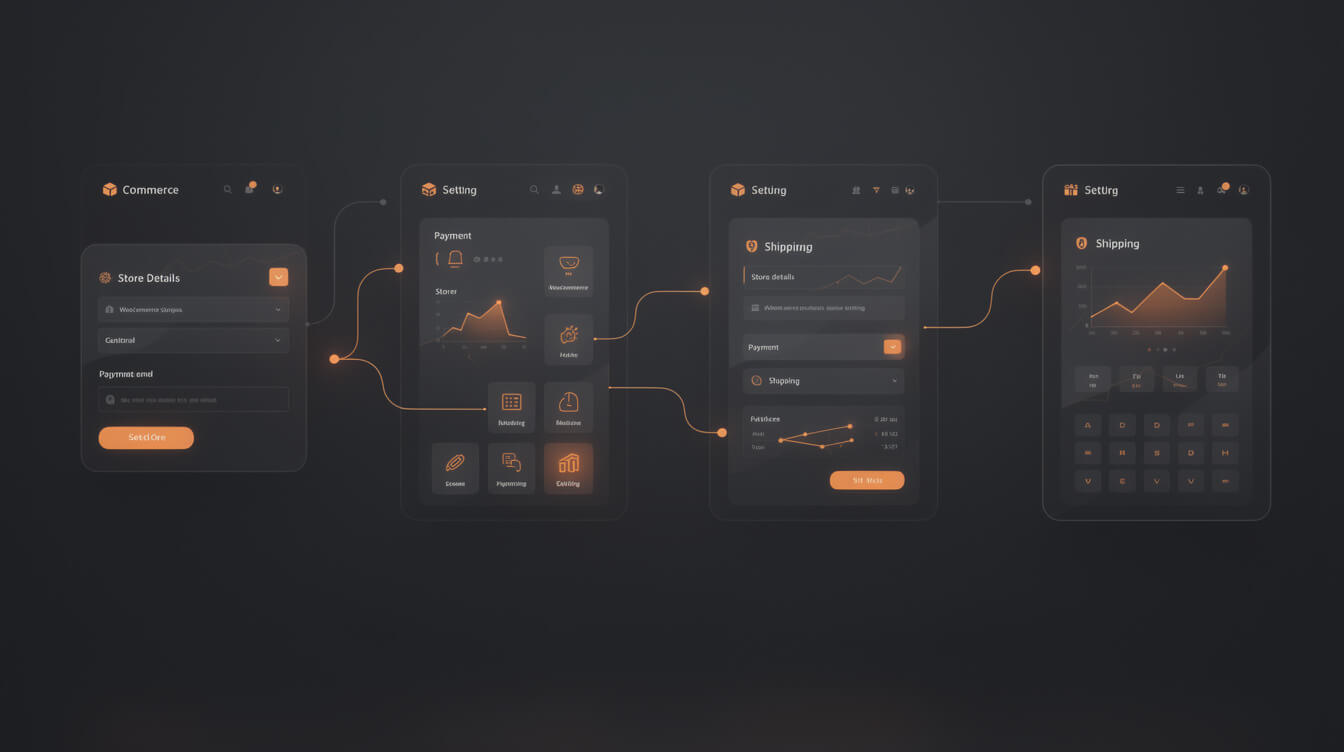
Setting up a no-minimum custom t-shirt storefront on WooCommerce takes four components: your domain and hosting, WordPress with WooCommerce installed, the Printful for WooCommerce plugin, and your product designs. Here is the sequence.
Step 1: Install WordPress and WooCommerce. Most managed hosting providers offer one-click WordPress installs. WooCommerce installs from the plugin directory at no cost. There is no monthly platform fee payable to WooCommerce.
Step 2: Connect Printful. Install the official Printful for WooCommerce plugin (free in the WooCommerce plugin directory). Connect your Printful account via the API key from your Printful dashboard. The plugin handles order routing automatically: every WooCommerce order for a Printful product routes to Printful for fulfillment without manual action.
Step 3: Create your product in Printful. Select your blank garment (Bella+Canvas 3001 is the most reliable for DTG), upload your design file as a PNG at 150 DPI or higher, and configure print positions. Printful generates product mockups automatically. Use these mockups as your WooCommerce product images.
Step 4: Push the product to WooCommerce. The plugin syncs the product, all size and color variants, mockup images, and the base cost. You set your retail price in WooCommerce above the Printful cost. Printful charges you the base cost when an order fulfills; you keep the difference.
Step 5: Set up Stripe as your payment processor. There is no Shopify override fee. You pay 2.9% plus $0.30 per transaction to Stripe, the same rate you would pay on Shopify, without the additional platform layer underneath.
For the design side of the setup, the traditional workflow is Canva or Adobe Illustrator per design, which takes 30 to 90 minutes per product. MEGA automates the full pipeline, from AI design generation to live WooCommerce product listing, in under seven minutes per product. If you are building a catalog rather than a single storefront, the throughput difference compounds quickly.
For a broader guide to launching a t-shirt business from zero, the how to start a t-shirt business guide covers niche selection and the decisions most launch guides skip. For building a brand with no minimum, the custom brand clothing guide covers supplier comparison and how POD enables branded storefronts without bulk order commitments.
Automate your no-minimum POD store end to end
MEGA handles the full product pipeline, from niche research to live WooCommerce listing, in under seven minutes. No Canva. No manual uploads. No Shopify tax.
Real margin math: what you actually net on a $25 custom t-shirt

Let us run the full unit economics for a $25 custom t-shirt sold through a WooCommerce store using Printful, then compare the same math on Shopify Basic.
WooCommerce scenario:
- Retail price: $25.00
- Printful base cost (Bella+Canvas 3001, front print): $9.95
- Printful shipping (absorbed, standard US): $4.69
- Total COGS: $14.64
- Gross margin: $10.36 (41.4%)
- Stripe processing fee (2.9% plus $0.30): $1.03
- WooCommerce platform fee: $0.00
- Hosting allocation ($25/month at 150 shirts/month): $0.17
- Net per shirt: $9.16 (36.6%)
Shopify Basic scenario (same shirt, same price):
- Retail price: $25.00
- Printful base cost: $9.95
- Printful shipping: $4.69
- Total COGS: $14.64
- Gross margin: $10.36 (41.4%)
- Stripe processing fee: $1.03
- Shopify Basic transaction override fee (2%): $0.50
- Shopify plan allocation ($39/month at 150 shirts/month): $0.26
- Net per shirt: $8.47 (33.9%)
The WooCommerce seller nets $0.69 more per shirt than the Shopify Basic seller. At 150 shirts per month, that is $103.50 per month in avoidable platform costs, or $1,242 per year. At 300 shirts per month, it is $207 per month, or $2,484 per year. This is the Shopify tax in its most concrete form: 5.8 percentage points of gross margin on every shirt you sell, paid to a platform that contributes nothing to your fulfillment.
When no minimum is a feature and when it becomes a cost trap

Not every store benefits equally from the no-minimum model. The economics work well in specific situations and turn against you in others.
No minimum works well when:
- Your customer needs exactly one custom item: personalized gifts, proof-of-concept runs for a new design, event shirts for a small group.
- Your store focuses on niche designs with long-tail demand. Selling 3 to 10 units per month across 200 designs adds up to real revenue without requiring any single design to carry the catalog.
- You are testing a new niche or design before committing advertising spend. POD lets you list 50 products and spend $0 on inventory before the first sale.
- Your customer is an individual buyer, not a group buyer. Individual buyers generate single-unit orders by default, which is where POD fulfillment is most cost-competitive relative to screen printing.
No minimum becomes a cost trap when:
- You are competing on price with bulk screen printers. A screen printer at 100-unit MOQ can produce a shirt for $5 to $7 all-in. Your Printful unit at $14.64 (base plus shipping) cannot match that on price without selling at a loss.
- Your customer expects same-day or next-day delivery. POD turnaround is two to five business days at Printful before shipping. Rush buyers go to RushOrderTees, not a WooCommerce POD store.
- Your paid acquisition cost per sale is high. If your cost per sale is $15 and your net per shirt is $9.16, you are losing money on every ad-driven sale. No-minimum stores that depend on paid traffic need AOV above $40 to make the unit economics positive after acquisition cost.
- Your designs require exact pantone color matching or specialty inks. DTG printing has limitations on dark blanks and design types that require precise color accuracy. Check Printful’s production guidelines before building a catalog that depends on exact color reproduction.
The underlying principle is this: no minimum is a fulfillment characteristic, not a pricing strategy. The model removes inventory risk and MOQ pressure. That is genuinely useful, particularly in the testing and early-catalog phases of a POD business. It does not change your need for margin, a traffic source that converts, and a platform that does not erode your take-home at the point of sale.
The stores that build durable no-minimum revenue understand their unit economics before they touch their first product. They price above COGS plus platform fees by enough margin to cover customer acquisition. They choose WooCommerce to eliminate the platform override fee. And they use automation to build catalog depth without burning 30 hours per week in Canva. That is the full picture of what the no-minimum model actually requires to work.
Implement AI. 30x your throughput. Get a 30-min call with the founder.
Drop your details and book a free 30-minute discovery call. Personalized advice on your POD stack, your margin, and where AI fits. No pitch, no fluff.